Every time you log into a digital learning platform, complete a quiz, download a lecture or submit an assignment, information about your learning activity may be recorded. For universities and education providers, this information can be valuable. It may help identify students who need additional support, reveal difficult course topics and improve teaching. But there is another side to the story.
How much should a university know about its students? Who can access their learning records? Could a prediction about academic performance unfairly influence how a student is treated?
As learning analytics becomes more common, these questions deserve serious attention.
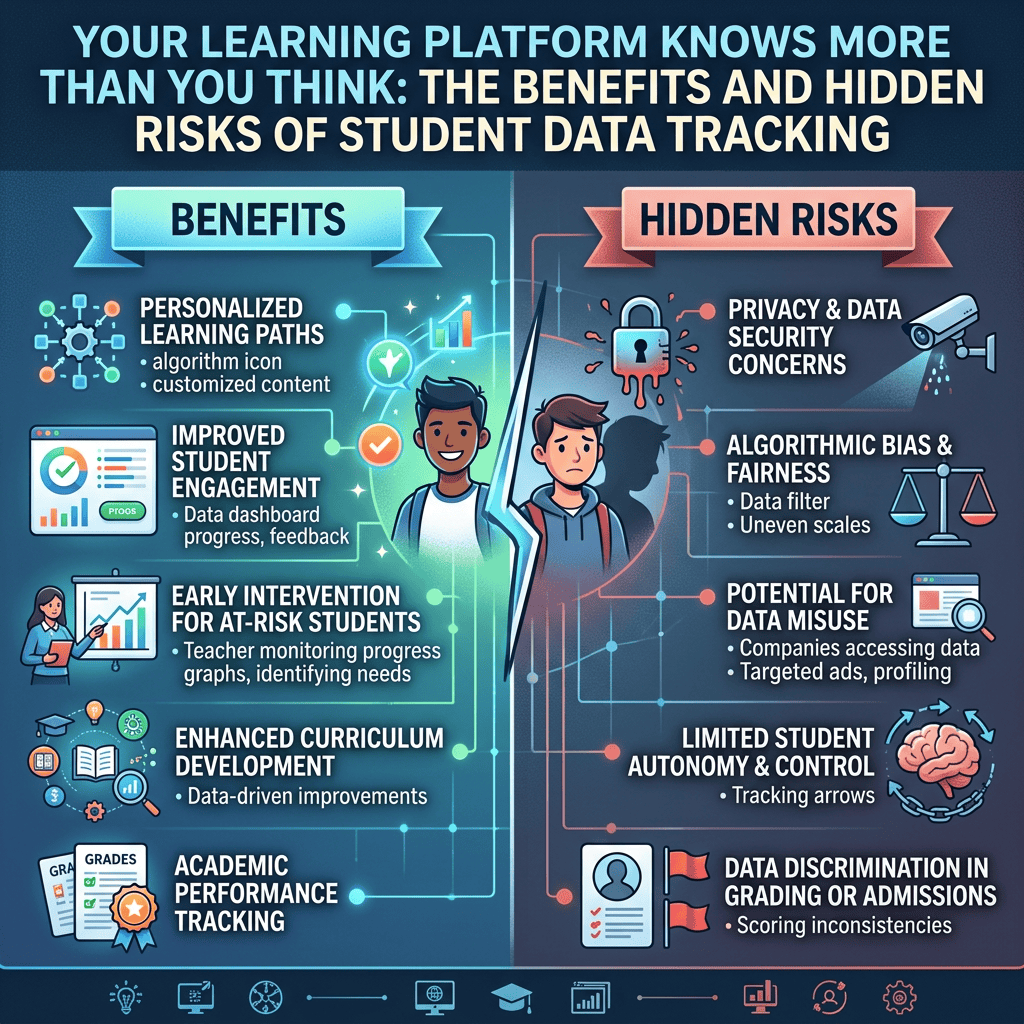
Educational data should help students learn—not turn them into permanent digital profiles.
1. What information can educational platforms collect?
Depending on the platform, institutional configuration and applicable privacy rules, digital learning systems may record:
- Login and participation activity.
- Course and resource access.
- Quiz and assessment results.
- Assignment submission dates.
- Discussion participation.
- Progress through learning modules.
- Feedback and interaction records.
- Technical information associated with platform use.
Some institutions combine this information with other educational records for particular purposes.
Not every platform collects the same information, and the fact that a system can collect data does not mean every form of collection is appropriate or lawful.
2. Why universities use student data
Learning analytics may support several educational functions.
Identifying students who need assistance
Patterns such as missed assessments or repeated difficulty with course activities may prompt a tutor to check whether a student needs support.
Improving teaching materials
If many students struggle with the same learning objective, lecturers may review the relevant teaching resources.
Supporting student planning
Dashboards can show deadlines, completed activities and assessment performance.
Evaluating educational programmes
Aggregated information may help institutions examine course participation and identify areas for improvement.
Understanding learning environments
Institutions may use appropriately collected data to evaluate how students interact with digital resources.
These applications can be beneficial, but the quality of the conclusions depends on how the information is interpreted.
3. The danger of assuming that digital activity equals academic ability
Imagine two students enrolled in the same online course. One logs into the platform every day, watches every recorded lecture and frequently downloads resources. The other downloads materials once, studies offline and completes the required assessments successfully. If the university measures engagement only through platform activity, the second student may appear less engaged even though their learning is strong. This illustrates an important limitation: digital traces do not provide a complete picture of a person’s learning. A responsible system should not treat time online, clicks or login frequency as direct measures of intelligence, motivation or academic potential.
4. Five major ethical risks
Risk 1: Privacy
Students may not know exactly what information is collected or how long it is retained.
Risk 2: Inadequate transparency
Institutions should explain the purposes of data collection and how analytical systems influence decisions.
Risk 3: Algorithmic bias
A predictive system may produce unfair results if the underlying data reflects existing inequalities or does not adequately represent different student groups.
Risk 4: Excessive surveillance
Constant monitoring can undermine trust and create unnecessary pressure.
Risk 5: Unfair automated decisions
A student should not be denied meaningful educational opportunities solely because of an automated prediction without appropriate review and safeguards.
Research on learning analytics ethics identifies privacy, informed consent, data ownership, validity and accountability as important concerns.
5. What rights and protections should students understand?
The precise legal position depends on the country, institution and type of information being processed.
For students in the UK and European Economic Area, relevant data protection frameworks include the UK GDPR and the EU GDPR respectively, alongside applicable national legislation.
In the United States, FERPA provides federal privacy protections for qualifying student education records at covered educational institutions.
Students should consult their institution’s privacy notice and relevant data protection officer or student support service to understand how their information is handled.
Useful questions include:
- What information does the platform collect?
- What is the educational purpose?
- Is the information shared with external providers?
- How long is it retained?
- Can students access or correct relevant information?
- Are automated predictions used to make significant decisions?
- Who is responsible for reviewing complaints?
6. What universities should do to build trust
Educational institutions should establish transparent and proportionate data practices.
Good practice includes:
- Collecting only information that is necessary for a legitimate purpose.
- Explaining data practices in accessible language.
- Restricting access to authorised individuals.
- Protecting information against unauthorised access.
- Reviewing analytical systems for bias and accuracy.
- Providing appropriate human oversight.
- Allowing students to raise concerns and challenge inaccurate records.
- Reviewing arrangements with external technology providers.
Student participation in policy development can also help institutions understand how data practices affect the people they are intended to support.
7. What students can do to protect themselves
Students should:
- Read relevant institutional privacy information.
- Avoid uploading sensitive personal information to unauthorised platforms.
- Use secure passwords and appropriate account protections.
- Check whether third-party applications are officially approved.
- Ask how automated recommendations are generated.
- Contact the appropriate institutional office if something appears inaccurate.
Do not assume that information entered into a learning platform is automatically private from every institution or service provider.
Final verdict: Educational data should empower students, not label them
Learning analytics can help universities identify patterns, improve teaching and provide targeted support. But student information is not just a collection of numbers. It relates to real people, their educational opportunities and their future.
The challenge is to balance useful educational insight with privacy, transparency, fairness and accountability.
A good learning system should help educators understand students better without reducing students to data points.
Recommended further reading
- The Ethics of Using Digital Trace Data in Education
- Mapping the Ethics of Learning Analytics in Higher Education
- UK Information Commissioner’s Office: Education and Data Protection
- US Department of Education: Family Educational Rights and Privacy Act (FERPA)
Stay connected with Scholars Careers
Subscribe to Scholars Careers for reliable information on higher education, digital learning, academic research, student rights and career development. Follow our updates and share this article with students, parents, lecturers and university administrators.
Should universities be allowed to track students’ digital learning activity if it helps identify those who may need academic support? Join the discussion.
Disclaimer
This article provides general educational and informational guidance, not legal advice. Data protection requirements differ by jurisdiction and institutional context. Students should consult the applicable law, institutional privacy notice and relevant data protection authority for specific concerns. Scholars Careers is an independent educational information platform and is not affiliated with or endorsed by the ICO, US Department of Education or the research organisations mentioned.


