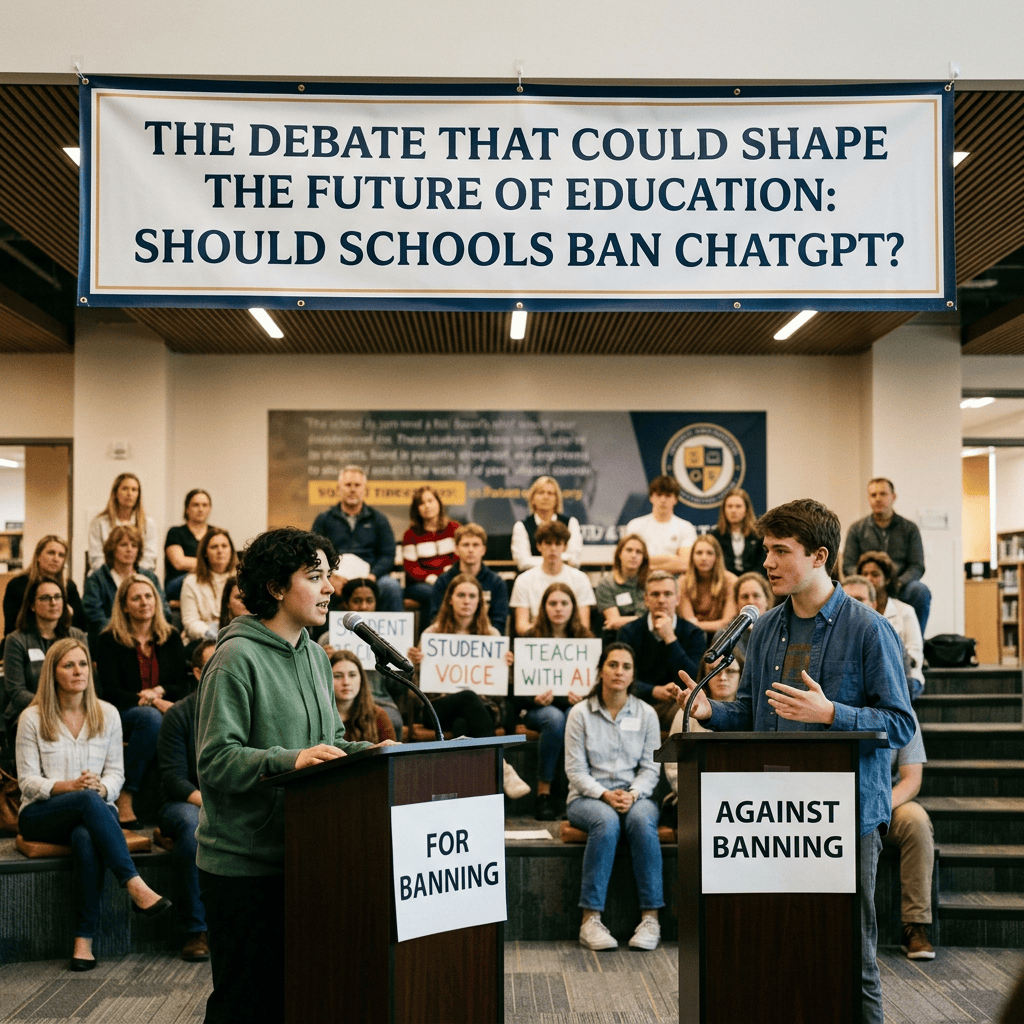
Imagine a school where students are not allowed to use ChatGPT, Gemini or other generative AI tools. Teachers can focus on traditional learning, assessments may become easier to control, and students are encouraged to develop their own writing and problem-solving abilities. Now imagine another school where students are taught how to use AI responsibly. They learn to question generated answers, identify misinformation, compare evidence and understand the technology shaping their future workplaces. Which school is preparing students better for the world ahead?
This is the central dilemma in the debate over AI bans in education. A ban may reduce certain risks, but unrestricted access can create others. The challenge is finding a policy that protects learning without ignoring technological change.
1. Why some educators support restrictions
There are legitimate reasons why schools may restrict or prohibit generative AI in particular circumstances.
Academic integrity
Students may use AI to generate essays, answer homework questions or complete assignments without demonstrating their own understanding.
Overdependence
If learners routinely outsource reading, writing and problem-solving, they may have fewer opportunities to practise essential cognitive skills.
Inaccurate information
AI-generated responses can contain factual errors, fabricated citations and misleading explanations.
Privacy and safeguarding
Some platforms collect user information or process uploaded content. Schools must consider age suitability, data protection, safeguarding and the confidentiality of student information.
Unequal access
Not every student has the same access to reliable devices, paid subscriptions, connectivity or digital skills. Unregulated classroom use may widen existing inequalities.
These concerns justify careful restrictions, particularly for assessments and activities where independent performance is essential.
2. Why a complete ban may not solve the problem
Students may still access AI tools outside school. A prohibition inside the classroom does not necessarily teach them how to recognise fabricated information, protect personal data or evaluate automated recommendations.
It may also leave students less prepared for workplaces where AI-assisted tools are increasingly used.
The OECD’s 2026 work on AI literacy emphasises the importance of helping learners understand AI, critically evaluate its outputs and use it ethically and creatively.
This suggests that education systems need to teach AI literacy rather than assume that avoiding AI will prepare students for an AI-rich society.
3. A better alternative: controlled and age-appropriate use
Schools can distinguish between activities where AI is prohibited, activities where it is permitted with conditions, and activities where it is deliberately incorporated into learning.
For example:
| Learning activity | Possible school policy |
|---|---|
| Independent examination | Prohibit unauthorised AI assistance |
| Concept explanation | Permit supervised use where appropriate |
| Essay drafting | Set clear limits and disclosure requirements |
| AI-generated references | Require independent source verification |
| Research brainstorming | Permit with critical evaluation |
| Personal or sensitive data | Restrict uploads and follow safeguarding rules |
The correct approach will depend on the age of learners, subject, assessment objectives and applicable law.
4. What an AI-integrated classroom could look like
A teacher could ask students to research a topic independently before asking an AI assistant to produce an alternative explanation.
Students could then compare both accounts, identify unsupported claims, consult reliable sources and explain which interpretation is better supported.
This approach makes the AI output an object of critical analysis rather than a substitute for learning.
Other classroom activities might include:
- Asking students to identify errors in an AI-generated explanation.
- Comparing AI summaries with original academic texts.
- Investigating bias in automated responses.
- Discussing privacy and responsible data use.
- Requiring students to explain their reasoning without AI assistance.
5. What parents and teachers should remember
Children and young people need more than access to technology. They need guidance on appropriate use, online safety, independent learning and the difference between information and evidence.
Parents can ask children how they used AI rather than simply asking whether they used it. Teachers can establish clear classroom rules and explain why some activities require independent work.
Schools should also provide staff training. UNESCO’s AI Competency Framework for Teachers identifies knowledge and skills relating to AI ethics, applications, pedagogy and professional learning.
6. The policy question: ban, permit or integrate?
A universal answer is unlikely to suit every educational context.
A school with limited digital infrastructure may need a different implementation strategy from a university with established AI governance. Younger pupils may require stronger safeguards than adult postgraduate learners.
A sensible policy can combine:
- Restrictions during assessments that require unaided performance.
- Approved tools for supervised educational activities.
- Clear disclosure and citation rules.
- Staff and student AI-literacy training.
- Privacy and safeguarding protections.
- Regular policy reviews as technology changes.
7. Schools should protect learning, not simply protect old methods
The purpose of education is not to make students dependent on technology. It is to develop knowledgeable, capable and responsible people.
Schools should be cautious about allowing AI to replace the intellectual work that education is designed to develop. But they should also be cautious about assuming that a blanket ban is a complete solution.
The strongest approach is likely to combine sensible restrictions with meaningful AI education.
The future may not belong to schools that use the most AI—or schools that use none. It may belong to those that teach students when to use it, when to question it and when to think independently.
Recommended further reading
- OECD: Empowering Learners for the Age of AI
- UNESCO: AI Competency Framework for Students
- UNESCO: AI Competency Framework for Teachers
Stay connected with Scholars Careers
Subscribe to Scholars Careers for useful insights into education, technology, scholarships, academic research and career development. Follow our updates and share this article with parents, teachers, students and education policymakers.
What do you think: Should schools ban ChatGPT, allow it under strict rules, or teach students to use it responsibly?
Disclaimer
This article is for general educational discussion and does not constitute legal, safeguarding or regulatory advice. School policies must comply with applicable national and local laws and institutional requirements. Scholars Careers is an independent educational platform and is not affiliated with UNESCO, the OECD or any AI technology provider mentioned.


