A student uses ChatGPT to understand a difficult research concept. Another asks it to improve the grammar of an essay. A third generates an entire assignment and submits it as original work. Are all three students cheating?
This question has become one of the most important debates in modern education. Generative AI tools have made it easier to produce essays, summaries, presentations, computer code and research outlines. Yet universities and schools are still adapting their policies to distinguish legitimate assistance from academic misconduct.
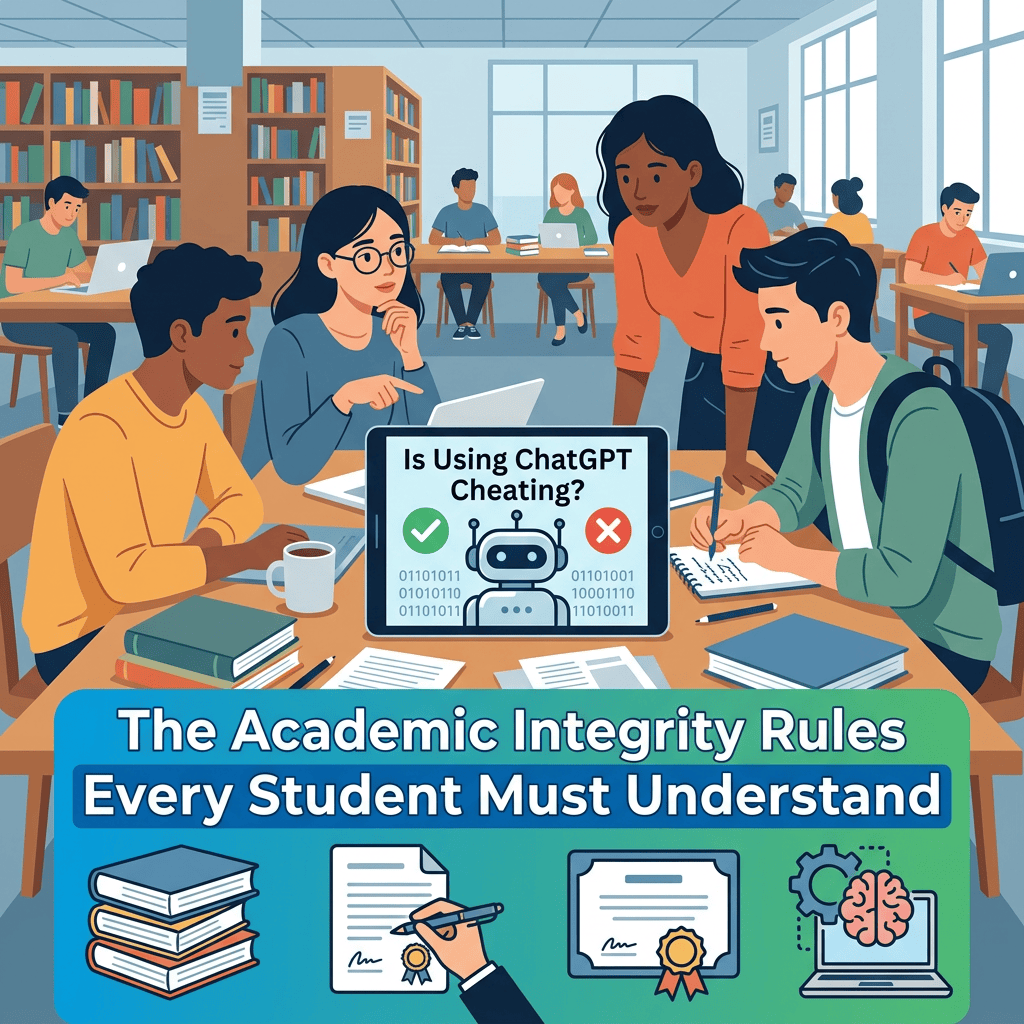
The central lesson is this: Using AI is not automatically cheating, but using it in a way that violates assessment rules or misrepresents authorship can be academic misconduct.
1. Why the answer is not simply yes or no
Academic integrity policies differ between institutions, departments, courses and individual assessments.
One lecturer may permit AI-assisted brainstorming but prohibit AI-generated paragraphs. Another may allow grammar assistance but require students to disclose any use. A third may design an assessment in which AI tools are explicitly permitted.
Consequently, students should never assume that a tool is allowed simply because it is publicly available.
The relevant question is not merely whether a student used AI. It is whether that use complied with the rules governing the particular assessment.
2. Examples of potentially acceptable AI assistance
Depending on institutional rules, acceptable uses may include:
- Asking for an explanation of a difficult concept.
- Generating practice questions for revision.
- Brainstorming possible research questions.
- Checking grammar and spelling.
- Exploring alternative outlines before writing independently.
- Debugging code with appropriate disclosure.
- Translating material where the assessment permits translation support.
These activities can support learning, but students should still verify the output and retain responsibility for their submitted work.
3. When AI use may become academic misconduct
The following practices can create serious academic-integrity problems:
Submitting AI-generated work as your own. If an assignment is intended to assess your knowledge and writing, presenting generated material as entirely your own may misrepresent your contribution.
Inventing references. AI systems can produce plausible-looking but nonexistent academic citations. Submitting fabricated sources undermines research integrity.
Using prohibited assistance. Even if an AI-generated answer is accurate, using it in an assessment that expressly prohibits AI assistance may breach the rules.
Concealing required disclosure. If your institution requires students to acknowledge AI assistance, failing to do so can constitute a policy violation.
Uploading confidential information. Sharing unpublished research, identifiable student information or restricted institutional material with an external AI service may breach privacy, confidentiality or research rules.
4. Why AI detectors should not be treated as unquestionable evidence
Some institutions use automated tools to identify writing that may have been generated by AI. However, detector outputs should not automatically be treated as proof of misconduct.
AI-detection systems can produce false positives and false negatives. A student may be wrongly flagged, while AI-generated content may go undetected.
A fair academic-integrity process should consider multiple forms of evidence, relevant institutional policy, the student’s explanation and the circumstances of the assessment.
Students should keep drafts, notes, research records and version histories where appropriate. These materials can help demonstrate how their work developed.
5. A practical AI disclosure statement
If your institution permits AI assistance but requires disclosure, a statement might look like this:
“I used [name of AI tool] on [date] to assist with [specific purpose]. I reviewed and independently verified the suggestions and remain responsible for the final submitted work.”
This is an example, not a universal formula. Follow your institution’s required wording and disclosure procedure.
6. What students should check before using AI
Before using ChatGPT, Gemini or another AI assistant for assessed work, ask:
- Does the assignment permit generative AI?
- Are some uses allowed while others are prohibited?
- Must AI assistance be acknowledged?
- Are there rules about references, quotations or generated code?
- Can the material I plan to upload be shared with an external service?
- Am I still demonstrating the knowledge and skills being assessed?
If the instructions are unclear, ask the lecturer or academic-integrity office before submitting the work.
7. What universities should do to reduce confusion
Institutions should avoid vague statements such as “use AI responsibly” without explaining what responsible use means.
Clear policies should distinguish between brainstorming, tutoring, editing, translation, content generation and prohibited assistance. They should also explain disclosure requirements, privacy considerations and procedures for investigating suspected misconduct.
Assessment design matters too. Oral examinations, reflective accounts, supervised writing, research logs, practical demonstrations and staged assignments can help educators understand how students develop and defend their work.
8. Transparency protects your academic reputation
Generative AI is changing how students study, write and conduct research. But the principles of academic integrity remain important: honesty, accountability, proper attribution and respect for the purpose of assessment.
Do not assume that every use of AI is cheating. Equally, do not assume that submitting AI-generated work is acceptable simply because the technology can produce it.
Check the rules, disclose when required, verify the information and take responsibility for every word you submit.
Recommended further reading
- UNESCO: Guidance for Generative AI in Education and Research
- OECD Digital Education Outlook 2026
- Your university’s current academic-integrity and AI-use policies.
Stay connected with Scholars Careers
Subscribe to Scholars Careers for practical guidance on academic success, research integrity, scholarships and international education. Follow our updates and share this article with students, lecturers and researchers.
Join the discussion: Should universities allow students to use ChatGPT in assignments if they openly disclose it?
Disclaimer
This article provides general educational information and is not legal advice or a substitute for institutional regulations. Academic-integrity requirements vary. Always consult the current rules of the institution and assessment concerned. Scholars Careers is independent and is not affiliated with or endorsed by any university or AI developer mentioned.


