Artificial intelligence has entered classrooms, lecture theatres, libraries and research environments at extraordinary speed. A student can now ask ChatGPT to explain a difficult theory, use Gemini to compare competing arguments, generate revision questions, or receive feedback on a draft in seconds.
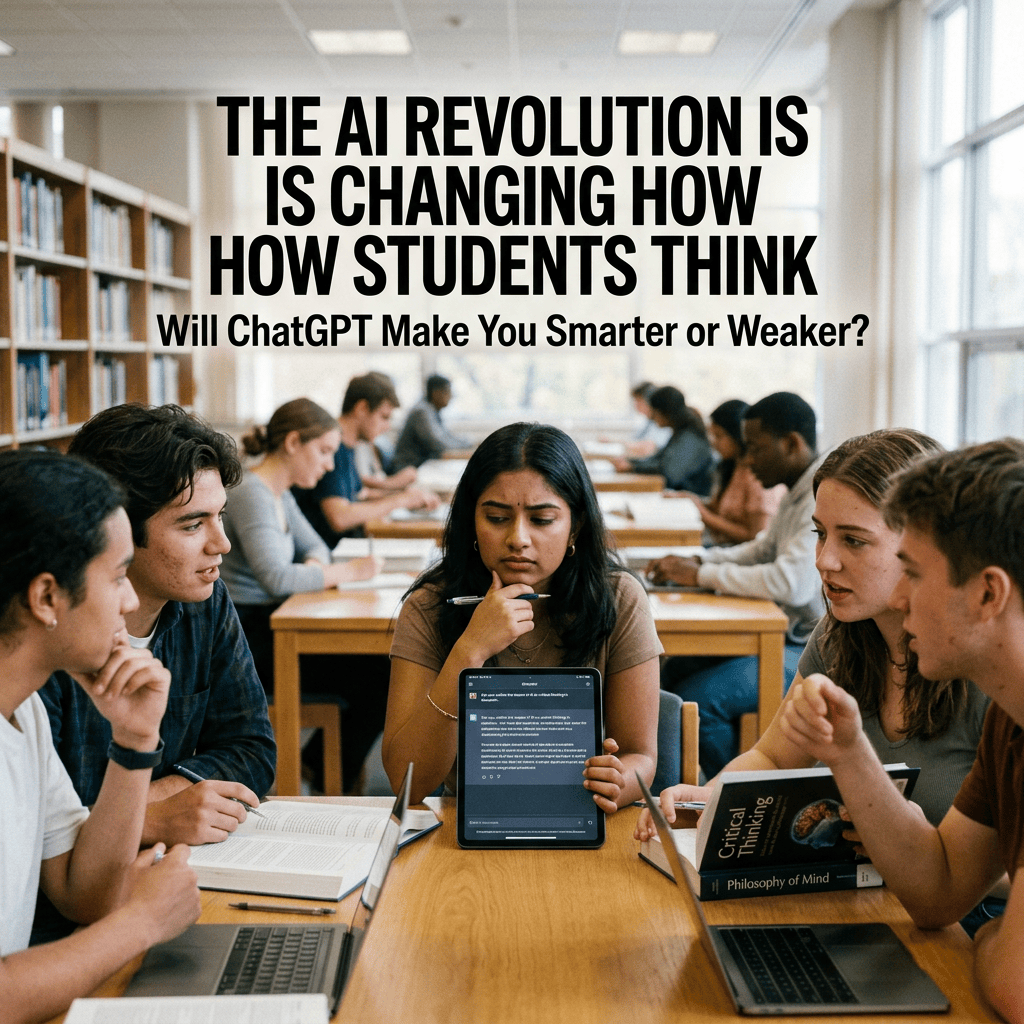
For millions of learners, this feels like an educational breakthrough. But an important question deserves attention: Are students using AI to improve their thinking—or gradually allowing it to think for them?
The answer depends less on the technology itself than on how it is used.
1. AI can make difficult subjects easier to understand
Generative AI tools can provide explanations at different levels of complexity. A learner struggling with a scientific concept can request a simpler explanation, ask for an analogy, or explore a worked example.
Used thoughtfully, this can support independent study by helping learners identify gaps in their understanding before approaching a teacher or lecturer.
AI can also help students:
- Generate practice questions from lecture notes.
- Compare alternative explanations of a concept.
- Receive feedback on the structure of an argument.
- Identify unfamiliar terminology.
- Develop revision plans.
- Practise a foreign language through conversation.
However, an explanation that sounds convincing is not necessarily accurate. Students must check important claims against textbooks, academic publications and reliable institutional sources.
2. The hidden danger: confusing a completed task with actual learning
Imagine two students preparing an essay.
The first student asks an AI chatbot to write the essay, copies the response and submits it. The second uses AI to identify counterarguments, checks the references independently, writes the essay personally and explains the reasoning behind every major point.
Both may produce polished documents. Yet their learning experiences are fundamentally different.
The first student may have completed the assignment without developing the skills it was designed to assess. The second has used technology as a thinking partner while retaining responsibility for the intellectual work.
The OECD’s Digital Education Outlook 2026 makes an important distinction: generative AI can improve task performance without necessarily producing lasting learning gains. Educational benefits are more likely when AI use is guided by clear teaching and learning objectives.
3. Can excessive AI dependence weaken critical thinking?
Critical thinking involves evaluating evidence, identifying assumptions, questioning conclusions and recognising uncertainty.
These abilities develop through practice. Students need opportunities to struggle with difficult questions, compare evidence, make mistakes and revise their conclusions.
If AI routinely performs these activities on their behalf, students may lose valuable opportunities to practise them.
This does not mean that every use of ChatGPT damages thinking. It means that educators should distinguish between using AI to support intellectual effort and using it to avoid intellectual effort.
A useful rule is simple: Try to think before asking AI to think with you.
4. Five ways to use AI without surrendering independent thinking
First, attempt the problem yourself. Write down your initial explanation, calculation or argument before consulting an AI tool.
Second, ask questions rather than requesting finished answers. For example: “What assumptions should I examine in this argument?” is often more educational than “Write my essay.”
Third, request counterarguments. Ask the tool to identify weaknesses in your reasoning, then investigate whether its criticisms are justified.
Fourth, verify important information. Check quotations, references, dates, statistics and technical explanations against original sources.
Fifth, explain the result in your own words. If you cannot explain an answer without AI assistance, you may not understand it sufficiently.
5. What should universities and schools do?
Educational institutions should not treat AI literacy as an optional technical skill. Students need to understand how generative AI works, what it can do, where it fails, and how to use it responsibly.
UNESCO’s AI Competency Framework for Students identifies four important dimensions: a human-centred mindset, ethics of AI, AI techniques and applications, and AI system design.
These principles point towards an educational approach that develops informed and responsible users rather than simply encouraging or prohibiting technology.
Teachers also need appropriate training, clear institutional guidance and assessment methods that reward genuine understanding.
Let AI expand your thinking, not replace it
ChatGPT, Gemini and similar tools can be valuable educational assistants. They can make explanations more accessible, support practice and help learners explore unfamiliar subjects.
But no chatbot can take responsibility for a student’s intellectual development.
The most valuable learners in the AI era will not necessarily be those who generate the fastest answers. They will be those who know how to ask meaningful questions, recognise weak evidence, challenge automated responses and defend their own conclusions.
Use AI to become a better thinker—not to avoid thinking.
Recommended further reading
- OECD Digital Education Outlook 2026
- UNESCO AI Competency Framework for Students
- UNESCO Guidance for Generative AI in Education and Research
Stay connected with Scholars Careers
If you found this article useful, subscribe to Scholars Careers for practical guidance on higher education, scholarships, research, academic careers and emerging developments in education.
Follow our updates, share this article with students and educators, and join the conversation: Is AI making students better thinkers, or making independent thinking less common?
Disclaimer
This article is intended for general educational and informational purposes. It does not replace institutional academic-integrity policies, professional teaching advice or independent verification of information. AI tools can produce inaccurate, incomplete or biased outputs. Always follow the rules of your school, university or research institution. Scholars Careers is an independent educational information platform and is not affiliated with or endorsed by UNESCO, the OECD, OpenAI, Google or the developers of the tools mentioned.


