For early-career researchers, securing a research grant can be an important step towards academic independence. Funding can support research assistants, equipment, fieldwork, data collection, international collaboration and the development of a new research programme. Yet many promising researchers struggle to identify suitable funding opportunities or prepare applications that meet funders’ expectations.
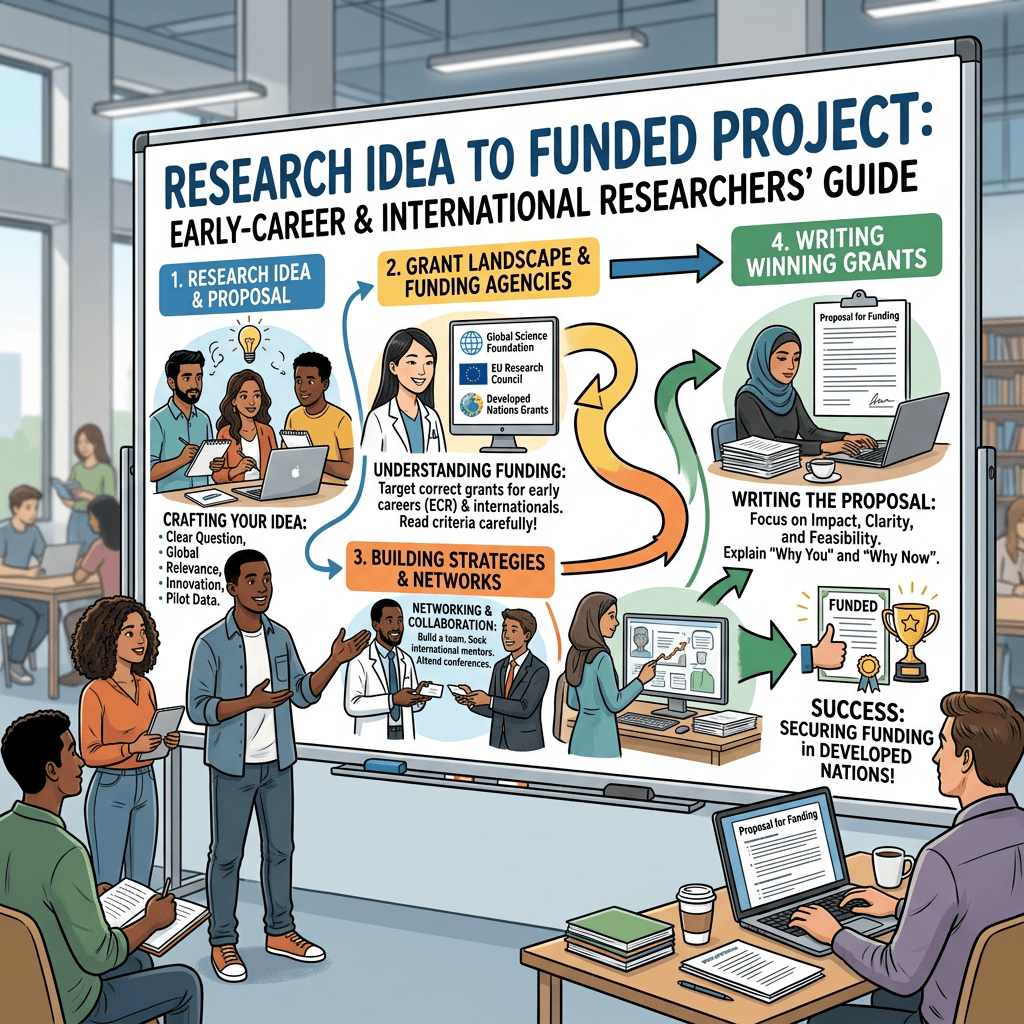
The challenge can be especially significant for international researchers who are unfamiliar with the funding systems, eligibility rules and institutional processes in another country.
This guide explains how to move from an initial research idea to a competitive funding application.
1. Understand the different types of research funding
Research funding is not limited to large grants for established professors. Depending on the country and discipline, opportunities may include:
- Early-career investigator grants
- Postdoctoral fellowships
- Research mobility awards
- Small project grants
- International collaboration grants
- Doctoral and postdoctoral research funding
- Institutional seed funding
- Industry partnership grants
Each type has different eligibility conditions. Some require an established institutional affiliation, while others are designed to support researchers moving between countries.
2. Find funding schemes that match your career stage
Do not spend time preparing applications for schemes where you do not meet the basic requirements.
Check whether the funder has restrictions based on:
- Years since PhD completion
- Nationality or residency
- Employment status
- Institutional affiliation
- Research discipline
- Previous funding received
- Location of the proposed research
Some schemes allow career breaks or provide special provisions for applicants with non-linear career histories. Read the current rules carefully.
3. Explore funding opportunities in developed countries
Useful organisations and funding portals include:
United States
- National Science Foundation: https://www.nsf.gov/
- National Institutes of Health: https://www.nih.gov/
United Kingdom
- UK Research and Innovation: https://www.ukri.org/
Canada
- Natural Sciences and Engineering Research Council: https://www.nserc-crsng.gc.ca/
- Social Sciences and Humanities Research Council: https://www.sshrc-crsh.gc.ca/
- Canadian Institutes of Health Research: https://cihr-irsc.gc.ca/
Germany
- German Research Foundation: https://www.dfg.de/
- Alexander von Humboldt Foundation: https://www.humboldt-foundation.de/
France
- National Research Agency: https://anr.fr/
Australia
- Australian Research Council: https://www.arc.gov.au/
- National Health and Medical Research Council: https://www.nhmrc.gov.au/
European programmes
- European Commission research funding: https://research-and-innovation.ec.europa.eu/
These are starting points rather than a complete list. Universities, foundations, charities and professional associations may also offer relevant schemes.
4. Build relationships with potential collaborators
International collaboration can strengthen a research project by bringing together complementary expertise, facilities or access to research settings.
Identify researchers whose work connects meaningfully with your project. Read their publications and look for shared research questions.
When contacting a potential collaborator, be specific about the proposed contribution and avoid sending generic messages to large numbers of academics.
5. Develop a fundable research question
A research idea becomes a funding proposal when it is focused, important and feasible.
Ask:
- What problem does the project address?
- What is already known?
- What important gap remains?
- What will the project establish?
- Why is the research timely?
- Who may benefit from the findings?
Support the rationale with relevant literature and evidence.
6. Demonstrate originality and value
Funders need to understand why the project deserves investment.
Explain what is new, whether that involves a new method, dataset, theoretical approach, application or research partnership.
Avoid claiming that your work will solve a large societal problem unless the proposed project can reasonably support that claim.
7. Collect preliminary evidence where appropriate
Pilot data, preliminary experiments or proof-of-concept work can help demonstrate feasibility.
However, not every funding scheme requires preliminary results. Check the call requirements and do not delay an application unnecessarily if the scheme is designed to support exploratory research.
8. Prepare a realistic budget
Develop the budget from the research plan rather than selecting an arbitrary funding amount.
Consider staffing, equipment, travel, fieldwork, consumables, data access and other eligible costs. Explain why each expense is necessary.
Ask your institution’s research office for help with costing, indirect costs and internal approval procedures.
9. Demonstrate that the project can be delivered
A credible application needs a clear timetable and a team with appropriate expertise.
Identify project stages, milestones, responsibilities and potential risks. Explain what you will do if a key activity is delayed or a planned method proves unsuitable.
10. Show why the institution is a suitable host
For schemes that require a host institution, explain how the university or research centre will support the project.
Relevant factors may include:
- Specialist supervisors or collaborators
- Laboratory or technical facilities
- Research infrastructure
- Access to relevant data or collections
- Interdisciplinary expertise
- Training and career development
- Links with industry, government or communities
The host should be a genuine academic fit, not simply a prestigious name.
11. Explain the expected outcomes
Identify the outputs the project is expected to produce, such as journal articles, datasets, software, policy reports, prototypes, training resources or public engagement activities.
Explain how you will communicate the findings to relevant audiences.
12. Address international eligibility and practical requirements
International researchers should investigate whether they need a particular employment status, institutional sponsorship, work authorisation or residence permission.
Funding eligibility and immigration permission are separate matters. An award does not automatically provide a visa or permission to work in a particular country.
Check the relevant funder’s rules and official immigration guidance before making commitments.
13. Use your institution’s research support services
Many universities have research development teams that help applicants identify calls, interpret guidance, prepare budgets and obtain approvals.
Contact them early. Institutional deadlines may be earlier than the funder’s final submission deadline.
14. Avoid common mistakes
Early-career researchers should be particularly careful to avoid:
- Applying without checking eligibility.
- Choosing a scheme that does not match their career stage.
- Proposing an unrealistic amount of work.
- Failing to identify the host institution’s contribution.
- Underestimating project costs.
- Overlooking ethics and data management.
- Leaving submission until the final hours.
- Treating a funding award as guaranteed employment or immigration permission.
15. Build a long-term funding strategy
A successful funding career usually develops over time. Start with opportunities appropriate to your experience and build evidence of research quality, collaboration and project delivery.
Keep a record of funding calls, deadlines, eligibility rules, reviewer feedback and future opportunities. Develop collaborations that are academically meaningful and maintain a clear research direction.
Final thoughts
Early-career and international researchers can access a range of research funding opportunities in developed countries, but the right scheme depends on discipline, career stage, institutional affiliation and eligibility.
A strong application combines a focused research question, credible methods, realistic costs, capable collaborators and a clear explanation of why the proposed project matters.
Stay connected with Scholars Careers
Subscribe to Scholars Careers for more practical guidance on research grants, international fellowships, postdoctoral opportunities, academic publishing and research careers.
Follow our updates and share this article with early-career academics, postdoctoral researchers, lecturers and international scholars. Sharing funding guidance can help researchers discover opportunities they might otherwise overlook.
Disclaimer: This article is for general educational and informational purposes. It does not guarantee eligibility, grant approval, employment, fellowship selection or immigration permission. Funding programmes, deadlines, institutional requirements and visa rules may change. Always consult the current official guidance from the funder, host institution and relevant government authorities. Scholars Careers is an independent information platform and is not affiliated with or endorsed by the organisations mentioned.


