Getting admitted into a PhD programme is a major academic achievement. But admission is only the beginning. The real challenge is becoming an independent researcher who can identify important problems, develop original ideas, conduct rigorous investigations and contribute meaningful knowledge to your academic discipline.
Some doctoral students struggle throughout their programmes, while others gradually develop into confident researchers, productive writers and respected academics.
What separates successful PhD students from those who struggle?
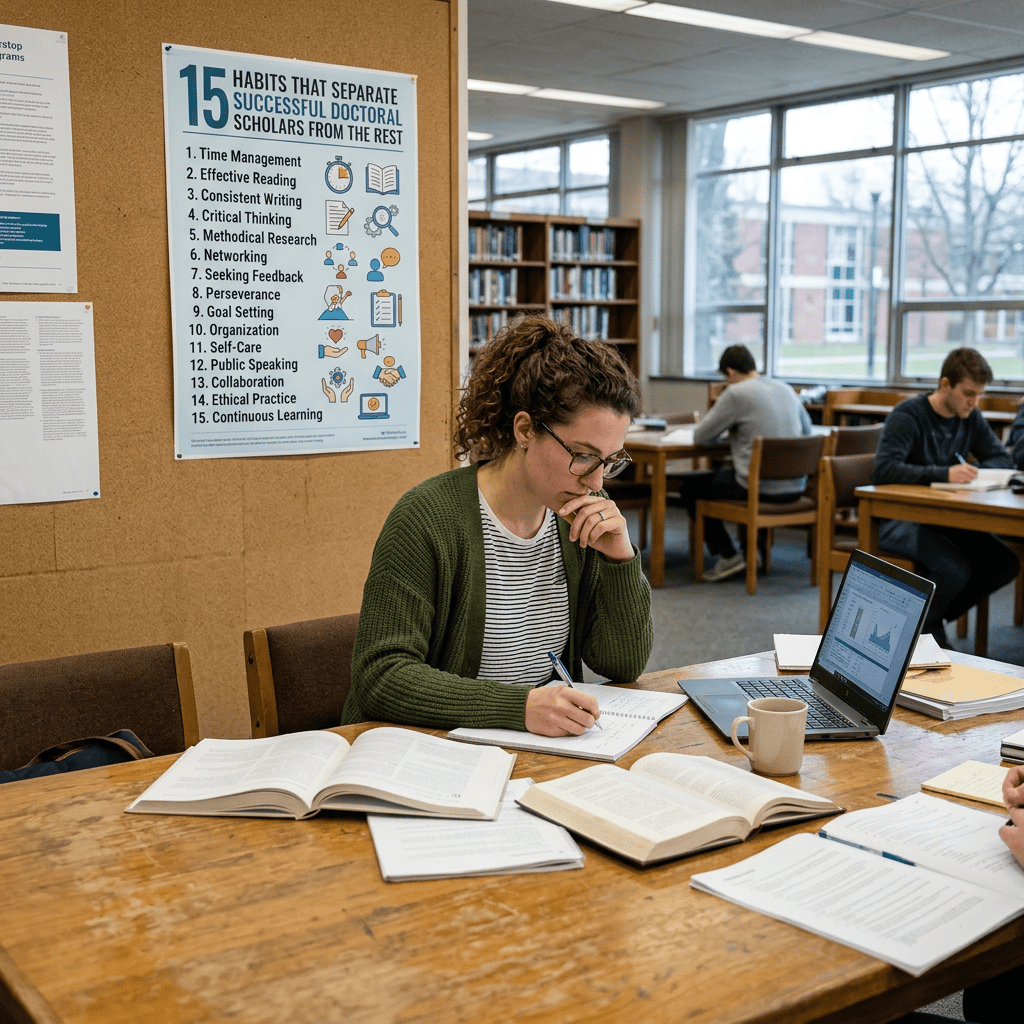
It is rarely one extraordinary achievement. More often, it is a combination of research habits, intellectual curiosity, discipline, effective communication and the ability to learn from setbacks.
Whether you have just started your doctorate or are already preparing your thesis, the following 15 habits can help you become a more effective researcher and increase your chances of completing your PhD successfully.
1. Think Like a Researcher, Not Just a Student
A PhD is fundamentally different from an undergraduate or Master’s degree.
At earlier academic levels, you are primarily expected to understand existing knowledge.
At doctoral level, you are expected to develop original knowledge or make a significant contribution to an existing field.
This requires you to move beyond memorising information.
Start asking:
- What is not yet understood in this field?
- Why does this research problem matter?
- What assumptions have previous researchers made?
- What evidence is missing?
- How can my research contribute something meaningful?
Developing this mindset is one of the most important steps towards becoming an independent academic.
2. Become an Expert in Your Research Area
You do not need to know everything about your discipline.
However, you should develop a deep understanding of the research area surrounding your doctoral project.
Read:
- Foundational academic publications.
- Recent high-quality journal articles.
- Important theoretical contributions.
- Relevant systematic reviews.
- Methodological studies.
- Research that challenges established assumptions.
Follow important journals and academic researchers in your field.
The goal is to understand not only what researchers have discovered but also how they reached their conclusions.
3. Read Academic Papers Actively
Reading hundreds of papers without retaining their important findings is not productive.
Develop a structured reading approach.
For every important paper, record:
| Question | What to identify |
|---|---|
| Research problem | What issue was investigated? |
| Objectives | What did the authors want to establish? |
| Methodology | How was the study conducted? |
| Findings | What were the main results? |
| Limitations | What weaknesses were identified? |
| Contribution | What did the study add? |
| Relevance | How does it relate to your research? |
This approach makes literature reviews more analytical and helps you identify research gaps.
4. Write Every Week
Successful researchers develop the habit of writing regularly.
Do not wait for inspiration or perfect conditions.
Write literature summaries, research notes, methodology sections, analytical discussions and preliminary findings.
Even a modest weekly writing target can produce substantial progress over several months.
The important thing is to establish a routine that is sustainable.
5. Develop Strong Critical Thinking Skills
A PhD is not about agreeing with everything published in academic journals.
You must learn to evaluate research critically.
Ask:
- Is the methodology appropriate?
- Are the conclusions supported by the evidence?
- Are there alternative explanations?
- Are the limitations adequately discussed?
- Can the findings be generalised?
- What assumptions influence the analysis?
Critical thinking is particularly important when developing your research argument and defending your findings.
6. Build a Productive Relationship With Your Supervisor
Your supervisor is an important source of academic guidance, but you remain responsible for managing your doctoral research.
Develop a professional relationship based on communication, preparation and mutual respect.
Practical habits include:
- Attend scheduled meetings.
- Submit work within agreed deadlines.
- Ask clear research questions.
- Respond constructively to feedback.
- Communicate difficulties early.
- Record agreed actions.
- Respect professional boundaries.
Do not interpret every criticism as a personal attack.
Academic feedback is often an essential part of developing stronger research.
7. Learn to Accept Academic Rejection
Rejection is part of academic life.
Your research proposal may require revision. A journal may reject your manuscript. A conference abstract may not be accepted. Your supervisor may ask you to rewrite an entire chapter.
These experiences do not necessarily mean you are failing.
Learn to distinguish between criticism of your work and criticism of your personal worth.
Read feedback carefully, identify recurring weaknesses and develop an action plan.
Resilience is an important quality for long-term research success.
8. Develop Excellent Research Communication Skills
A good researcher must be able to communicate complex ideas clearly.
You may be required to:
- Write academic papers.
- Present conference findings.
- Deliver research seminars.
- Explain methodology.
- Discuss findings with colleagues.
- Defend your thesis during an oral examination.
Practise explaining your research in different ways.
Try describing your project in:
- One sentence.
- One minute.
- Five minutes.
- A 15-minute presentation.
If you can explain your research clearly to someone outside your discipline, you are developing an important academic skill.
9. Publish Quality Research
Academic publications can help establish your research profile.
They also provide opportunities to receive feedback from other scholars and contribute to discussions in your field.
However, publication should be strategic.
Before submitting a manuscript:
- Identify an appropriate journal.
- Read its submission requirements.
- Examine recently published papers.
- Check the journal’s reputation.
- Review its peer-review process.
- Understand publication charges.
- Ensure the manuscript meets ethical requirements.
Do not sacrifice research quality simply to increase your publication count.
10. Build a Strong Academic Network
Research is not an isolated activity.
Develop professional relationships with researchers, academics, postgraduate students and professionals working in your area.
You can build your network through:
- Academic conferences.
- Research seminars.
- University workshops.
- Research collaborations.
- Professional associations.
- Academic social networks.
- International research events.
Platforms such as LinkedIn and academic networking communities can also help you discover research discussions and opportunities.
Networking should be based on genuine academic interests rather than simply collecting contacts.
11. Develop Skills Beyond Your Thesis Topic
The most successful researchers often possess complementary skills that improve their academic effectiveness.
Depending on your discipline, consider developing:
- Statistical analysis.
- Programming.
- Scientific writing.
- Project management.
- Research ethics.
- Grant writing.
- Data visualisation.
- Academic teaching.
- Public speaking.
- Research leadership.
These skills can improve your employability after graduation.
12. Learn How to Apply for Research Grants and Fellowships
Do not wait until after graduation to explore academic funding opportunities.
Learn how researchers identify funding calls, develop proposals and prepare competitive applications.
Explore opportunities offered by:
- Universities.
- Research councils.
- Government agencies.
- International foundations.
- Professional associations.
- Research institutes.
For international research opportunities, explore:
EURAXESS: https://euraxess.ec.europa.eu/
Marie Skłodowska-Curie Actions: https://marie-sklodowska-curie-actions.ec.europa.eu/
UKRI: https://www.ukri.org/
Horizon Europe: https://research-and-innovation.ec.europa.eu/
Eligibility varies considerably, and some programmes are intended for postdoctoral researchers rather than current PhD students.
13. Prepare for Your Viva or Doctoral Defence Early
Do not wait until you submit your thesis before thinking about your oral examination.
Depending on the university and country, the doctoral defence may involve a formal viva, public presentation, examination panel or other assessment format.
You should be able to explain:
- Why you selected your research topic.
- What problem your research addresses.
- What makes your work original.
- Why you selected your methodology.
- What your principal findings are.
- What limitations your study has.
- How your work contributes to the field.
- What future research could investigate.
Practise discussing your work with colleagues and academic mentors.
The objective is not to memorise answers but to understand and defend your research decisions.
14. Maintain Your Mental Health and Work-Life Balance
Academic success should not come at the expense of your health.
PhD research can involve uncertainty, isolation, financial pressure and prolonged periods of demanding intellectual work.
Develop a sustainable routine.
Make time for:
- Physical exercise.
- Adequate sleep.
- Family and friends.
- Hobbies.
- Social activities.
- Regular breaks.
- University support services.
If you experience persistent stress, anxiety or burnout, seek appropriate professional support.
A healthy researcher is better positioned to sustain long-term academic productivity.
15. Start Thinking About Your Career Beyond the PhD
Your doctoral degree is an important qualification, but it should also prepare you for your next professional stage.
Depending on your interests, possible career paths include:
Academic careers
- Lecturer.
- Research fellow.
- Postdoctoral researcher.
- University professor.
- Research group leader.
Research and industry careers
- Research scientist.
- Data scientist.
- Policy analyst.
- Research consultant.
- Industry specialist.
International and development careers
- Programme researcher.
- Monitoring and evaluation specialist.
- International policy adviser.
- Research officer.
- Development consultant.
Use your doctoral years to build the skills, professional relationships and experience relevant to your intended career.
The Successful PhD Researcher’s Daily Routine
There is no single routine that works for everyone, but the following example illustrates how you might organise a productive research day.
| Time | Activity |
|---|---|
| 8:00–9:00 AM | Review priorities and research plan |
| 9:00–11:00 AM | Focused research or academic writing |
| 11:00 AM–12:00 PM | Literature review |
| 12:00–1:00 PM | Break |
| 1:00–3:00 PM | Data analysis, experiments or fieldwork |
| 3:00–4:00 PM | Academic reading and research notes |
| 4:00–4:30 PM | Review progress and plan tomorrow |
Adjust this routine according to your research discipline, teaching commitments and personal circumstances.
Final Thoughts: Your PhD Should Transform You Into an Independent Scholar
A PhD is much more than obtaining another academic qualification.
It is an opportunity to develop intellectual independence, contribute original knowledge, strengthen your research abilities and establish yourself within an academic or professional community.
You will encounter difficult periods, unanswered questions, disappointing results and critical feedback.
What matters is how you respond.
Develop strong research habits, communicate effectively, remain intellectually curious and take responsibility for your progress.
Do not measure your success only by the speed at which you complete your doctorate.
Measure it by the quality of your research, the knowledge you contribute and the professional you become.
Your journey from PhD student to outstanding researcher begins with the habits you develop today.
Share this article with fellow doctoral researchers who are working towards academic excellence.


