Are you looking for a legitimate international job that allows you to earn money in foreign currency without relocating to another country? Would you like to work for companies in the United States, United Kingdom, Canada, Europe, or other parts of the world while living in your home country?
The good news is that international remote employment continues to create opportunities for skilled professionals, graduates, freelancers, and people looking to build careers online.
In 2026, companies are recruiting remote professionals across technology, customer service, digital marketing, finance, education, administration, writing, and other industries.
Unlike traditional employment, many remote positions allow successful candidates to work from home, provided they meet the employer’s country, legal employment, and time-zone requirements.
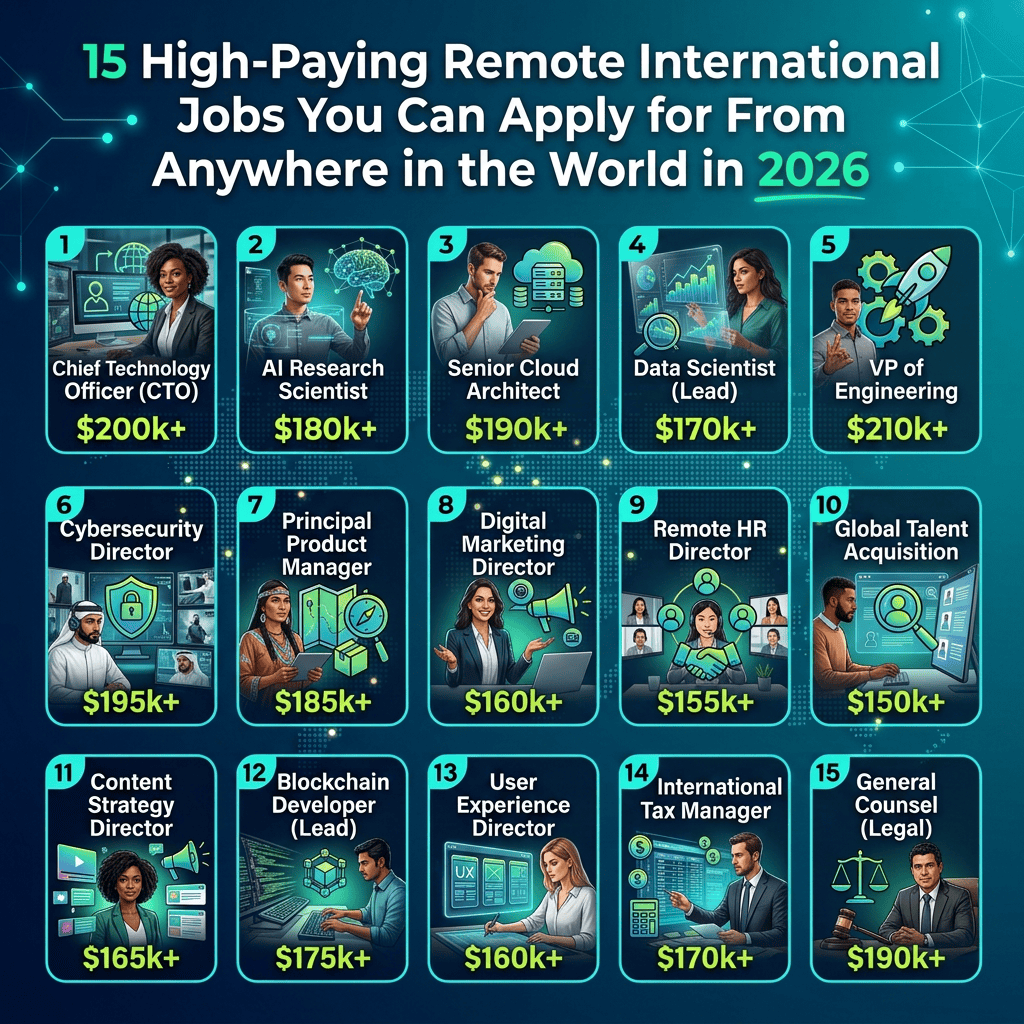
This article highlights 15 remote international career opportunities, the skills required, and where to find legitimate vacancies.
What Are Remote International Jobs?
Remote international jobs are employment opportunities offered by companies that allow workers to perform their duties outside the employer’s physical office.
Depending on the employer, you may be allowed to work from another country, either as a full-time employee, independent contractor, consultant, or freelancer.
However, it is important to understand that not every job advertised as remote is open worldwide. Some companies only recruit candidates living in specific countries or regions.
Always check the location and eligibility requirements before submitting your application.
15 Remote International Jobs to Consider in 2026
1. Remote Virtual Assistant
Virtual assistants provide administrative and organisational support to businesses, entrepreneurs, and executives.
Typical responsibilities include:
- Managing emails and calendars.
- Scheduling appointments and meetings.
- Preparing documents and reports.
- Conducting online research.
- Organising files and handling customer enquiries.
Skills required: Communication, organisation, Microsoft Office, Google Workspace, time management, and attention to detail.
This is a good entry point for people with administrative experience who want to work remotely.
2. Remote Customer Support Representative
International businesses hire customer support professionals to assist customers through email, live chat, telephone, and social media.
Responsibilities include answering questions, resolving complaints, processing requests, and providing product information.
Skills required: Excellent communication, patience, problem-solving, computer literacy, and professional customer service.
Some employers provide training, making this an opportunity worth exploring for entry-level applicants.
3. Software Developer
Software developers build, maintain, and improve websites, mobile applications, business systems, and software products.
Common specialisations include:
- Front-end development.
- Back-end development.
- Full-stack development.
- Mobile application development.
- Software testing and automation.
Skills required: Programming languages such as Python, JavaScript, Java, or PHP, depending on the position.
Software development is particularly suitable for professionals who can demonstrate their abilities through a portfolio of completed projects.
4. Remote Content Writer
Content writers create informative and engaging articles for websites, businesses, blogs, and online publications.
Typical assignments include blog posts, website content, product descriptions, newsletters, and marketing materials.
Skills required: Excellent writing, research, grammar, editing, SEO knowledge, and originality.
Applicants can improve their chances by developing a portfolio containing published articles and writing samples.
5. Digital Marketing Specialist
Digital marketing professionals help businesses attract customers and increase online visibility.
Their duties may include:
- Search engine optimisation (SEO).
- Social media marketing.
- Email marketing.
- Online advertising.
- Marketing analytics.
- Content strategy.
Skills required: Digital marketing knowledge, creativity, analytical thinking, and familiarity with platforms such as Google Analytics and social media advertising tools.
6. Remote Data Analyst
Data analysts help organisations understand business performance by collecting, analysing, and interpreting information.
Their work involves preparing reports, identifying trends, building dashboards, and supporting management decisions.
Skills required: Excel, SQL, Power BI, Tableau, statistics, and analytical thinking.
A strong portfolio of practical data projects can help applicants demonstrate their competence.
7. Online English Teacher
Online teaching platforms and educational organisations recruit English teachers to provide lessons to international students.
Responsibilities include teaching grammar, pronunciation, vocabulary, conversation, and examination preparation.
Skills required: Strong English communication, teaching ability, lesson planning, and reliable internet access.
Some employers require a TEFL or TESOL qualification, while others have different educational requirements.
8. Graphic Designer
Graphic designers produce visual materials for companies, advertising agencies, websites, and social media campaigns.
Typical projects include:
- Logo design.
- Social media graphics.
- Business presentations.
- Marketing materials.
- Website illustrations.
Skills required: Canva, Adobe Photoshop, Illustrator, Figma, creativity, and visual communication.
9. Social Media Manager
Social media managers develop and manage the online presence of businesses and organisations.
Their responsibilities include content planning, publishing posts, responding to followers, monitoring engagement, and preparing performance reports.
Skills required: Social media strategy, copywriting, content creation, analytics, and communication.
10. Remote Project Coordinator
Project coordinators support teams in planning, organising, and completing business projects.
Typical duties include scheduling meetings, tracking deadlines, preparing reports, communicating with team members, and updating project management systems.
Skills required: Organisation, communication, problem-solving, and familiarity with tools such as Trello, Asana, Monday.com, or Jira.
11. Cybersecurity Analyst
Cybersecurity professionals help organisations protect computer networks, systems, and sensitive information.
Responsibilities may include monitoring security alerts, investigating threats, reviewing vulnerabilities, and supporting incident response.
Skills required: Networking, security fundamentals, risk assessment, operating systems, and security tools.
Relevant certifications and practical experience can strengthen an application.
12. Online Research Assistant
Research assistants support businesses, universities, consultants, and research organisations by collecting and organising information.
Responsibilities include literature reviews, internet research, data collection, fact-checking, and report preparation.
Skills required: Research, writing, critical thinking, data organisation, and attention to detail.
This can be an attractive opportunity for graduates and candidates with academic research experience.
13. Remote Accountant or Bookkeeper
International businesses hire remote accounting professionals to manage financial records and support financial reporting.
Common duties include bookkeeping, invoice processing, account reconciliation, expense tracking, and financial documentation.
Skills required: Accounting knowledge, Excel, bookkeeping software, accuracy, and financial reporting.
Some positions require professional accounting qualifications and familiarity with the employer’s local regulations.
14. Video Editor
Video editors create and edit videos for businesses, content creators, educational platforms, and digital marketing agencies.
Assignments may include YouTube videos, promotional advertisements, online courses, interviews, and social media videos.
Skills required: Video editing, storytelling, sound editing, colour correction, and software such as Adobe Premiere Pro or DaVinci Resolve.
15. AI Data Specialist and AI Trainer
Artificial intelligence companies and technology service providers recruit specialists to evaluate AI-generated content, annotate data, review responses, and improve machine-learning systems.
Some opportunities involve:
- Data annotation.
- AI response evaluation.
- Language assessment.
- Content quality review.
- Subject-matter expertise.
Skills required: Attention to detail, analytical thinking, strong language skills, and relevant subject knowledge.
These opportunities vary significantly in availability, payment structure, and country eligibility.
Where to Find Legitimate Remote International Jobs
The following platforms can help you discover remote employment opportunities.
- Remote OK: https://remoteok.com/ – Remote opportunities across technology, marketing, sales, and other fields.
- We Work Remotely: https://weworkremotely.com/ – A remote-focused job board featuring different professional categories.
- Himalayas: https://himalayas.app/jobs – Remote jobs with useful location and work-arrangement information.
- Wellfound: https://wellfound.com/jobs – Employment opportunities with startups and technology companies.
- FlexJobs: https://www.flexjobs.com/ – A platform specialising in flexible and remote employment opportunities.
- Working Nomads: https://www.workingnomads.com/jobs – Curated remote job opportunities across different industries.
- LinkedIn Jobs: https://www.linkedin.com/jobs/ – Search for international remote opportunities and connect directly with recruiters.
- Actually Remote: https://actuallyremote.work/ – A platform that identifies jobs explicitly advertised as open worldwide.
Important: Always check the employer’s original vacancy announcement. A remote position may still be restricted to particular countries.
How to Apply for Remote International Jobs Successfully
Getting an international remote job requires preparation and a strategic application process.
Follow these steps:
Step 1: Prepare a Professional CV
Create a modern CV that highlights your education, relevant experience, technical skills, achievements, and ability to work independently.
Step 2: Optimise Your LinkedIn Profile
Use a professional photograph, clear headline, detailed experience section, and relevant keywords. Recruiters frequently use LinkedIn to discover potential candidates.
Step 3: Build Evidence of Your Skills
Create a portfolio showing your work. Writers can provide published articles, designers can share visual projects, and developers can showcase completed applications.
Step 4: Search Using the Right Keywords
Use search terms such as:
- Worldwide remote jobs.
- International remote jobs.
- Work from anywhere jobs.
- Remote jobs open globally.
- Remote jobs with visa sponsorship.
- International work-from-home opportunities.
Remember that remote work and visa sponsorship are different arrangements. If you are not relocating, you may not need employer-sponsored relocation, but the employer must still be able to hire you legally in your country.
Step 5: Submit Tailored Applications
Avoid sending the same CV to every employer. Adapt your application to the job description and demonstrate how your experience meets the employer’s requirements.
Step 6: Prepare for Online Interviews
Practise answering questions about your professional experience, communication skills, time management, availability, and ability to work independently.
How Much Can You Earn From Remote International Jobs?
Remote salaries vary considerably depending on the employer, country, experience, specialisation, and contract arrangement.
Some employers offer fixed monthly salaries, while others pay hourly rates or project-based fees.
Before accepting an offer, confirm:
- The salary and payment currency.
- Whether compensation is location-adjusted.
- Whether the position is permanent or contractual.
- Payment frequency and method.
- Working hours and time-zone expectations.
- Benefits, leave, and tax responsibilities.
Do not assume that every international employer pays the same salary to workers in different countries.
How to Avoid Remote Job Scams
Unfortunately, fraudulent job advertisements target people searching for international employment.
Protect yourself by following these precautions:
- Never pay a recruitment fee to secure a job.
- Verify the company’s official website and contact information.
- Check whether the vacancy appears on the employer’s careers page.
- Be cautious of offers promising unusually high salaries for very little work.
- Never disclose banking passwords or sensitive personal information to recruiters.
- Do not pay for equipment or training using suspicious payment arrangements.
- Request a written contract and understand the employment terms before accepting an offer.
Legitimate employers should be willing to explain their recruitment process and employment arrangements.
Final Thoughts
Remote international jobs offer an exciting opportunity to develop your career, gain international experience, and work with organisations beyond your geographical location.
Whether you are a graduate, an experienced professional, a freelancer, or someone changing careers, there are different remote employment paths worth exploring.
The most important thing is to identify your strongest skills, prepare a professional application, and focus on vacancies that genuinely accept applicants from your country.


