Starting a PhD is one thing. Completing it successfully is another. For many doctoral students, the journey becomes more challenging than expected. What initially appears to be an exciting academic adventure can turn into years of research delays, endless literature reviews, rejected manuscripts, supervisor disagreements, data collection problems and difficult thesis revisions.
Some students complete their doctorates within the expected period, while others spend considerably longer than planned.
What makes the difference?
Is it intelligence? Research experience? Access to funding? A supportive supervisor?
All these factors can matter, but successful PhD completion also depends heavily on planning, discipline, research management and the ability to make consistent progress.
The good news is that you can adopt practical strategies to make your doctoral journey more efficient without compromising research quality.
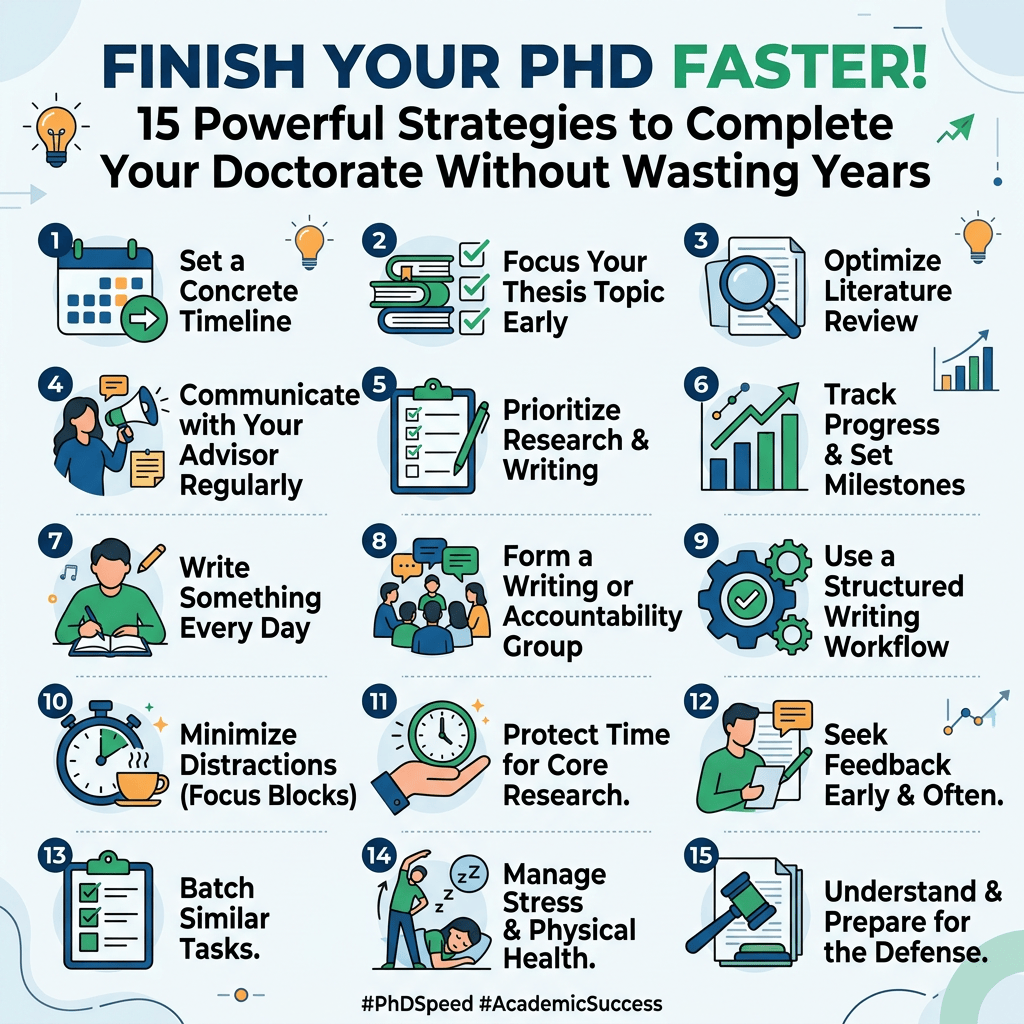
In this article, we discuss 15 powerful ways to manage your PhD effectively, reduce unnecessary delays and increase your chances of completing your doctorate on time.
1. Choose a Research Topic That Is Focused and Manageable
Your research topic can determine how difficult your PhD journey becomes.
One of the biggest mistakes new doctoral researchers make is choosing a topic that is excessively broad.
For example, a topic such as “The Impact of Technology on Society” is too broad for most doctoral projects.
A more focused topic might investigate a specific technology, population, geographical area and measurable outcome.
Your research topic should:
- Address a meaningful research problem.
- Be sufficiently original.
- Fit within your available time.
- Have an achievable methodology.
- Be supported by accessible research resources.
- Match your department’s expertise.
A manageable research question is not necessarily an unambitious one. It is one that can be investigated rigorously within the available resources and timeframe.
2. Agree on Clear Expectations With Your Supervisor
Your relationship with your supervisor can significantly influence your doctoral experience.
At the beginning of your PhD, discuss:
- Expected completion timelines.
- Research milestones.
- Meeting frequency.
- Publication expectations.
- Feedback arrangements.
- Research training requirements.
- Thesis structure.
- Departmental progress reviews.
Ask your supervisor how frequently they expect progress reports and how long they generally need to review substantial pieces of work.
Clear expectations can prevent misunderstandings later.
3. Develop a Realistic PhD Completion Plan
Do not begin a PhD without a written research and completion plan.
Divide your doctorate into manageable stages.
For example:
| PhD stage | Main activities |
|---|---|
| Months 1–6 | Research training, literature review and proposal development |
| Months 7–12 | Research design, methodology and ethics approval |
| Months 13–24 | Data collection or experimental work |
| Months 25–30 | Data analysis and interpretation |
| Months 31–36 | Thesis writing, revision and submission preparation |
This is an illustrative 36-month plan, not a universal PhD timeline. Your actual schedule will depend on your country, discipline, research design and university regulations.
Some research projects require longer data collection, fieldwork or laboratory work.
4. Stop Reading Everything: Master the Literature Review
A common problem among PhD students is spending too much time reading without producing written work.
You do not need to read every publication related to your research area.
Instead, develop a systematic literature review strategy.
Start by identifying:
- Foundational publications.
- Recent high-quality studies.
- Important theoretical frameworks.
- Methodological approaches.
- Major disagreements in the field.
- Unanswered research questions.
Use academic databases such as:
- Google Scholar: https://scholar.google.com/
- PubMed: https://pubmed.ncbi.nlm.nih.gov/
- Scopus: https://www.scopus.com/
- Web of Science: https://www.webofscience.com/
- Semantic Scholar: https://www.semanticscholar.org/
The most useful literature review is not the longest one. It is the one that demonstrates your understanding of the research problem and explains why your study is necessary.
5. Start Writing From the Beginning
Do not wait until you have completed your research before beginning to write.
This is one of the most important strategies for completing a PhD efficiently.
Start writing:
- Research notes.
- Literature summaries.
- Methodology drafts.
- Research questions.
- Conference abstracts.
- Preliminary findings.
- Thesis chapter outlines.
Your early writing will improve as your research develops.
Writing regularly also helps you identify gaps in your understanding before they become major problems.
6. Set Weekly Research Targets
A PhD can become overwhelming when you focus exclusively on the final submission date.
Instead, concentrate on weekly achievements.
For example:
Monday: Read and summarise three relevant academic papers.
Tuesday: Analyse research data.
Wednesday: Draft a section of your thesis.
Thursday: Work on research methods or experiments.
Friday: Review progress and prepare questions for your supervisor.
Your weekly plan should reflect your research discipline and current project stage.
The goal is to make consistent progress rather than simply remain busy.
7. Use Reference Management Software
Do not waste valuable research time manually organising hundreds of academic references.
Use reference management software such as:
- Zotero: https://www.zotero.org/
- Mendeley: https://www.mendeley.com/
- EndNote: https://endnote.com/
These tools can help you organise academic papers, manage citations and generate bibliographies.
Choose one system early and maintain a consistent research library.
8. Learn Data Analysis Before You Need It
Another common cause of PhD delays is discovering too late that you lack the skills required to analyse your research data.
Depending on your discipline, consider learning:
- SPSS.
- R.
- Python.
- Stata.
- MATLAB.
- NVivo.
- ATLAS.ti.
- Excel.
- Relevant laboratory and statistical methods.
You do not need to master every software package.
Identify the tools required by your research methodology and obtain the necessary training early.
9. Do Not Delay Research Ethics Approval
If your research involves human participants, animals, sensitive personal information or other regulated research activities, you may need formal ethical approval.
Begin the relevant process early.
Prepare:
- Research protocols.
- Participant information sheets.
- Consent forms.
- Recruitment procedures.
- Data protection arrangements.
- Risk assessments.
Do not begin activities requiring ethics approval before receiving the necessary authorisation.
Delays in ethical approval can affect your entire research schedule.
10. Develop a Productive Relationship With Your Supervisor
Do not wait until your supervisor asks for an update. Take responsibility for managing your doctoral progress.
Before each meeting:
- Prepare a brief progress report.
- Identify completed activities.
- Explain any challenges.
- Share work requiring feedback.
- Prepare specific questions.
- Agree on the next steps.
After the meeting, record the agreed actions and deadlines.
If you encounter persistent supervisory difficulties, consult your graduate school, doctoral programme director or appropriate academic support service.
11. Publish Strategically, Not Desperately
Academic publications can strengthen your research profile and help communicate your findings.
However, not every PhD programme requires a specific number of publications.
Understand your university’s examination and publication requirements.
Where appropriate, consider:
- Review articles.
- Conference papers.
- Original research articles.
- Methodological papers.
- Book chapters.
Prioritise reputable journals relevant to your discipline.
Avoid predatory publishers promising guaranteed publication in exchange for payment.
Remember that publishing a paper is not automatically more important than completing a high-quality thesis.
12. Use Artificial Intelligence Responsibly
AI tools can support research productivity when used appropriately.
They may help with:
- Organising research notes.
- Explaining difficult concepts.
- Generating preliminary outlines.
- Improving grammar.
- Developing coding ideas.
- Debugging research scripts.
- Preparing literature search terms.
However, AI should not replace your independent academic judgement.
Never rely on fabricated references, unverified research findings or AI-generated explanations without checking them against original sources.
Follow your university’s rules on AI use, authorship, research integrity and disclosure.
13. Learn to Say No to Unnecessary Distractions
A PhD requires sustained concentration.
Excessive commitments can reduce the time available for research.
Be selective about:
- Unnecessary meetings.
- Unrelated projects.
- Excessive teaching commitments.
- Activities that do not support your objectives.
- Social media distractions.
You do not have to accept every opportunity simply because it is academically related.
Protect dedicated research time.
14. Protect Your Mental and Physical Wellbeing
Finishing a PhD is important, but your wellbeing matters too.
Long periods of stress, isolation and exhaustion can undermine productivity.
Develop sustainable habits:
- Maintain regular sleep.
- Take breaks.
- Exercise regularly.
- Stay connected with friends and family.
- Use university wellbeing services when needed.
- Maintain interests outside research.
- Seek support when difficulties become overwhelming.
Working longer hours does not necessarily mean producing better research.
Consistency is more sustainable than constant overwork.
15. Start Thesis Preparation Earlier Than You Think
Do not wait until the final year to understand your university’s thesis requirements.
Find out:
- Maximum thesis length.
- Formatting rules.
- Submission procedures.
- Examination requirements.
- Publication expectations.
- Viva or oral examination arrangements.
- Deadlines for corrections.
Create a thesis outline early and gradually populate it with your research findings.
Ask your supervisor for feedback on chapter drafts well before the submission deadline.
A Practical PhD Productivity System
Here is a simple weekly system you can adopt.
| Activity | Suggested target |
|---|---|
| Focused research | 15–25 hours |
| Academic reading | 3–5 papers, depending on complexity |
| Thesis writing | 500–1,500 words |
| Data analysis | 2–3 focused sessions |
| Supervisor engagement | As agreed |
| Weekly review | 30–60 minutes |
These are illustrative targets, not academic requirements. Adjust them to your research stage, employment responsibilities and university expectations.
Five Signs Your PhD Is Falling Behind Schedule
Watch for these warning signs:
- You have no clear research question.
- You spend months reading without writing.
- You repeatedly postpone supervisor meetings.
- Your research methodology remains unresolved.
- You have no realistic thesis completion plan.
If you recognise these patterns, reassess your project and seek guidance early.
Final Thoughts: A Successful PhD Is Built Through Consistent Progress
Completing a PhD is not a competition to see who works the longest hours or reads the most academic papers. It is a structured research journey that requires intellectual independence, planning, discipline, resilience and effective supervision. The most important lesson is simple: do not postpone important research activities unnecessarily. Choose a manageable topic, agree on realistic milestones, write consistently, develop your research skills and protect your time. You do not need to be perfect every day. You need to make meaningful progress consistently.


