Imagine earning a Master’s or PhD degree from a world-class university without having to worry about tuition fees, accommodation costs and other major study expenses. For many students, studying at prestigious universities such as Harvard, Oxford, Cambridge, Stanford, MIT, Yale, ETH Zurich, Imperial College London and the University of Toronto may seem financially impossible. However, thousands of international students pursue postgraduate education every year through university scholarships, government-funded programmes, research studentships and international fellowship opportunities.
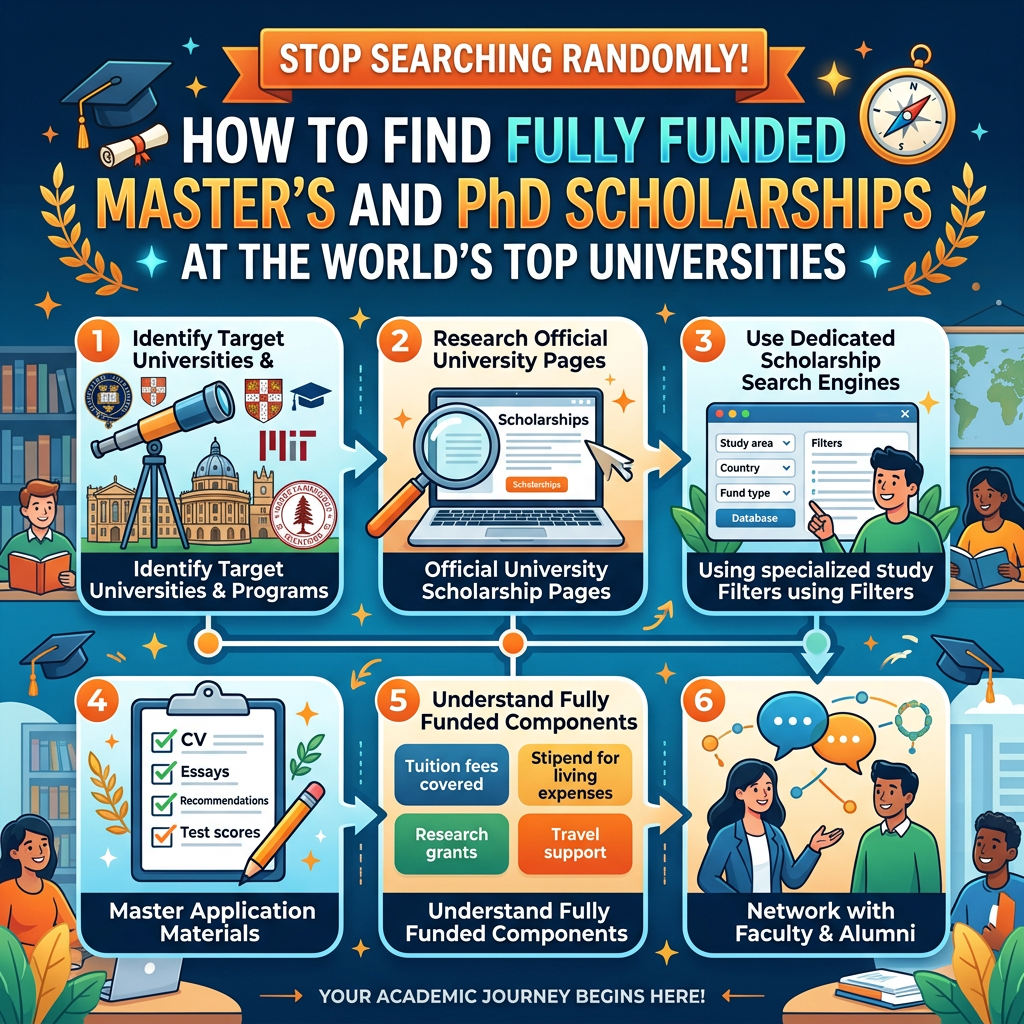
The challenge is not necessarily the absence of scholarships. It is knowing where to find them, how to identify opportunities that match your academic profile and how to submit competitive applications. If you are planning to pursue a Master’s or PhD degree abroad, this comprehensive guide will show you how to identify scholarship opportunities at leading global universities, where to search and how to improve your chances of receiving funding.
1. Understand the Different Types of International Scholarships
Before searching for scholarships, understand the funding opportunities available to international postgraduate students.
A. Fully Funded Scholarships
Fully funded scholarships generally cover major educational expenses and may include:
- Full university tuition fees.
- Monthly living stipends.
- Accommodation allowances.
- Health insurance.
- Research expenses.
- Travel or relocation allowances.
The benefits vary between programmes. Always read the official scholarship terms to understand exactly what is covered.
B. University-Funded Scholarships
Many prestigious universities operate scholarship programmes for international students.
Examples include:
- Oxford Clarendon Fund – University of Oxford.
- Gates Cambridge Scholarship – University of Cambridge.
- Knight-Hennessy Scholars – Stanford University.
- Yale Graduate School fellowships – Yale University.
- President’s PhD Scholarships – Imperial College London.
- ETH Zurich doctoral positions and funding opportunities.
Some awards are available to Master’s applicants, while others are specifically intended for doctoral candidates.
C. Government-Funded Scholarships
National governments also provide financial support to international students.
Important examples include:
- Chevening Scholarships – United Kingdom.
- Commonwealth Scholarships – United Kingdom.
- Erasmus Mundus Joint Masters – European Union.
- Fulbright Foreign Student Program – United States.
- DAAD Scholarships – Germany.
- MEXT Scholarships – Japan.
- Australia Awards Scholarships – Australia.
- Swedish Institute Scholarships – Sweden.
- Türkiye Scholarships – Türkiye.
- Chinese Government Scholarship – China.
Each programme has its own nationality, academic, experience and application requirements.
D. Research Assistantships and PhD Studentships
If you intend to pursue a PhD, do not limit your search to traditional scholarship programmes.
Many universities advertise funded doctoral research positions through individual academic departments and research groups.
These opportunities may provide:
- Tuition fee coverage.
- Monthly stipends or salaries.
- Research funding.
- Access to laboratories and research facilities.
- Conference and training support.
In some countries, doctoral researchers are employed as university staff rather than receiving a conventional scholarship.
2. The 15 Best Places to Find International Master’s and PhD Scholarships
One of the biggest mistakes scholarship applicants make is relying exclusively on social media announcements.
Instead, search through official scholarship databases, university funding pages and recognised international education platforms.
Here are 15 useful resources.
1. University of Oxford Scholarships
https://www.ox.ac.uk/admissions/graduate/fees-and-funding
Explore graduate scholarships, departmental funding and the Clarendon Fund.
2. University of Cambridge Funding
https://www.postgraduate.study.cam.ac.uk/funding
Find postgraduate funding opportunities, including information about the Gates Cambridge Scholarship.
3. Harvard University Graduate Funding
https://gsas.harvard.edu/financial-support
Explore financial support and funding information for eligible graduate programmes.
4. Stanford University Graduate Funding
https://financialaid.stanford.edu/grad
Find information about graduate financial support and funding arrangements.
5. Yale University Graduate Funding
https://gsas.yale.edu/admissions/funding
Explore funding information for graduate students.
6. MIT Graduate Funding
Research graduate funding, fellowships, research assistantships and teaching assistantships.
7. ETH Zurich
https://ethz.ch/en/studies/financial/scholarships.html
Explore scholarship and financial support opportunities for eligible students.
8. Imperial College London
https://www.imperial.ac.uk/study/fees-and-funding
Find postgraduate funding and scholarship information.
9. DAAD Scholarship Database
https://www.daad.de/en/studying-in-germany/scholarships
Discover scholarship opportunities for studying and researching in Germany.
10. Erasmus Mundus Catalogue
https://www.eacea.ec.europa.eu/scholarships/erasmus-mundus-catalogue_en
Explore joint Master’s programmes offered by international university partnerships.
11. Chevening Scholarships
Find information about fully funded UK Master’s scholarships for eligible applicants.
12. Commonwealth Scholarships
Explore scholarship programmes for eligible Commonwealth citizens.
13. Fulbright Foreign Student Program
https://foreign.fulbrightonline.org
Discover postgraduate study and research opportunities in the United States.
14. Australia Awards
https://www.dfat.gov.au/people-to-people/australia-awards
Explore Australian government scholarships for eligible international applicants.
15. FindAPhD
Search for doctoral projects, funded PhD positions and research opportunities across different countries.
Always verify the current application status, eligibility and deadlines through the relevant university or scholarship provider.
3. How to Find Scholarships at Top Universities Even If You Have Limited Connections
You do not need to know a professor personally or have connections with university administrators to begin searching for postgraduate funding.
You need a systematic search strategy.
Step 1: Identify Your Preferred Countries
Start by choosing three to five countries where you would genuinely like to study.
For example:
- United Kingdom.
- United States.
- Canada.
- Germany.
- Australia.
- Netherlands.
- Sweden.
- Switzerland.
- Japan.
Research the tuition fees, living costs, language requirements and scholarship opportunities in each country.
Step 2: Identify Universities Offering Your Preferred Programme
Do not choose a university simply because it is famous.
Identify institutions with strong departments in your academic discipline.
For example, if you want to study:
- Public health, explore universities with established public health schools.
- Computer science, identify institutions with strong computing research groups.
- Economics, examine universities with relevant economics departments.
- Engineering, investigate institutions with suitable laboratories and research facilities.
- Education, explore universities with established education faculties.
A university’s academic reputation in your specific field can be more important than its overall global ranking.
Step 3: Search for the Programme and Its Funding Opportunities Together
Instead of searching only for “fully funded scholarships”, use targeted search phrases.
Examples:
- Fully funded Master’s scholarships in public health 2027.
- Fully funded PhD positions in artificial intelligence.
- International postgraduate scholarships in Europe.
- Funded PhD positions in environmental science.
- University scholarships for international Master’s students.
- Graduate research assistantships for international students.
Also search individual university websites using the programme name and the words “funding”, “scholarships”, “studentships” or “financial support”.
Step 4: Examine Departmental Funding Opportunities
This is particularly important for PhD applicants.
Many funded doctoral opportunities are advertised by academic departments rather than central university scholarship offices.
Visit the websites of relevant departments and research centres.
Look for sections titled:
- PhD opportunities.
- Research studentships.
- Graduate funding.
- Doctoral vacancies.
- Research assistantships.
- Funded projects.
Step 5: Contact Potential Supervisors
For research-based Master’s degrees and PhD programmes, contacting an academic whose research matches your interests may be helpful.
Read their publications and research interests before sending an email.
Explain:
- Your academic background.
- Your proposed research interest.
- Why their research is relevant to your plans.
- Whether they expect to supervise new students.
- Whether funded doctoral opportunities are available.
A thoughtful, personalised email is much more effective than sending the same generic message to dozens of professors.
4. How to Prepare a Winning Scholarship Application
Finding a scholarship is only the beginning. You must also prepare a strong application.
A. Prepare an Excellent Academic CV
Your CV should highlight:
- Educational qualifications.
- Academic achievements.
- Research experience.
- Publications, if applicable.
- Conference presentations.
- Professional experience.
- Relevant technical skills.
- Leadership and extracurricular activities.
For research-intensive programmes, academic and research achievements are particularly important.
B. Write a Powerful Statement of Purpose
Your statement of purpose should explain:
- Your academic background.
- Your interest in the proposed programme.
- Your relevant achievements.
- Why you selected the university.
- Your future academic or professional goals.
- How the scholarship will support your plans.
Avoid generic statements that could be submitted to any university.
C. Develop a Strong Research Proposal
For research-based Master’s programmes and PhD applications, a well-developed research proposal can strengthen your application.
Your proposal should identify:
- The research problem.
- The knowledge gap.
- The research objectives.
- Relevant literature.
- Proposed methodology.
- Expected contribution.
- Feasibility of the research.
Make sure the proposed research aligns with the department’s expertise and the supervisor’s interests.
D. Secure Strong Recommendation Letters
Choose referees who know your academic or professional abilities.
A detailed recommendation from someone who can discuss your research potential is generally more valuable than a generic letter from a prestigious individual who barely knows you.
E. Prepare for English Language Requirements
Some universities require IELTS, TOEFL or other approved evidence of English proficiency.
Others may accept alternative evidence or grant exemptions under specific conditions.
Check the requirements of your chosen university and scholarship programme before paying for an examination.
5. When Should You Start Applying?
One of the biggest mistakes applicants make is waiting until a scholarship deadline is approaching.
For competitive postgraduate programmes, begin preparing approximately 9–12 months before your intended admission date whenever possible.
A suggested timeline:
| Period | Activity |
|---|---|
| 12 months before | Research universities and funding opportunities |
| 10 months before | Prepare CV and academic documents |
| 9 months before | Contact potential supervisors |
| 8 months before | Develop personal statements and proposals |
| 6–8 months before | Submit applications as deadlines open |
| 3–6 months before | Attend interviews and respond to university requests |
| Before enrolment | Complete admission and visa requirements |
This is a planning guide, not a universal application calendar. Some scholarship programmes have much earlier or later deadlines.
6. Common Scholarship Application Mistakes to Avoid
Avoid these mistakes if you want to improve your chances:
- Applying without checking nationality eligibility.
- Submitting generic personal statements.
- Ignoring departmental funding opportunities.
- Sending poorly written emails to professors.
- Waiting until the last minute.
- Applying for programmes unrelated to your academic background.
- Ignoring application instructions.
- Failing to demonstrate research potential.
- Paying unofficial agents who promise guaranteed scholarships.
- Assuming that admission automatically means full funding.
7. Can You Get a Fully Funded Master’s or PhD Scholarship With a Low GPA?
Yes, some scholarship opportunities consider applicants with varied academic backgrounds, but eligibility depends on the specific programme.
A strong research profile, relevant work experience, publications, professional achievements and compelling academic goals may strengthen an application.
However, these achievements do not automatically override minimum academic requirements.
If your grades are below the required standard, concentrate on institutions and funding programmes where you genuinely meet the eligibility criteria.
Final Advice: Start Your Scholarship Search Today
Winning a prestigious international scholarship requires preparation, research, patience and a well-targeted application strategy.
Do not spend all your time searching social media for scholarship announcements.
Visit official university websites, examine departmental funding opportunities, contact suitable supervisors and prepare your documents early.
Remember that the best scholarship is not necessarily the most famous one. It is the opportunity that matches your academic interests, career objectives, financial needs and eligibility.
If you need further guidance on how to package your application, use contact us form to book an appointment.


