Europe offers international students a wide range of higher education systems, research environments and academic traditions. Germany, France, the Netherlands, Switzerland, Sweden and Finland are especially attractive to students seeking internationally recognised qualifications and opportunities to study in diverse academic settings. But these countries are not interchangeable. They differ in tuition fees, language requirements, admissions, degree structures, student support and post-study arrangements.
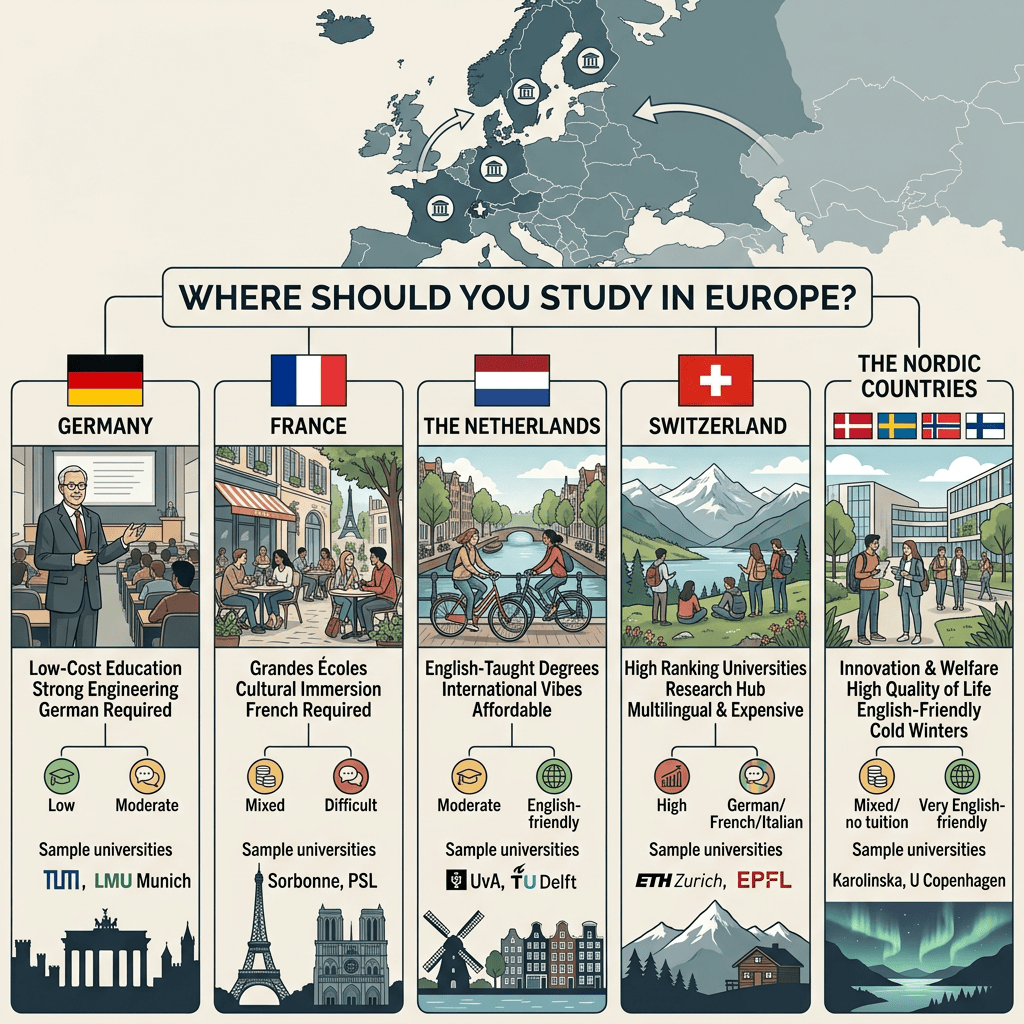
This guide compares six destinations to help you identify where to investigate further.
1. Germany: Strong research traditions and varied tuition arrangements
Germany has universities, universities of applied sciences and specialised institutions. It is particularly attractive to students interested in engineering, natural sciences, technology, business and research.
Many public universities charge relatively low tuition compared with some other destinations, but fees and semester contributions vary by state, institution and programme. Some programmes are taught in English, especially at postgraduate level, while German remains important across much of the system and for daily life.
Applications may be made directly to universities or through designated application services, depending on the qualification and institution.
Useful starting points:
- DAAD: https://www.daad.de/
- Study in Germany: https://www.study-in-germany.de/
2. France: Broad academic pathways and specialist institutions
France has universities, grandes écoles, specialised schools and research institutions. Its system offers a variety of academic and professional pathways.
Some programmes are taught in English, particularly at postgraduate level, but French-language ability can be important for many courses, internships and everyday activities.
Tuition arrangements depend on institution, programme and student status. Scholarships and research funding are available through universities, government schemes and external organisations.
Useful starting points:
- Campus France: https://www.campusfrance.org/
- French government information: https://www.service-public.fr/
3. The Netherlands: International programmes and structured degree pathways
The Netherlands is known for a substantial range of English-taught programmes, particularly at master’s level. Universities of research and universities of applied sciences serve different educational purposes.
Admission requirements depend on the programme and the applicant’s previous qualification. Some courses have selection procedures, subject prerequisites or limited places.
International students should examine tuition fees, housing availability and the cost of living carefully. Housing can be a significant practical challenge in some university cities.
Useful starting point: https://www.studyinnl.org/
4. Switzerland: Research-intensive universities and specialised institutions
Switzerland has internationally recognised universities and specialised higher education institutions. It is particularly prominent in areas such as science, engineering, finance, medicine and technology.
Admission requirements can be demanding and vary by institution and programme. Language requirements also differ: programmes may be taught in English, German, French or Italian.
Living costs can be high, so students should investigate accommodation, insurance, transport and funding before accepting an offer.
Useful starting point: https://www.studyinswitzerland.plus/
5. Sweden: Independent learning and research opportunities
Swedish universities offer bachelor’s, master’s and doctoral programmes, with many master’s courses available in English.
The academic environment often emphasises critical thinking, independent learning, collaboration and discussion. International applicants should check programme-specific requirements and the availability of scholarships.
Useful starting point: https://studyinsweden.se/
6. Finland: Research, innovation and student support
Finland offers universities and universities of applied sciences, with a variety of English-taught programmes.
The system includes research-oriented academic degrees and professionally oriented programmes. Students should examine tuition arrangements, scholarship conditions and language requirements.
Useful starting point: https://www.studyinfinland.fi/
7. Comparing admission processes
Across these countries, applicants may need:
- Recognised previous qualifications
- Academic transcripts
- Evidence of language proficiency
- A motivation letter or statement of purpose
- References
- A CV
- A research proposal for selected postgraduate programmes
Some countries and institutions use centralised application platforms, while others require direct applications. Always follow the instructions of the specific programme.
8. Tuition fees and scholarships
There is no simple rule that all European public universities are free or inexpensive for international students.
Fees depend on nationality, programme, institution and national policy. Scholarships may cover tuition, living expenses or only part of the cost.
Check whether an award is available to your nationality and degree level, whether it is renewable and whether it covers the full study period.
9. Language and everyday life
An English-taught degree does not necessarily mean that English will be sufficient for every aspect of life.
Local-language ability can improve access to internships, professional networks, part-time work and community activities. Students should consider the language environment of the city as well as the language of instruction.
10. Working during study and after graduation
Each country has its own rules for international students. Work rights may depend on residence status, study progress and other conditions.
Post-study residence arrangements also differ and may be updated. Consult official immigration authorities before assuming that a degree automatically provides a right to remain or work.
Useful government information:
- Germany: https://www.make-it-in-germany.com/
- France: https://www.service-public.fr/
- Netherlands: https://ind.nl/
- Switzerland: https://www.sem.admin.ch/
- Sweden: https://www.migrationsverket.se/
- Finland: https://migri.fi/
11. Which country is best for doctoral research?
For PhD applicants, the most important considerations are often the supervisor, research group, funding, facilities and employment conditions.
Some doctoral positions are advertised as salaried research jobs; others operate through scholarships or other funding arrangements. Read the terms carefully and compare the financial and employment implications.
12. How to make a practical comparison
Create a shortlist of actual programmes and compare:
- Academic fit and course content
- Admission requirements
- Language of instruction
- Tuition and funding
- Accommodation and living costs
- Research facilities and supervision
- Student support
- Work and residence conditions
Final thoughts
Germany, France, the Netherlands, Switzerland, Sweden and Finland all offer distinctive higher education opportunities. The best destination is the one that combines academic fit, realistic funding, suitable living conditions and a credible path towards your goals.
Stay connected with Scholars Careers
Subscribe to Scholars Careers for more international study guides, scholarship information and academic career advice.
Follow our updates and share this article with students considering European universities. Sharing reliable comparisons can help applicants make better-informed decisions.
Disclaimer: This article provides general educational information and is not legal, financial, admissions or immigration advice. Tuition arrangements, admission requirements, scholarships, work permissions and residence rules vary and can change. Confirm details with the university and relevant official authorities before applying or making financial commitments. Admission, funding, employment and immigration outcomes are not guaranteed. Scholars Careers is independent and is not affiliated with the institutions or governments mentioned.


