A postdoctoral fellowship at a leading university or research institute can be an important step towards an independent academic career. It offers opportunities to deepen your expertise, develop new collaborations, publish research and build the experience needed for future academic or industry positions.
However, securing a postdoctoral fellowship at institutions such as Oxford, Cambridge, Harvard, MIT, Stanford, ETH Zurich or other internationally recognised research centres is highly competitive. Strong candidates need more than an impressive academic record: they must demonstrate research potential, independence, institutional fit and a convincing plan for their next career stage.
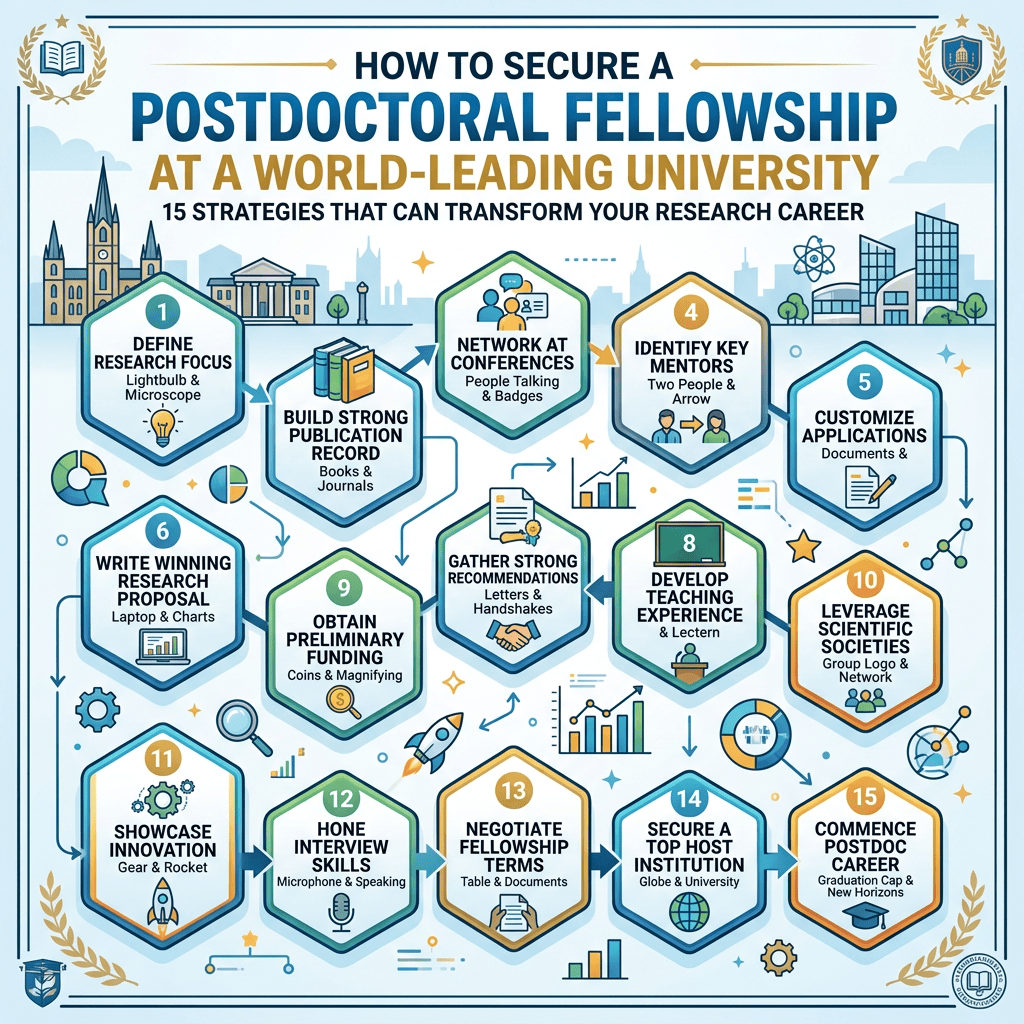
Here are 15 practical strategies to strengthen your application.
1. Develop a clear research identity
Before applying, identify the research questions, methods and subject areas that define your academic interests. A clear research identity helps selection panels understand what you contribute and how your work could develop.
Avoid presenting yourself as someone who is interested in everything. Instead, explain the themes connecting your previous research and future plans.
2. Identify institutions that genuinely fit your research
Do not select universities based on reputation alone. Look for departments, centres and research groups with expertise, facilities, datasets or collaborations relevant to your proposed work.
Explore institutional research pages, recent publications and funded projects to understand where your research could make a meaningful contribution.
3. Find potential supervisors and mentors
A suitable host researcher can provide intellectual guidance, access to facilities and an environment in which your project can develop.
Read recent papers by potential supervisors. Consider whether their research complements yours and whether the group has the capacity to host another researcher.
4. Build a strong publication record
Publications can demonstrate your ability to complete research and communicate findings. Focus on producing rigorous, relevant work rather than pursuing publication numbers at any cost.
Explain your individual contribution to collaborative publications, particularly where your role may not be obvious from the author list.
5. Demonstrate research independence
A postdoctoral researcher is generally expected to contribute ideas, not simply carry out instructions. Show how you have developed research questions, selected methods, solved problems or initiated collaborations.
Your application should make clear what you can bring to the host institution.
6. Prepare a focused research proposal
A strong proposal identifies an important problem, explains what is not yet known and presents a realistic plan for addressing it.
Include research questions, objectives, methods, expected outputs, a timetable and potential limitations. Make sure the project can be completed within the fellowship period.
7. Explain why the host institution is essential
Your proposal should explain why the selected institution is particularly suitable. Identify relevant expertise, facilities, research networks or training opportunities.
Avoid generic statements such as “this is a world-class university.” Explain the specific academic reasons behind your choice.
8. Search widely for fellowship opportunities
Explore university-funded positions, national research councils, international mobility schemes and independent fellowships.
Examples include:
- Marie Skłodowska-Curie Postdoctoral Fellowships: https://marie-sklodowska-curie-actions.ec.europa.eu/
- Alexander von Humboldt Foundation: https://www.humboldt-foundation.de/
- Fulbright Program: https://fulbrightprogram.org/
- UK Research and Innovation: https://www.ukri.org/
- European Research Council: https://erc.europa.eu/
Eligibility, host requirements and deadlines differ between programmes. Always read the current call documents.
9. Tailor your academic CV
Your CV should make your research strengths easy to identify. Include education, research experience, publications, grants, awards, teaching, supervision, technical skills and relevant service.
Prioritise achievements relevant to the fellowship rather than listing every activity without context.
10. Secure strong references
Choose referees who can discuss your research ability, independence, reliability and potential. Give them sufficient notice and provide the fellowship description, your CV and a summary of your proposed project.
A detailed, relevant reference is generally more useful than a prestigious name who knows little about your work.
11. Demonstrate collaboration and leadership
Evidence may include coordinating a research task, mentoring students, contributing to a multidisciplinary project, organising a seminar or developing an external partnership.
Describe what you actually did and what resulted from your contribution.
12. Show the wider value of your research
Explain how your work could contribute to your discipline, society, policy, technology or professional practice. Avoid exaggerated claims. Make the potential benefits credible and proportionate to the project.
13. Prepare for interviews
Be ready to explain your research in accessible language, justify your methods and discuss challenges. You may be asked why you chose the institution, what you would do if the project encountered difficulties and how the fellowship fits your longer-term goals.
Practise concise answers without memorising a script.
14. Understand practical and ethical requirements
Check research ethics, data protection, intellectual property, laboratory safety and any permissions required for your project. If the fellowship involves international relocation, investigate visa, employment and funding conditions through official sources.
15. Learn from unsuccessful applications
A rejection does not necessarily mean your research is weak. Fellowships may receive many strong applications and have limited funding.
Where feedback is available, use it to improve the proposal, clarify institutional fit and strengthen your evidence of independence. Keep a record of deadlines and plan future applications strategically.
Final thoughts
Securing a postdoctoral fellowship requires a combination of research quality, strategic planning and a clear academic identity. Start early, select opportunities carefully and make every part of your application explain why you are a strong match for the project and host institution.
Stay connected with Scholars Careers
If you found this guide useful, subscribe to Scholars Careers for more practical guidance on academic careers, international fellowships, research funding and higher education opportunities.
Follow Scholars Careers and share this article with doctoral researchers, recent PhD graduates and colleagues who may be preparing postdoctoral applications. Your share could help another researcher discover an opportunity or improve an application.
Disclaimer: This article is intended for general educational and informational purposes. Fellowship programmes, eligibility requirements, application procedures and deadlines can change. Always consult the official fellowship provider and host institution before applying. The strategies discussed here do not guarantee selection or funding. Scholars Careers is an independent information platform and is not affiliated with or endorsed by the universities or funding organisations mentioned.


