Research grants can provide the financial resources needed to investigate important questions, develop new methods, employ research staff and establish international collaborations. However, securing funding in countries such as the United States, United Kingdom, Canada, Germany, France and Australia is highly competitive. Funding organisations receive applications from researchers with strong academic records and promising ideas.
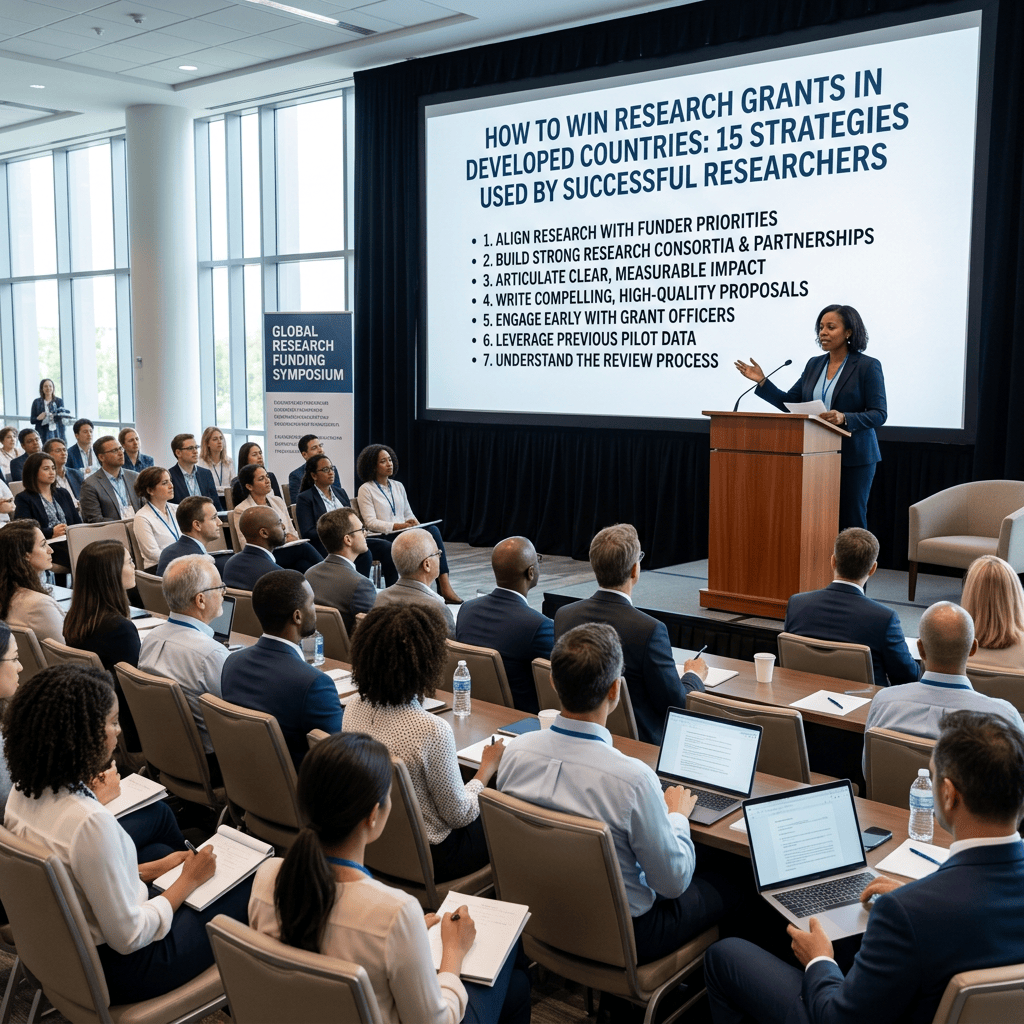
A successful grant proposal must do more than describe an interesting topic. It needs to demonstrate a significant research problem, a credible methodology, a capable team, realistic costs and a strong match with the funder’s priorities.
Here are 15 strategies to help you develop a competitive application.
1. Identify the right funding organisation
Start by identifying organisations that support research in your discipline and career stage.
Examples include:
- United States: National Science Foundation (NSF), National Institutes of Health (NIH) and other federal agencies.
- United Kingdom: UK Research and Innovation (UKRI), research councils and charitable funders.
- Canada: Natural Sciences and Engineering Research Council (NSERC), Social Sciences and Humanities Research Council (SSHRC) and Canadian Institutes of Health Research (CIHR).
- Germany: German Research Foundation (DFG) and other national research organisations.
- France: National Research Agency (ANR).
- Australia: Australian Research Council (ARC) and National Health and Medical Research Council (NHMRC).
- European research: European Commission funding programmes, including Horizon Europe.
Official websites:
- https://www.nsf.gov/
- https://www.nih.gov/
- https://www.ukri.org/
- https://www.nserc-crsng.gc.ca/
- https://www.sshrc-crsh.gc.ca/
- https://www.dfg.de/
- https://anr.fr/
- https://www.arc.gov.au/
- https://www.nhmrc.gov.au/
- https://research-and-innovation.ec.europa.eu/
Funding priorities and eligibility differ between programmes. Always check the current call.
2. Match your project to the funding call
A strong proposal submitted to an unsuitable scheme may have little chance of success.
Read the funder’s objectives, assessment criteria, eligible disciplines, budget limits and applicant requirements. Identify exactly how your project addresses the call.
3. Define a significant research problem
Explain what problem your research will address and why it matters.
Avoid presenting a topic as important simply because it is interesting to you. Support your case with evidence from the literature, relevant data or a clearly explained practical need.
4. Formulate clear research questions
Your research questions should be focused, answerable and aligned with the project’s objectives.
A proposal becomes difficult to assess when it attempts to address too many unrelated questions. Define what the project will and will not investigate.
5. Demonstrate originality
Funders need to understand what your project adds to existing knowledge.
Originality may come from a new theoretical perspective, an innovative method, a different dataset, an unexplored population or a new application of existing knowledge.
Explain the contribution precisely and avoid overstating novelty.
6. Develop a rigorous methodology
Describe how you will achieve the objectives. Explain your research design, data sources, sampling strategy, analytical methods and quality-control procedures.
Address potential limitations and explain how you will manage them.
7. Build the right research team
The team should have the expertise needed to deliver the project. Explain the responsibilities of each investigator and collaborator.
Where relevant, include interdisciplinary expertise, technical support, community partners or international collaborators.
8. Prepare a realistic budget
Every budget item should have a clear connection to the research plan.
Depending on the scheme, eligible costs may include staff, equipment, travel, fieldwork, data access, consumables and institutional costs.
Follow the funder’s budget rules. Do not assume that a cost is eligible simply because it is useful to your research.
9. Create a credible project timeline
Break the project into work packages, milestones and deliverables. Show that the research can be completed within the proposed period.
Include time for recruitment, approvals, data collection, analysis, dissemination and project management where relevant.
10. Demonstrate the team’s capacity
Explain why the investigators and institution can deliver the proposed work.
Relevant evidence may include publications, previous projects, technical expertise, facilities, partnerships and experience managing research activities.
11. Explain the potential impact
Describe the likely contribution to academic knowledge and any realistic wider benefits.
Depending on the discipline, these may include policy development, improved services, technological innovation, environmental benefits or public engagement.
Distinguish between outputs you can deliver and longer-term impacts that depend on external factors.
12. Address research ethics and data management
Explain how the project will handle consent, confidentiality, data protection, research integrity and any required approvals.
Include a data management plan if required by the funder. Identify risks and explain how sensitive information will be protected.
13. Follow the assessment criteria
Structure your proposal so reviewers can easily identify the evidence they need.
If the call assesses significance, originality, feasibility, team capability and impact, address each criterion explicitly. Do not assume that reviewers will infer important information from a general description.
14. Obtain feedback before submission
Ask experienced researchers or research development staff to review your application.
A reviewer outside your immediate specialism may identify unclear explanations, while a subject expert can assess the technical strength of the proposal.
Leave enough time to incorporate feedback and complete institutional approvals.
15. Learn from unsuccessful applications
Funding decisions are competitive, and a strong proposal may still be unsuccessful.
If feedback is available, examine it carefully. You may need to strengthen the research design, clarify the impact, improve the budget or select a more appropriate funding scheme.
Common grant-writing mistakes to avoid
- Submitting a generic proposal that does not address the call.
- Describing an important topic without a focused research question.
- Overloading the project with too many objectives.
- Using methods that do not answer the research questions.
- Underestimating costs or project duration.
- Failing to explain the team’s responsibilities.
- Making exaggerated impact claims.
- Ignoring eligibility and submission instructions.
- Leaving institutional approvals until the last minute.
Final thoughts
Winning research grants requires preparation, strategic funding searches and a well-developed proposal. Researchers should begin early, build suitable collaborations and ensure that their project is both ambitious and feasible.
Stay connected with Scholars Careers
Subscribe to Scholars Careers for more guidance on research funding, grant writing, academic careers, international fellowships and research development.
Follow our updates and share this article with researchers, lecturers, doctoral candidates and early-career academics who may be preparing funding applications.
Disclaimer: This article provides general educational information and does not guarantee grant eligibility, funding or award success. Funding calls, deadlines, budgets, institutional requirements and assessment criteria change. Applicants must consult the current official guidance from the relevant funder and their institution. Scholars Careers is an independent information platform and is not affiliated with or endorsed by the funding organisations mentioned.


