The United States and Canada are among the most popular destinations for international students. Both offer internationally recognised universities, research opportunities and diverse student communities. However, their higher education systems differ in admissions, tuition, funding, academic structures and post-study opportunities.
So, which country should you choose?
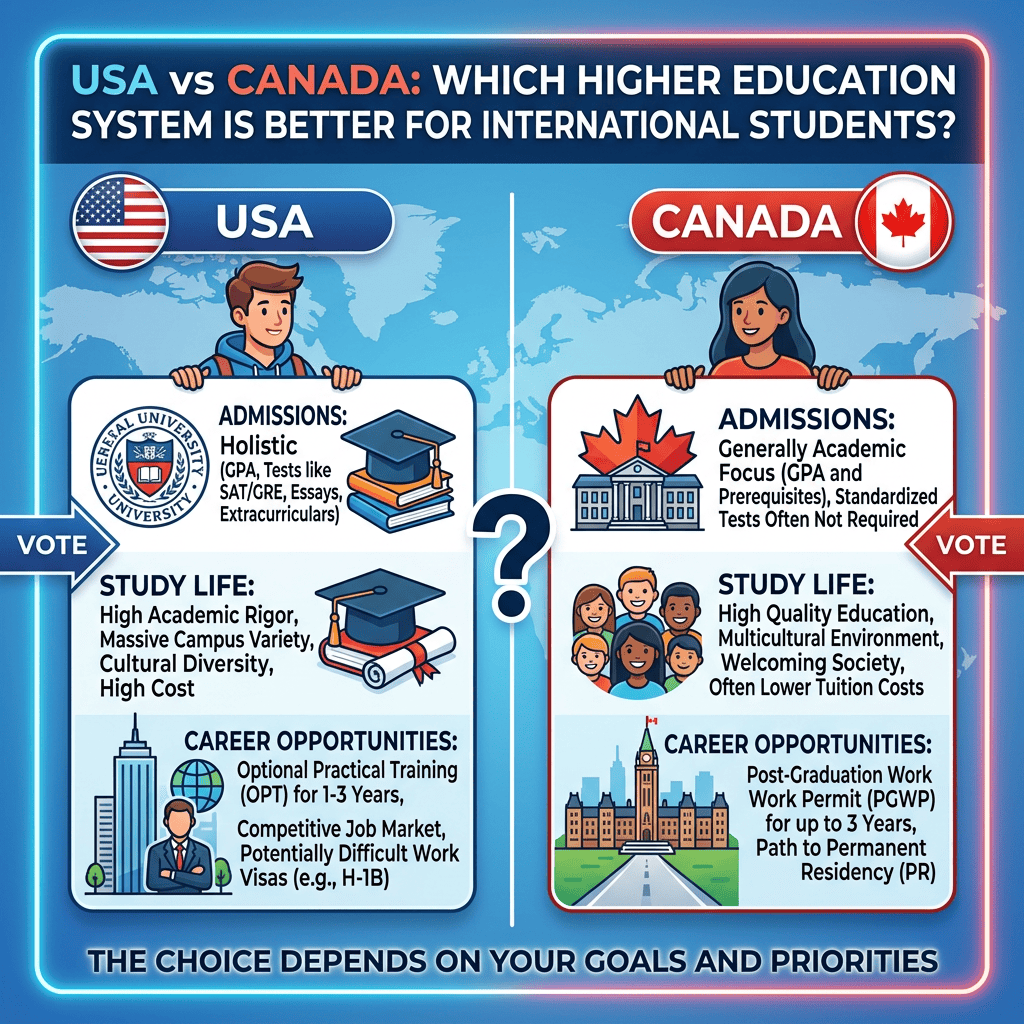
The answer depends on your academic goals, financial circumstances, preferred learning environment and longer-term plans.
1. Understanding the university systems
The United States has a large and diverse higher education sector, including public universities, private universities, liberal arts colleges and specialised institutions. Students can choose from a wide range of undergraduate and postgraduate programmes.
Canada also has public and private institutions, although publicly funded universities and colleges play a central role. Canadian universities offer bachelor’s, master’s and doctoral programmes, while colleges often provide applied, technical and career-focused education.
Both countries have research-intensive universities and institutions with strong international reputations.
2. University admission in the United States
Undergraduate applicants may be assessed on academic results, personal statements, recommendations, extracurricular activities and, where required or considered, standardised tests.
Requirements vary considerably. Some universities use holistic admissions, while others place greater emphasis on academic qualifications and programme-specific criteria.
Graduate applicants commonly submit:
- Academic transcripts
- A statement of purpose
- Recommendation letters
- A CV or résumé
- Evidence of English proficiency, where required
- Writing samples, portfolios or test scores, depending on the programme
Doctoral applicants should investigate whether prospective supervisors, research groups and funding opportunities align with their interests.
Official starting point: https://educationusa.state.gov/
3. University admission in Canada
Canadian universities generally assess academic qualifications, programme prerequisites and evidence of language proficiency. Graduate applications may also require a research proposal, statement of intent, references and a CV.
Some research-based master’s and PhD programmes expect applicants to identify a potential supervisor. Others admit students through a departmental process.
Check each university’s official admissions page because requirements differ by institution, province and discipline.
Official starting point: https://www.educanada.ca/
4. Tuition fees and funding
The United States has substantial variation in tuition fees. Private universities can be expensive, while public universities may have different rates for domestic and international students.
Funding may include institutional scholarships, assistantships, fellowships, grants and external awards. Doctoral programmes in some fields provide substantial funding packages, but this should never be assumed.
Canadian international tuition also varies by university, programme and province. Funding options include entrance awards, research assistantships, teaching assistantships and external scholarships.
Compare the full cost of attendance, including tuition, accommodation, insurance, transport and living expenses.
5. The student experience
Both countries offer multicultural campuses, student societies, research opportunities and extensive academic support.
US universities may provide a broad undergraduate curriculum, particularly in the early years of a bachelor’s degree. Canadian programmes can be more specialised from the outset, although structures vary.
In either country, students should make use of academic advising, libraries, careers services, writing centres and research training.
6. Working while studying
International students may have permission to work under specific conditions. In the US, F-1 students may qualify for certain forms of on-campus employment and authorised practical training, subject to immigration rules.
In Canada, eligible study permit holders may work under the conditions set by the federal government. Limits and eligibility requirements can change.
Never rely on informal advice or outdated online posts. Check official immigration guidance before accepting employment.
US information: https://www.uscis.gov/
Canadian information: https://www.canada.ca/en/immigration-refugees-citizenship.html
7. Post-study opportunities in the United States
Some eligible graduates may qualify for Optional Practical Training (OPT). Certain STEM graduates may be eligible for an additional extension if they meet the applicable requirements.
OPT is not permanent residence and does not guarantee long-term employment or a future immigration status. Students should consult their university’s international student office and official US immigration guidance.
8. Post-study opportunities in Canada
Eligible graduates of qualifying Canadian institutions and programmes may be able to apply for a Post-Graduation Work Permit (PGWP), subject to current rules.
Eligibility can depend on the institution, programme, study history and other requirements. A PGWP does not guarantee employment or permanent residence.
Official information: https://www.canada.ca/en/immigration-refugees-citizenship/services/study-canada/work/after-graduation.html
9. Which country is more affordable?
There is no universal answer. Costs depend on the university, city, programme, funding package and lifestyle.
Compare actual offers rather than relying on national averages. A funded doctoral offer in one country may be more financially attractive than an unfunded offer elsewhere.
10. Which country should you choose?
Consider the following:
- Research fit: Which university has the strongest group in your subject?
- Funding: Which offer provides reliable support for the full study period?
- Programme structure: Do you prefer a broad or specialised curriculum?
- Career plans: Where are relevant employers and professional networks?
- Immigration rules: What are the current lawful options after graduation?
- Personal circumstances: Which location best fits your budget and support needs?
Final thoughts
The United States and Canada both offer excellent opportunities, but neither is automatically better for every student. The strongest choice is the institution and programme that fit your academic interests, finances and career plans.
Stay connected with Scholars Careers
Subscribe to Scholars Careers for more practical guides to international university admissions, scholarships, student life and academic careers.
Follow our updates and share this article with students comparing study destinations. It may help someone make a more informed decision before applying.
Disclaimer: This article is for general educational purposes and is not an admissions, financial, legal or immigration guarantee. University requirements, tuition fees, scholarships, work permissions and immigration programmes can change. Confirm all details directly with the institution and relevant government authorities before making decisions. Scholars Careers is an independent information platform and is not affiliated with the universities or governments mentioned.


