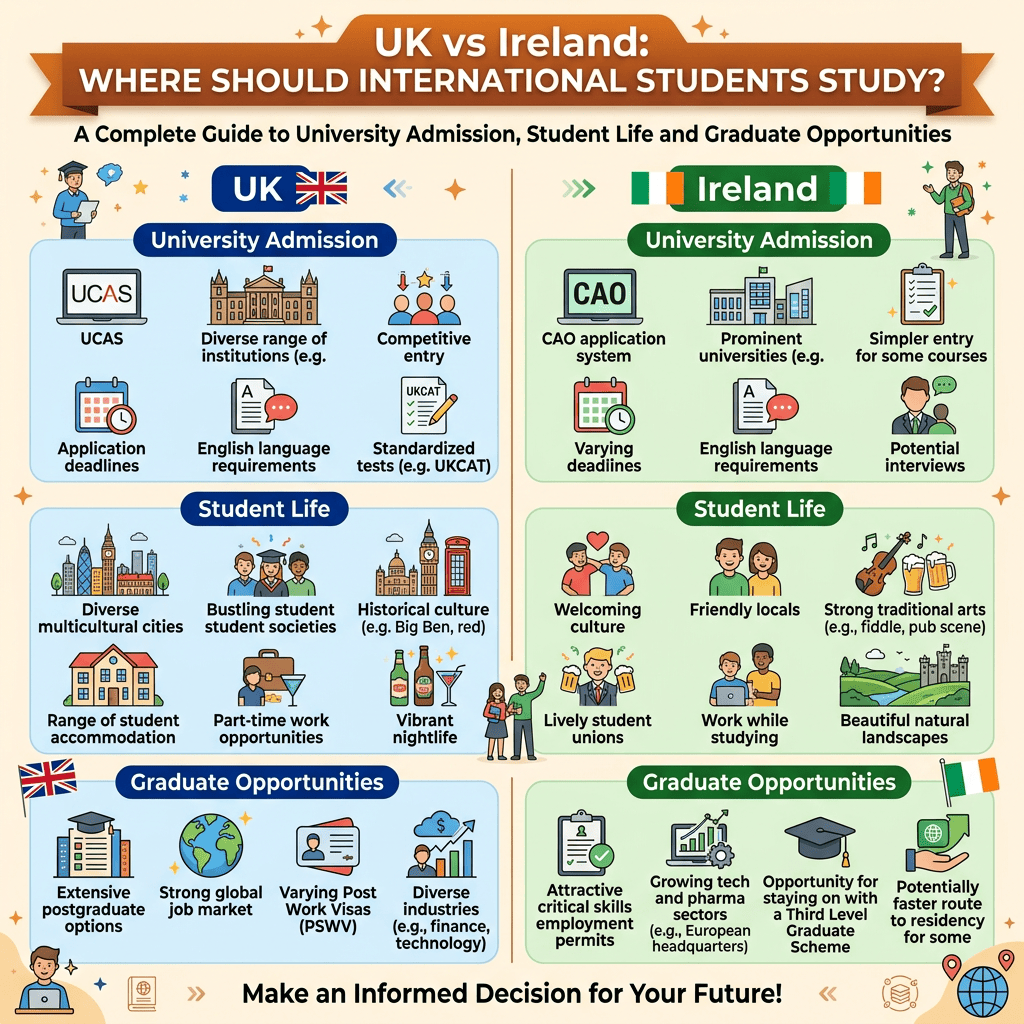
The United Kingdom and Ireland attract international students with established universities, English-language programmes, internationally recognised qualifications and connections to global employers.Although the two destinations share some educational traditions, their university systems, application processes, costs and post-study arrangements are different.
This guide compares the UK and Ireland to help prospective students make a more informed choice.
1. Understanding higher education in the UK
The UK includes England, Scotland, Wales and Northern Ireland. Its higher education system offers bachelor’s degrees, master’s degrees, doctoral programmes and professional qualifications.
Degree structures can differ across the four nations. For example, undergraduate degree length and programme organisation are not identical everywhere.
The UK is home to research-intensive universities, specialist institutions and universities with strong professional and vocational programmes.
2. Understanding higher education in Ireland
Ireland has universities, technological universities and other higher education institutions. It offers undergraduate, taught postgraduate and research postgraduate programmes.
Many programmes are delivered in English, and Irish institutions have research and industry links in areas such as technology, pharmaceuticals, business, health and the humanities.
The best institution depends on the subject, course structure, research environment and available support.
3. Applying to universities in the UK
Many undergraduate applications are made through UCAS, although some courses and institutions have alternative arrangements.
Applicants commonly need academic qualifications, a personal statement or equivalent application responses, references and evidence of English proficiency where required.
Postgraduate applicants generally apply directly to universities. Requirements may include transcripts, a statement of purpose, references, a CV, a portfolio or a research proposal.
Official application information: https://www.ucas.com/
4. Applying to universities in Ireland
Undergraduate applications by many applicants are processed through the Central Applications Office (CAO). Some international and postgraduate applications may be handled directly by institutions.
Graduate applications often require academic transcripts, references, a personal statement and programme-specific documents.
Official starting points:
- CAO: https://www.cao.ie/
- Education in Ireland: https://www.educationinireland.com/
5. Tuition fees and scholarships
Tuition fees differ by institution, programme, student status and academic year.
In the UK, international fees can vary substantially between universities and disciplines. Scholarships may be offered by universities, charitable organisations and external funding bodies.
In Ireland, fees also vary, and funding may include university awards, research studentships and government-supported schemes.
Do not assume that a scholarship covers all living expenses. Read the award conditions carefully and prepare a realistic budget.
6. Academic and student life
UK universities often offer extensive student societies, academic support, career services and research facilities. Ireland also has active campus communities and opportunities for academic and professional networking.
Both countries provide opportunities to participate in research, volunteering, internships and student organisations, subject to programme and immigration conditions.
7. Working during study
International students may be permitted to work under specific immigration conditions. The permitted hours and eligibility requirements depend on the type of permission held and current rules.
Students should check official guidance before taking employment.
UK immigration information: https://www.gov.uk/student-visa
Irish immigration information: https://www.irishimmigration.ie/
8. Post-study options in the UK
Eligible graduates may be able to apply under the UK’s Graduate route, subject to the rules in force at the time of application. The route has specific eligibility conditions and does not itself guarantee employment or settlement.
Because immigration policy can change, students should check the official government page rather than relying on old descriptions of visa duration or eligibility.
Official information: https://www.gov.uk/graduate-visa
9. Post-study options in Ireland
Eligible graduates may qualify for Ireland’s Third Level Graduate Programme, which can provide permission to remain for a specified period to seek graduate-level employment or pursue other permitted activities.
The conditions depend on the qualification and current immigration rules. Students should verify their eligibility and the applicable permission before making plans.
Official information: https://www.irishimmigration.ie/
10. Comparing career opportunities
Both countries have employers in finance, technology, healthcare, education, engineering, research and professional services.
The availability of opportunities depends on the student’s field, qualifications, language skills, work experience and eligibility to work.
Research local labour markets and professional accreditation requirements before choosing a programme.
11. Which country offers better value?
The answer depends on the complete financial package. Compare tuition, rent, transport, health-related costs, scholarships and likely living expenses.
A lower tuition fee does not always mean a lower total cost if accommodation and other expenses are higher.
12. How to make your decision
Before applying, ask yourself:
- Does the programme match my academic and career goals?
- Does the university have the expertise or facilities I need?
- Can I afford the full programme?
- Are scholarships or research funding available?
- What are the current rules for working during and after study?
- Does the location offer relevant professional opportunities?
Final thoughts
The UK and Ireland both provide strong higher education opportunities. The best choice is not determined by reputation alone. Compare specific programmes, funding, student support and realistic career pathways before deciding.
Stay connected with Scholars Careers
Subscribe to Scholars Careers for more guides on studying abroad, university admissions, scholarships and international academic careers.
Follow our updates and share this article with prospective students who are considering the UK or Ireland. A well-informed comparison can help applicants avoid costly assumptions.
Disclaimer: This article provides general educational information, not legal, immigration or admissions advice. University requirements, fees, scholarships, work conditions and graduate immigration routes may change. Confirm current details with the relevant university and official government authorities. Admission, employment or immigration outcomes are not guaranteed. Scholars Careers is independent and is not affiliated with the institutions or governments mentioned.