The United States, Canada and the United Kingdom are three of the world’s most popular destinations for international students. Each offers internationally recognised univjersities, English-language programmes, research opportunities and access to diverse academic and professional networks. However, choosing between them is not always easy. The three countries have different university structures, admission processes, tuition fees, scholarship opportunities, student experiences and immigration arrangements after graduation.
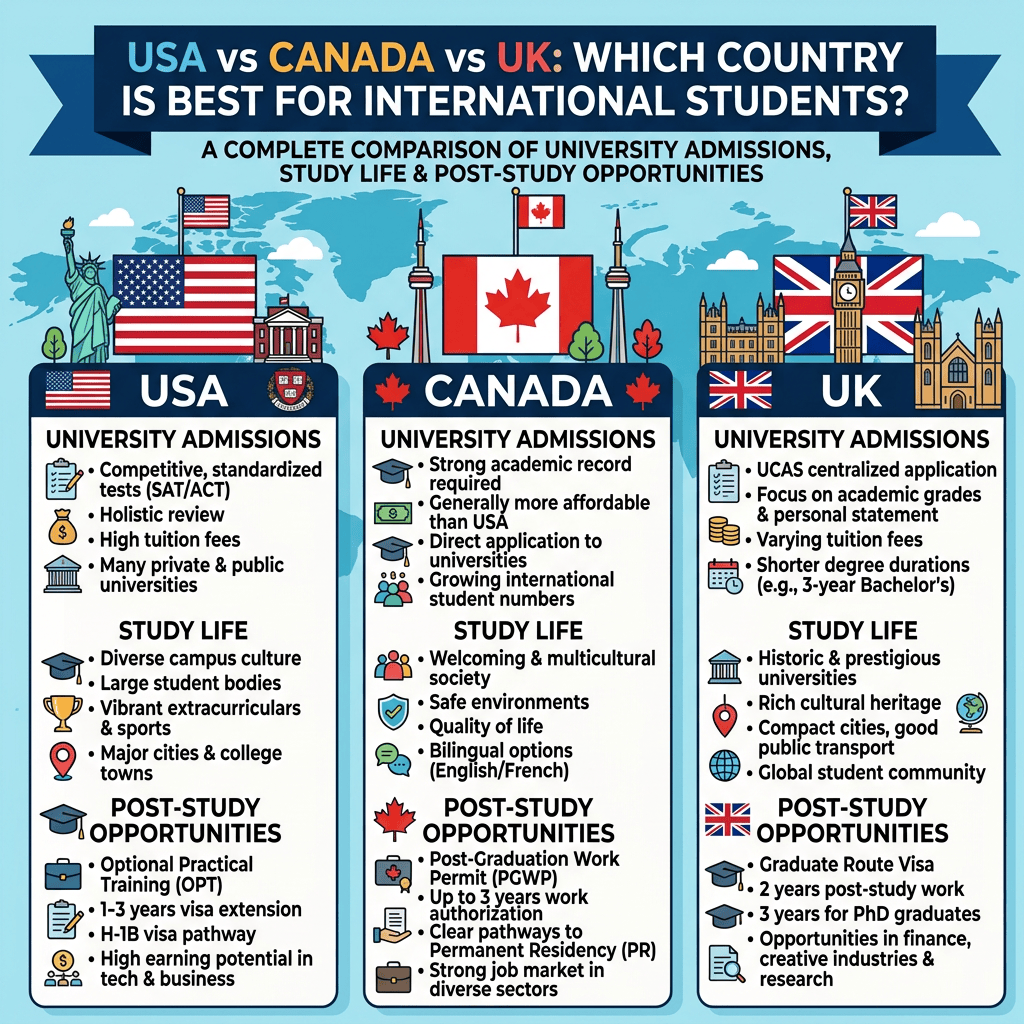
For some students, the United States offers the greatest variety of universities and research opportunities. Canada may appeal to those seeking a combination of academic study and eligible post-graduation work opportunities. The UK attracts students interested in established universities and relatively compact degree programmes.
But which country is actually better?
This guide compares the USA, Canada and the UK across the most important stages of the international student journey: securing admission, studying, managing costs, gaining work experience and planning for life after graduation.
1. Understanding the higher education systems
Before choosing a destination, it is important to understand how its higher education system operates.
United States
The United States has one of the world’s largest and most diverse higher education systems. It includes:
- Public universities
- Private universities
- Liberal arts colleges
- Community colleges
- Research-intensive institutions
- Specialised professional schools
Undergraduate programmes commonly take four years, although duration varies. Master’s degrees often take one or two years, depending on the discipline and programme. Doctoral programmes can take several years and may include coursework, examinations, research and a dissertation.
One distinctive feature of the American undergraduate system is that some students complete general education courses before concentrating fully on their major subject.
Graduate education can be highly research-intensive, particularly in science, engineering, medicine, social sciences and humanities.
Canada
Canada has universities, colleges and polytechnic institutions. Universities generally provide bachelor’s, master’s and doctoral degrees, while colleges and polytechnics often focus on applied, technical and professional education.
Bachelor’s degrees commonly take three or four years, depending on the province and programme. Master’s degrees often take one or two years, while doctoral programmes vary by discipline and research requirements.
Canadian universities have strong research environments in areas such as artificial intelligence, engineering, medicine, environmental science, agriculture and social sciences.
United Kingdom
The UK higher education system includes universities and specialist higher education institutions across England, Scotland, Wales and Northern Ireland.
Bachelor’s degrees in England, Wales and Northern Ireland commonly take three years, while many Scottish undergraduate honours degrees take four years. Some professional and integrated master’s programmes take longer.
Taught master’s degrees are commonly one year full-time, although some programmes take longer. Doctoral programmes typically involve several years of independent research and thesis preparation.
The UK system is often more specialised from the beginning of a degree than the broad undergraduate structure found at many American universities.
2. How to secure university admission in the United States
Admission to American universities can be competitive, particularly at highly selective institutions. However, the country has a large number of universities with different entry requirements and academic profiles.
Undergraduate admission
International undergraduate applicants may be assessed on:
- Secondary school qualifications
- Academic transcripts
- Personal statements or application essays
- Recommendation letters
- Extracurricular activities
- English-language proficiency, where required
- Standardised test scores, where required by the institution
Some universities use holistic admissions, considering academic performance alongside personal achievements, leadership, interests and other evidence of potential.
Testing policies differ between institutions and can change, so applicants should check the current requirements of each university.
Master’s and PhD admission
Graduate applications commonly require:
- Bachelor’s or master’s degree certificates
- Academic transcripts
- Statement of purpose
- Academic references
- CV or résumé
- English-language test results, where required
- Research proposal for relevant programmes
- Writing samples, portfolios or additional tests where applicable
PhD applicants should pay particular attention to research fit. Investigate faculty members, research groups, available funding and the department’s expectations before applying.
Some doctoral programmes provide funding through fellowships, research assistantships or teaching assistantships, but funding is not guaranteed for every student or programme.
Useful official resource: https://educationusa.state.gov/
3. How to secure university admission in Canada
Canadian universities generally assess academic qualifications, programme prerequisites and English-language proficiency where required.
Undergraduate admission
Applicants may need:
- Recognised secondary school qualifications
- Academic transcripts
- Evidence of subject prerequisites
- English-language proficiency results, where required
- Personal statements or supplementary application materials for selected programmes
Admission requirements vary by province, institution and academic programme.
Master’s and PhD admission
Graduate applicants may be required to submit:
- Previous university qualifications
- Academic transcripts
- CV
- Statement of intent
- Recommendation letters
- Research proposal, where applicable
- English-language test results, where required
For research-based master’s and PhD programmes, identifying a suitable supervisor can be important. Some departments expect applicants to contact potential supervisors before applying, while others use a central admissions process.
Applicants should investigate whether the programme offers funding, research assistantships or teaching assistantships.
Useful official resource: https://www.educanada.ca/
4. How to secure university admission in the UK
The UK has a relatively structured undergraduate application system.
Undergraduate admission
Many undergraduate applicants apply through the Universities and Colleges Admissions Service (UCAS).
Applications may require:
- Recognised secondary school qualifications
- Academic grades
- Personal statement or application responses under the applicable UCAS process
- Academic reference
- English-language evidence, where required
- Additional assessments for selected programmes
Some courses, particularly in medicine and certain competitive subjects, have additional admissions tests or interviews.
Official application resource: https://www.ucas.com/
Master’s and PhD admission
Many postgraduate applications are submitted directly to universities.
Applicants commonly provide:
- Degree certificates and transcripts
- CV
- Personal statement or statement of purpose
- Academic references
- English-language test results, where required
- Research proposal for research degrees
For PhD applications, identifying an appropriate supervisor and demonstrating a strong research fit can be especially important.
Applicants should also check whether the department has funded studentships or whether they must secure external funding.
5. Tuition fees and the cost of studying
The financial cost of studying abroad is one of the most important factors in choosing a destination.
There is no universal answer to which country is cheapest. Tuition and living costs vary considerably by institution, location, qualification and subject.
United States
The US has substantial variation in university fees. Private universities can charge high tuition, while public universities often have different fee arrangements for domestic and international students.
The total cost may include:
- Tuition
- Accommodation
- Health insurance
- Food
- Transport
- Books and learning materials
- University fees
Some universities offer substantial financial support, but international student eligibility varies. Graduate funding may be available through assistantships, fellowships and research grants.
Canada
Canadian international tuition varies by institution, programme and province. Living costs also differ significantly between major cities and smaller university towns.
Students should budget for tuition, housing, food, transport, health-related costs and other expenses.
Scholarships, entrance awards, research assistantships and teaching assistantships may be available, particularly at postgraduate level.
United Kingdom
International tuition fees vary by university, programme and qualification. Some courses, especially laboratory-based or clinical programmes, may be more expensive than others.
Students should also consider accommodation, transport, food, course materials and the Immigration Health Surcharge where applicable.
Scholarship opportunities include university awards, external funding and selected government-supported schemes.
Which country offers the best financial value?
Compare actual university offers rather than national averages.
A programme with higher tuition may provide a more generous scholarship or better research funding. Similarly, a university in a lower-cost city may offer better overall value than one in an expensive metropolitan area.
The most important figure is the total cost after confirmed funding—not simply the advertised tuition fee.
6. Scholarships and funding opportunities
All three countries offer funding opportunities, but eligibility depends on the scholarship, nationality, academic level and field of study.
Funding opportunities in the United States
International students can investigate:
- University scholarships
- Graduate assistantships
- Research fellowships
- Departmental funding
- External foundations
- Discipline-specific awards
Useful starting points include university financial aid and graduate funding pages.
Funding opportunities in Canada
Students can explore:
- University entrance scholarships
- Graduate research awards
- Teaching and research assistantships
- Departmental funding
- External research scholarships
Funding availability differs by institution and programme. Ask departments whether funding is guaranteed, competitive or dependent on annual renewal.
Funding opportunities in the UK
Potential sources include:
- University scholarships
- Research council-funded studentships
- Chevening Scholarships
- Commonwealth Scholarships
- GREAT Scholarships
- External charitable and subject-specific awards
Official starting points:
- Chevening: https://www.chevening.org/
- Commonwealth Scholarships: https://cscuk.fcdo.gov.uk/
- GREAT Scholarships: https://study-uk.britishcouncil.org/
Always check the current scholarship conditions. Some awards cover tuition only, while others may include living expenses, travel or additional support.
7. What is student life like in the USA, Canada and UK?
The student experience goes beyond lectures and examinations. It includes accommodation, campus culture, social activities, academic support and opportunities to develop professional relationships.
Student life in the United States
Many American universities have extensive campus facilities, student societies, sports programmes, research centres and career services.
Some universities have residential campus environments, while others are integrated into large cities.
Students may have opportunities to join academic societies, volunteer organisations, cultural groups and professional networks.
Student life in Canada
Canadian universities are generally multicultural, with international student communities across major cities and smaller university towns.
Students can access clubs, sports, research activities, student services and career development programmes.
The climate varies considerably across the country, so prospective students should consider the weather and living conditions of their intended location.
Student life in the UK
UK universities offer a wide range of student societies, academic communities, sports clubs and professional development activities.
Many institutions have established student unions and support services. Students may also benefit from the UK’s geographic connections to other European destinations, although travel arrangements depend on immigration and border requirements.
The student experience varies between large city universities, campus-based institutions and smaller specialist universities.
8. Can international students work while studying?
Working during study can help eligible international students gain experience and manage some living expenses. However, immigration rules impose conditions.
Working while studying in the United States
Students in F-1 status may be eligible for certain forms of on-campus employment and authorised practical training, subject to applicable rules.
Off-campus employment is restricted and generally requires an appropriate authorisation or qualifying category.
Students should consult their institution’s international student office before accepting any employment.
Official information: https://www.uscis.gov/
Working while studying in Canada
Eligible international students may work under the conditions of their study permit and current Canadian immigration rules.
Eligibility, permitted hours and other requirements can change. Students should check the current government guidance before beginning employment.
Official information: https://www.canada.ca/en/immigration-refugees-citizenship/services/study-canada/work.html
Working while studying in the UK
Eligible students on a UK Student visa may be permitted to work during their studies, subject to restrictions based on the course, sponsor and immigration conditions.
Some students may have restrictions on working hours during term time. Self-employment and certain types of work are generally prohibited under the Student route.
Official information: https://www.gov.uk/student-visa
9. Post-study opportunities in the United States
One important consideration for international students is whether they may remain in the country after completing their studies.
In the United States, eligible F-1 graduates may apply for Optional Practical Training (OPT), which allows qualifying employment related to their field of study.
Post-completion OPT is generally available for up to 12 months. Eligible graduates with qualifying STEM degrees may be able to apply for a 24-month STEM OPT extension, subject to additional requirements.
Students should understand that OPT is temporary work authorisation, not permanent residence. Future immigration options depend on individual circumstances, employer sponsorship and applicable immigration rules.
Official information: https://www.uscis.gov/working-in-the-united-states/students-and-exchange-visitors/optional-practical-training-opt-for-f-1-students
10. Post-study opportunities in Canada
Canada offers the Post-Graduation Work Permit (PGWP) to eligible graduates of qualifying programmes at designated learning institutions.
However, graduating from a designated institution does not automatically make someone eligible. Programme eligibility, study history, language requirements and other conditions may apply.
Under current published rules, eligible master’s graduates may qualify for a three-year PGWP even where the master’s programme was shorter than two years, provided the applicable requirements are met. Other programmes have different duration rules.
A PGWP can provide an opportunity to gain Canadian work experience, but it does not guarantee employment or permanent residence.
Official information:
- PGWP overview: https://www.canada.ca/en/immigration-refugees-citizenship/services/study-canada/work/after-graduation.html
- PGWP eligibility and duration: https://www.canada.ca/en/immigration-refugees-citizenship/services/study-canada/work/after-graduation/about.html
11. Post-study opportunities in the United Kingdom
Eligible graduates may apply under the UK’s Graduate visa route after successfully completing an eligible course with an approved education provider.
Important timing distinction for applicants in 2026 and 2027:
- Applications made on or before 31 December 2026: the Graduate visa lasts two years for eligible bachelor’s and master’s graduates.
- Applications made on or after 1 January 2027: the period is 18 months for eligible bachelor’s and master’s graduates.
- Graduates with a PhD or another eligible doctoral qualification can receive a three-year Graduate visa.
The Graduate visa is not extendable. Graduates who wish to remain longer may need to qualify for another immigration route, such as the Skilled Worker route.
The route can provide time to seek employment, but it does not guarantee a job or long-term residence.
Official information: https://www.gov.uk/graduate-visa
12. Comparing the three countries side by side
| Feature | United States | Canada | United Kingdom |
|---|---|---|---|
| University system | Public and private universities, colleges and specialist institutions | Universities, colleges and polytechnics | Universities and specialist higher education institutions |
| Common bachelor’s duration | Often 4 years | Often 3–4 years | Often 3 years in England, Wales and Northern Ireland; commonly 4 in Scotland |
| Common master’s duration | Often 1–2 years | Often 1–2 years | Often 1 year |
| PhD structure | Often coursework and research | Research-focused, varies by programme | Commonly research-focused |
| Undergraduate applications | Institution-specific | Institution-specific or provincial pathways | Many applications through UCAS |
| Graduate applications | Usually university or department-based | Usually university or department-based | Usually direct to the university |
| Funding | Scholarships, assistantships and fellowships | Scholarships, assistantships and research awards | Scholarships, studentships and external awards |
| Student work | Restricted F-1 employment and authorised training | Subject to study permit conditions | Subject to Student visa conditions |
| Post-study route | OPT; STEM extension for eligible graduates | PGWP for eligible graduates | Graduate visa for eligible graduates |
| Main consideration | Large range of institutions and research opportunities | Programme eligibility and PGWP conditions | Degree structure and changing Graduate visa duration |
This table provides a broad overview, not a substitute for checking individual programme and immigration requirements.
13. Which country is better for master’s students?
For master’s applicants, the choice should depend on the subject, programme duration, funding and intended career direction.
The UK may appeal to students seeking a relatively short master’s programme, particularly in England, Wales and Northern Ireland.
Canada may appeal to students interested in eligible programmes that could support a PGWP application, provided they meet the current requirements.
The United States offers a wide variety of specialised master’s programmes and research opportunities, but applicants should investigate the total cost and available funding carefully.
14. Which country is better for PhD students?
For doctoral students, the supervisor and research environment are often more important than the country alone.
The United States has many research-intensive universities and doctoral programmes that combine coursework, examinations and research.
Canada offers research-focused doctoral programmes and funding opportunities through universities and external organisations.
The UK has a substantial doctoral research sector, with many programmes centred on independent research and thesis completion.
Before accepting a PhD offer, compare:
- Supervisor expertise and availability
- Research group reputation and working environment
- Funding duration and conditions
- Teaching obligations
- Laboratory, library or fieldwork facilities
- Publication and conference opportunities
- Thesis requirements and expected completion time
A fully funded PhD offer with strong supervision may be more valuable than an unfunded offer from a more famous institution.
15. Which country offers the best post-study experience?
The answer depends on your intended career and eligibility.
The United States offers OPT and, for eligible STEM graduates, a possible extension. Students should plan carefully for what happens after their authorised period.
Canada’s PGWP can provide eligible graduates with an opportunity to gain Canadian work experience, but programme eligibility and immigration rules must be checked before enrolling.
The UK’s Graduate visa offers eligible graduates a period to seek work or gain experience. Its duration changes from two years to 18 months for bachelor’s and master’s graduates applying from 1 January 2027, while eligible doctoral graduates receive three years.
Do not choose a university solely because of a post-study route. Immigration policy can change, and none of these routes guarantees employment or permanent residence.
16. How to choose between the USA, Canada and UK
Before making a decision, ask yourself the following questions:
- Which country has universities with the strongest expertise in my subject?
- Which programme best matches my academic and professional goals?
- Can I afford the tuition and living costs?
- Are scholarships or funded research opportunities available?
- What are the actual admission requirements?
- What work permissions apply during my studies?
- What post-study immigration routes could I qualify for under current rules?
- Which academic and social environment would suit me best?
- Does the country offer relevant employers or research organisations in my field?
- What is my alternative plan if I do not secure a scholarship, job or post-study permission?
Compare actual offers and official requirements rather than relying on general impressions.
Final Thought
There is no single winner for every international student.
- Choose the United States if you want to explore a very large university system, a broad range of research opportunities and diverse academic pathways.
- Consider Canada if you find a suitable university and programme, have a realistic funding plan and understand the current PGWP eligibility rules.
- Consider the United Kingdom if you prefer its degree structures, shorter master’s options in many institutions and established university networks.
Ultimately, the best country is the one that offers the right academic programme, affordable funding, suitable supervision and realistic career opportunities.
A carefully selected university in any of these three countries can provide an excellent educational experience.
Stay connected with Scholars Careers
If you found this comparison useful, subscribe to Scholars Careers for more practical guidance on international university admissions, scholarships, PhD opportunities, research funding and academic careers.
Follow Scholars Careers and share this article with friends, colleagues, prospective students and researchers who are comparing the United States, Canada and the United Kingdom.
Your share could help another student make a better-informed decision about studying abroad.
Disclaimer: This article is intended for general educational and informational purposes only. It does not constitute admissions, financial, legal or immigration advice. University entry requirements, tuition fees, scholarships, student work permissions and post-study immigration rules can change. Immigration information reflects published guidance available at the time of writing and should be checked again before making decisions or submitting applications. Admission, scholarships, employment, work permits and permanent residence are not guaranteed. Always consult the relevant university and official government authorities. Scholars Careers is an independent information platform and is not affiliated with or endorsed by the universities or governments mentioned.


