You have an examination approaching, a demanding work schedule and several topics to revise. You know you need to study, but finding two or three uninterrupted hours every day seems almost impossible. What if you could make meaningful progress through shorter, focused learning sessions? This is the idea behind microlearning.
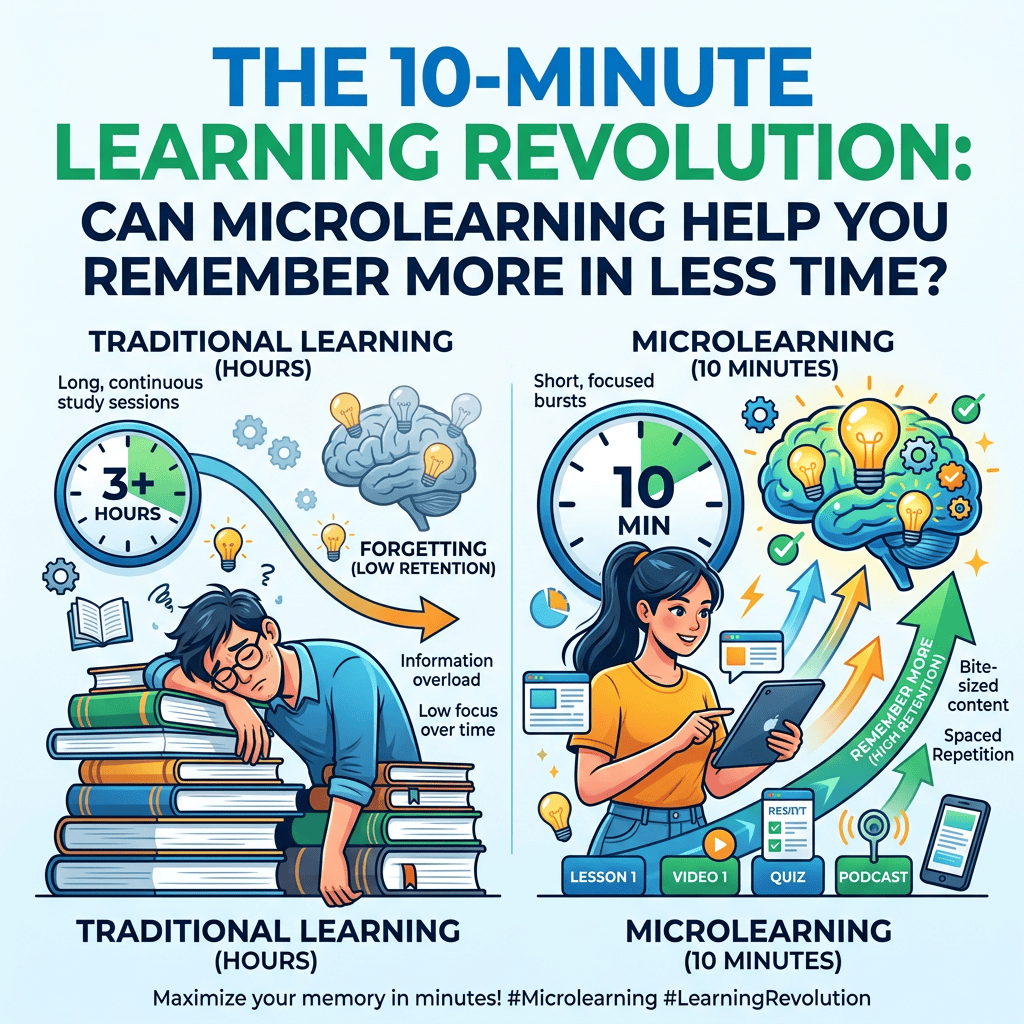
Instead of presenting a large amount of information in one long lesson, microlearning divides content into smaller units designed around specific learning objectives.
It is increasingly used in online education, professional training, language learning and digital learning platforms.
But can ten minutes really make a difference? The answer depends on what you study, how you practise and whether you revisit the material.
1. What exactly is microlearning?
Microlearning is an instructional approach that delivers focused, manageable learning activities, often in short sessions lasting seconds or minutes.
Examples include:
- A short video explaining one scientific concept.
- A five-question vocabulary quiz.
- A brief lesson on a research method.
- A flashcard session covering important definitions.
- A short demonstration of a technical procedure.
- A focused exercise on one mathematical skill.
The objective is not merely to make lessons shorter. It is to make each learning activity specific, manageable and connected to a meaningful outcome.
2. Why microlearning appeals to modern learners
Many students and working professionals face competing responsibilities. They may struggle to allocate long periods to study.
Short learning activities can make it easier to fit learning into daily routines.
For example, a student might:
- Review ten vocabulary terms during a break.
- Watch a short explanation before a lecture.
- Complete a practice quiz while travelling, where safe and appropriate.
- Review key concepts before sleeping.
- Practise a professional skill between work commitments.
However, shorter lessons do not automatically mean better learning. Complex subjects still require sustained attention, deeper reading, discussion and application.
3. What does research say about microlearning?
A 2025 systematic review titled Microlearning Beyond Boundaries examined 40 relevant studies and reported positive findings across several learning outcomes, including knowledge acquisition, retention, recall, application, engagement and self-regulation.
The review also highlights the importance of instructional design. Effective microlearning needs clear objectives, appropriately sized content, relevant activities and suitable delivery methods.
This means that simply cutting a one-hour lecture into six ten-minute videos may not produce an effective microlearning programme.
The learning activities must be redesigned around what students need to understand and practise.
4. Five examples of effective microlearning
Example 1: Vocabulary development
Learn a small group of words, practise their meanings and use them in sentences.
Example 2: Scientific concepts
Study one process at a time, such as a stage of cell division or a principle in physics.
Example 3: Academic writing
Complete a focused activity on writing a thesis statement, constructing a paragraph or evaluating a source.
Example 4: Digital skills
Practise one software function or technical procedure before moving to the next.
Example 5: Professional development
Complete a short learning activity on communication, workplace safety or project management.
5. The best way to structure a 10-minute learning session
Try this simple routine:
Minute 1: Set a specific objective.
Decide what you want to understand or remember.
Minutes 2–5: Learn one focused concept.
Read a short explanation, watch a demonstration or review a carefully selected resource.
Minutes 6–8: Test yourself.
Close the material and try to recall the main ideas. Answer practice questions without looking at your notes.
Minutes 9–10: Review and record.
Check your answers, correct mistakes and note what you need to revisit.
This approach combines short content with retrieval practice, rather than relying entirely on passive reading.
6. What microlearning cannot replace
Microlearning is not suitable as the only method for every subject.
A doctoral student cannot develop a sophisticated theoretical framework through a collection of isolated short videos alone.
A medical student cannot acquire all the necessary clinical competencies through flashcards.
A language learner cannot develop advanced communication skills by memorising vocabulary without practising listening, speaking, reading and writing.
Long-form reading, sustained problem-solving, supervised practical work and detailed feedback remain important.
Microlearning should complement deeper learning, not replace it.
7. How teachers and universities can use microlearning
Educators can use short activities to prepare students for lectures, reinforce difficult concepts and provide opportunities for repeated practice.
A good microlearning resource should:
- Address one clear objective.
- Avoid unnecessary information.
- Include an opportunity to practise.
- Provide useful feedback.
- Connect with the wider course.
- Be accessible to different learners.
- Be evaluated for actual learning outcomes.
The key is instructional quality, not the number of videos or quizzes produced.
Final verdict: Small learning sessions can create meaningful progress when they are designed well
Microlearning can make education more flexible and manageable. It may be particularly useful for revision, professional development, vocabulary acquisition and practising focused skills.
But the real advantage comes from combining short lessons with active recall, feedback and repeated practice.
Do not confuse watching ten short educational videos with learning ten things. Test what you remember, apply what you understand and revisit what you forget.
Recommended further reading
- Microlearning Beyond Boundaries: A Systematic Review (2025)
- Retrieval Practice Consistently Benefits Student Learning: A Systematic Review
- Systematic Review of Distributed Practice and Retrieval Practice in Health Professions Education
Stay connected with Scholars Careers
Subscribe to Scholars Careers for practical advice on study strategies, academic research, digital education, scholarships and professional development. Follow our updates and share this article with students, teachers and busy professionals.
Could you commit to ten minutes of focused learning every day? What skill or subject would you choose first?
Disclaimer
This article provides general educational information. The effectiveness of microlearning varies by subject, learner, instructional design and learning objective. Short lessons should not replace essential practical training, comprehensive study or professional instruction. Scholars Careers is an independent educational information platform and is not affiliated with or endorsed by the researchers or publishers mentioned.


