Imagine a student who rarely volunteers answers suddenly becoming enthusiastic about solving mathematics problems. Instead of avoiding revision, the student begins completing short challenges, tracking progress and trying to improve previous results. What has changed?
One possible explanation is gamification: the use of selected game-design elements in activities that are not traditionally games.
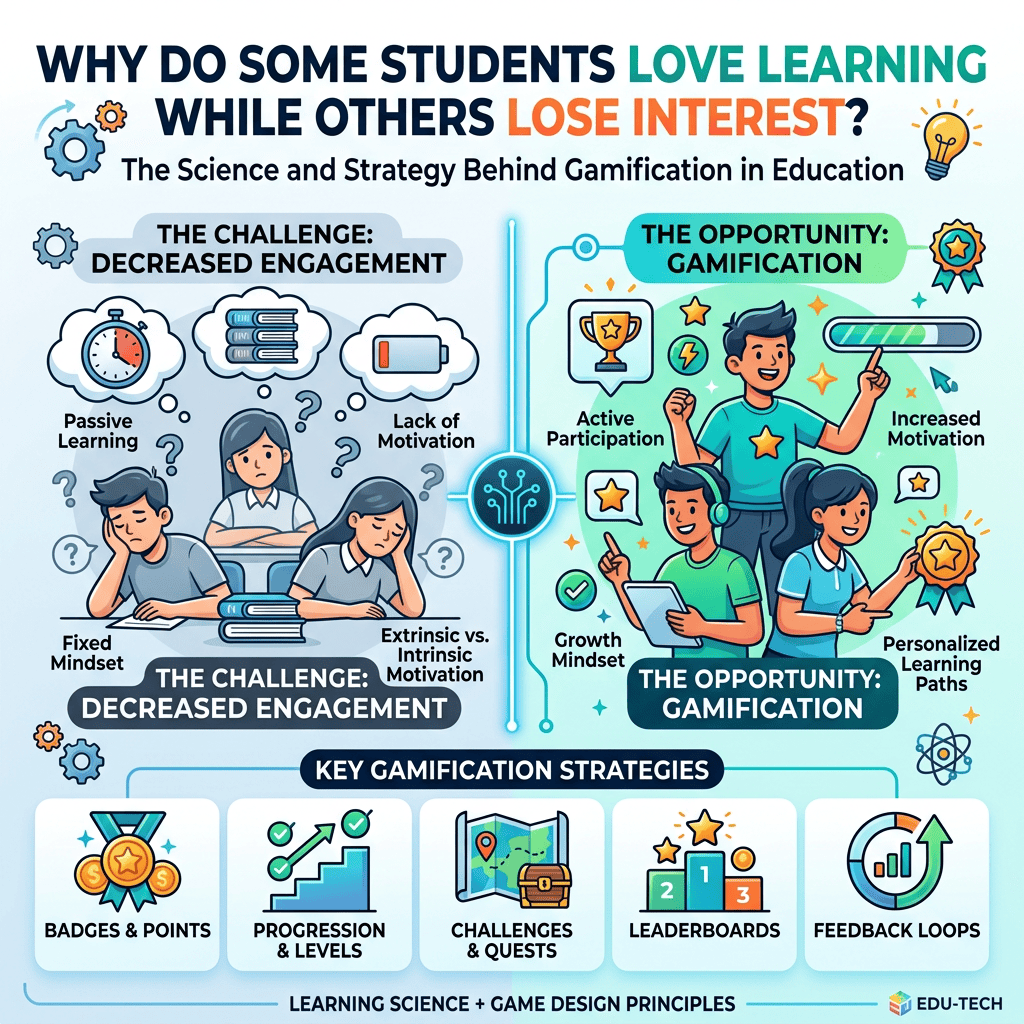
Schools, universities and online learning platforms increasingly experiment with points, progress bars, badges, challenges, feedback and collaborative competitions.
But can these features genuinely improve learning? Or do they simply make students chase rewards?
The difference is important because education should develop knowledge, understanding and skills—not just collect points.
1. What is gamification?
Gamification means applying selected elements commonly found in games to non-game activities.
In education, these may include:
- Points for completing learning activities.
- Badges for demonstrating particular skills.
- Progress bars showing advancement.
- Levels representing increasing difficulty.
- Quests or challenges linked to learning objectives.
- Immediate feedback.
- Team-based activities.
- Leaderboards and optional competitions.
Gamification is not the same as game-based learning.
Game-based learning uses an actual game as the main learning environment or teaching activity. Gamification adds game-like elements to an existing educational experience.
Both approaches can be useful, but they are not interchangeable.
2. Why gamification attracts students
Games often provide clear goals, visible progress, feedback and a sense of achievement.
Educational activities can borrow these features to make learning more structured and engaging.
For example, a language-learning platform might award a badge when a learner completes a series of vocabulary exercises. A science teacher might organise a team challenge in which students solve problems and explain their reasoning.
These approaches can help students recognise progress and remain involved in activities that might otherwise feel repetitive.
However, enthusiasm is not the same as understanding. A student may enjoy collecting points without remembering the material.
3. Five gamification strategies educators can try
Strategy 1: Break large tasks into smaller challenges
A long assignment can feel overwhelming. Dividing it into manageable stages gives students clear short-term goals.
For example, a research project might be divided into topic selection, literature searching, source evaluation, drafting and revision.
Strategy 2: Use progress indicators
A progress bar or checklist can show students which learning objectives they have completed and which still need attention.
Strategy 3: Give useful feedback quickly
Feedback should explain why an answer is correct or incorrect. Simply displaying a score may not help a student understand how to improve.
Strategy 4: Introduce collaborative challenges
Students can work in teams to solve problems, discuss evidence or complete practical activities.
Competition should not become so intense that it discourages learners who need more time or support.
Strategy 5: Reward mastery, not just speed
Educational games should recognise accuracy, improvement, persistence and understanding.
If the only reward goes to the fastest student, learners may rush rather than think carefully.
4. What does research say about gamification?
A 2024 systematic review by Lampropoulos and Kinshuk examined research on virtual reality and gamification in education. It illustrates the growing academic interest in how game-related design and immersive technology can support educational experiences.
Research findings across gamification studies are not uniform. Outcomes can depend on the subject, age group, duration, design, feedback and whether the game elements support the actual learning objectives.
This means that educators should avoid assuming that adding badges or leaderboards will automatically improve academic performance.
The best approach is to evaluate whether students demonstrate stronger understanding, retention or application of knowledge.
5. When gamification can go wrong
Overemphasis on rewards: Students may focus on collecting points instead of understanding concepts.
Unhealthy competition: Public rankings can discourage learners who consistently appear near the bottom.
Superficial engagement: Attractive graphics and animations can distract from educational content.
Accessibility problems: Some activities may disadvantage students with particular disabilities, learning needs or limited digital access.
Privacy concerns: Learning platforms may collect information about student activity and performance. Institutions should review data practices carefully.
Poor alignment: Game mechanics may reward behaviours that have little connection to the intended learning outcomes.
6. How to design a meaningful educational game
Before introducing gamification, educators should ask:
- What should students learn?
- What specific behaviour or skill should the activity encourage?
- Why would game elements improve this learning experience?
- How will progress and understanding be measured?
- Can all students participate fairly?
- Will the activity support motivation without creating unnecessary pressure?
A good educational game makes the learning objective more accessible and meaningful. It does not hide weak teaching behind entertainment.
7. A simple example: Turning vocabulary revision into a challenge
A language teacher could organise vocabulary practice into five stages.
- Stage 1: Recognise the word.
- Stage 2: Match the word to its meaning.
- Stage 3: Use the word in a sentence.
- Stage 4: Explain the word in context.
- Stage 5: Use the word in a short conversation.
Students receive feedback at every stage. Progress is based on demonstrating understanding, not simply completing the fastest attempt.
This creates a structured learning journey while preserving the educational purpose.
Final verdict: Make learning engaging, but never let entertainment replace education
Gamification can make some learning activities more interactive, structured and motivating. It can help students recognise progress, practise skills and participate in challenges.
But effective gamification requires careful design, inclusive participation and meaningful assessment.
The objective is not to turn every lesson into a video game. It is to make the process of learning more purposeful, rewarding and effective.
Recommended further reading
- Virtual Reality and Gamification in Education: A Systematic Review (2024)
- UNESCO Global Education Monitoring Report: Technology in Education
- OECD: Shaping Digital Education
Stay connected with Scholars Careers
Subscribe to Scholars Careers for practical insights into educational innovation, student success, research, scholarships and future learning technologies. Follow our updates and share this article with teachers, parents, students and education professionals.
Would you prefer learning through traditional lessons, educational games or a combination of both? Tell us what works best for you.
Disclaimer
This article is intended for general educational information. Gamification outcomes vary according to implementation, learners and learning objectives. Educational platforms should consider accessibility, student wellbeing, privacy and data protection. Scholars Careers is an independent educational platform and is not affiliated with or endorsed by the research publishers or technology providers mentioned.


