Every student experiences setbacks, although the nature and consequences of those setbacks can vary considerably. An examination result may be lower than expected, a scholarship application may be unsuccessful, a supervisor may recommend substantial revisions to a research proposal, or an important experiment may produce results that contradict the original hypothesis. For some students, these experiences become reasons to question their abilities and reconsider their future. Others gradually learn to evaluate what happened, seek feedback and adapt their approach without allowing one disappointing outcome to define their entire academic journey.
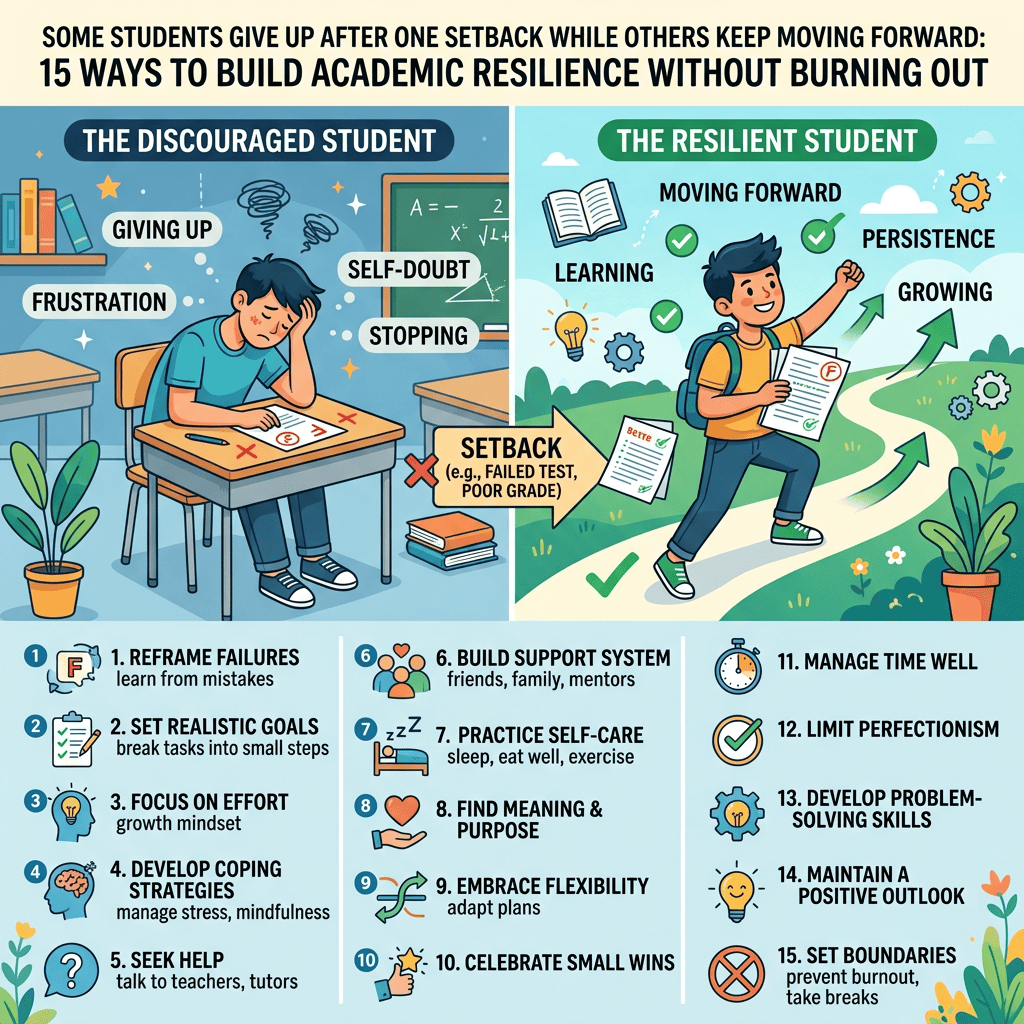
The ability to respond constructively to difficulty is often described as academic resilience. It involves adapting to challenges, using available resources, maintaining a sense of direction and recovering from setbacks where possible. However, resilience should not be misunderstood as the ability to tolerate unlimited pressure or succeed regardless of circumstances. Students may face financial hardship, discrimination, health problems, inadequate supervision or institutional barriers that cannot be overcome through positive thinking alone. A realistic understanding of resilience recognises both personal capabilities and the importance of supportive environments.
This article explores 15 practical ways to strengthen academic resilience, explains how students can respond to common setbacks and considers the responsibilities universities have in helping learners progress.
1. Understand what academic resilience really means
Academic resilience is not the absence of disappointment, stress or uncertainty. It is the capacity to respond to academic challenges in ways that support continued learning and development. A resilient student may feel disappointed after receiving a poor grade but still examine the feedback, identify areas for improvement and make a plan for the next assessment.
This ability can develop over time. Students learn from experience, receive guidance from others and discover which strategies help them manage difficult situations. Resilience is therefore better understood as a set of skills and supportive resources than as a fixed personality trait that some people possess and others lack.
2. Separate an academic setback from your personal identity
One disappointing result does not establish that a student is unintelligent, incapable or unsuitable for higher education. Grades provide information about performance against particular assessment criteria under particular conditions; they do not measure every aspect of a person’s potential, creativity, knowledge or future contribution.
When students interpret every setback as a judgement of their identity, it becomes harder to respond constructively. A more useful approach is to ask what the result reveals about preparation, understanding, assessment technique or the support available. This shifts attention from self-condemnation towards specific questions that can be investigated and addressed.
3. Learn to interpret feedback without becoming discouraged
Academic feedback can be difficult to receive, particularly when students have invested considerable time in an assignment or research project. Comments about unclear arguments, weak methodology or insufficient evidence may feel personal, even when they are intended to improve the work.
Students can make feedback more manageable by reading it carefully, identifying recurring themes and separating essential changes from optional suggestions. If comments are unclear, they should ask the lecturer or supervisor for examples and clarification. It may also help to create a revision table that connects each comment with a practical action, allowing feedback to become a working document rather than a source of continuing anxiety.
4. Develop a growth-oriented approach to learning
A growth-oriented approach recognises that knowledge and skills can develop through practice, feedback and appropriate support. It does not mean that effort guarantees success or that every obstacle can be overcome by trying harder. Instead, it encourages students to consider which aspects of performance can be improved and which may require a change of strategy or additional resources.
For example, a student who struggles with academic writing might benefit from a writing centre, structured practice, reading model papers and feedback from a tutor. Simply spending more hours writing without understanding the underlying difficulty may not produce the same progress. Resilience is strengthened when effort is combined with reflection and effective methods.
5. Set goals that are challenging but realistic
Ambitious goals can provide direction, but goals that are disconnected from available time and resources may create unnecessary pressure. A student who intends to complete an entire dissertation chapter in one evening may become discouraged when the task proves more complex than expected. A more realistic target might involve drafting a defined subsection, organising evidence or preparing a detailed outline.
Long-term goals should be divided into milestones that can be reviewed and adjusted. Students can identify the next important action, estimate the time required and consider what support or materials are needed. This makes progress more visible and reduces the tendency to measure success only by distant outcomes such as graduation, publication or employment.
6. Strengthen problem-solving skills
When a problem arises, students can begin by defining it as clearly as possible. A vague concern such as “my research is failing” may contain several separate issues: data collection is delayed, the research question is too broad, access to participants is limited or the analytical method is unclear. Each problem may require a different response.
After identifying the issue, students can consider available options, evaluate likely consequences and decide which action is most practical. Where the problem involves technical or academic uncertainty, consulting a supervisor, librarian, statistician or relevant specialist may be more effective than attempting to solve everything independently.
7. Build relationships with people who can provide support
Resilience is not an entirely individual achievement. Friends, classmates, family members, mentors, supervisors and professional support services can help students maintain perspective and identify solutions. A supportive academic network may also provide practical resources, such as advice about research methods, information about funding opportunities or feedback on an application.
Students should aim to develop relationships before a major crisis occurs. Regular communication with academic advisers, participation in peer groups and involvement in research communities can make it easier to seek help when difficulties arise. A network does not need to be large; a few reliable relationships may be more useful than numerous superficial contacts.
8. Learn to adapt when the original plan no longer works
Research and higher education rarely progress exactly as planned. A student may discover that a research question is too broad, an experimental method is unsuitable or an expected funding opportunity is unavailable. In such situations, continuing with the original plan simply because considerable time has already been invested can make the problem worse.
Adaptability involves examining the evidence, discussing alternatives and making informed changes. For doctoral candidates, this may mean refining a research question, adjusting a methodology or revising a timeline in consultation with supervisors and relevant ethics or programme processes. A change of direction is not automatically a failure; sometimes it is a necessary part of responsible academic work.
9. Develop healthy responses to failure
Students often receive more guidance on how to succeed than on how to respond when something goes wrong. Yet setbacks are a normal part of learning, research and professional development. An unsuccessful application, rejected manuscript or failed examination attempt can provide information about expectations, preparation and areas that need attention.
A constructive review can involve identifying what was within the student’s control, what depended on external circumstances and what could be done differently next time. This distinction is important because not every unsuccessful outcome reflects poor performance. Funding decisions, admissions outcomes and publication decisions can be influenced by competition, available resources, institutional priorities and other factors beyond an applicant’s control.
10. Protect wellbeing while pursuing academic goals
Resilience should not be confused with working continuously. Students who neglect sleep, meals, relationships and recovery may find it increasingly difficult to concentrate and manage emotions. A sustainable routine should include realistic study hours, opportunities for movement and periods when academic responsibilities are not the main focus.
Students should also recognise when self-management is not enough. Persistent anxiety, low mood, exhaustion or difficulty functioning may require professional support. The ability to ask for help is not evidence of weak resilience; it can be an important part of responding responsibly to difficult circumstances.
11. Use reflection to learn from experience
Regular reflection can help students recognise patterns that might otherwise remain hidden. After completing an assignment or major research task, they can consider what worked well, what caused difficulty, which resources were useful and what should change next time.
A short reflection does not need to become another demanding assignment. Students might record three observations: one successful strategy, one challenge and one action to try in the next project. Over time, these notes can reveal whether problems are connected to planning, communication, subject knowledge, workload or access to support.
12. Develop confidence through evidence of progress
Confidence is easier to maintain when students can see evidence that they are developing. Keeping a record of completed milestones, improved skills, feedback received and problems solved can provide a more balanced picture of progress than relying on feelings during a difficult week.
For research students, this record might include a completed literature search, a refined methodology, an ethics approval milestone, a conference presentation or a revised manuscript. For undergraduate students, it might include improved assessment results, stronger analytical writing or increased confidence in presentations. The purpose is not to create a competition with other students, but to recognise genuine development.
13. Strengthen financial and practical resilience
Academic progress can be affected by practical pressures that have little to do with intellectual ability. Unexpected accommodation costs, limited funding, transport difficulties, caring responsibilities or the need to work alongside study may make it difficult to maintain a consistent academic routine.
Students can improve their ability to respond by becoming familiar with available institutional resources, including hardship funds, financial advice, accommodation support, emergency assistance and careers services. Eligibility varies, and support is not guaranteed, but knowing where to seek accurate information can make difficult situations easier to navigate.
14. Universities must create conditions in which resilience can develop
Institutions sometimes place considerable emphasis on student resilience without adequately examining the conditions that make academic life unnecessarily difficult. A student cannot solve every problem through better time management if assessment schedules are unreasonable, supervision is inadequate or essential support services are inaccessible.
Universities can strengthen resilience by providing transparent academic expectations, accessible teaching, fair assessment processes, effective supervision and clear routes for raising concerns. They should also recognise that students have different financial, cultural, disability-related and personal circumstances. A supportive institution does not remove every challenge, but it can make it more realistic for students to respond to challenges constructively.
15. Create a personal academic resilience plan
Students can turn these principles into a practical plan by identifying their most common academic difficulties and deciding how they will respond. Someone who struggles with procrastination might divide assignments into smaller tasks and arrange regular check-ins with a study partner. A doctoral researcher who feels isolated might join a postgraduate writing group and schedule more consistent supervisory meetings.
The plan should include academic, social and wellbeing considerations. It can identify trusted people to contact, institutional services to approach, strategies that have worked previously and warning signs that suggest additional support may be necessary. Reviewing the plan at the beginning of each term can help students adapt it as their responsibilities and circumstances change.
Frequently asked questions
Can academic resilience be learned?
Resilience-related skills can develop through experience, reflection, supportive relationships and effective strategies. It is not simply an inborn quality.
Does resilience mean never giving up?
No. Sometimes changing direction, requesting an extension, taking an approved break or reconsidering a programme is a reasonable response to difficult circumstances. Persistence is valuable when it serves a meaningful and realistic goal.
How can I become more resilient after failing an examination?
Review the feedback, understand the reassessment rules, identify gaps in knowledge and speak with an appropriate academic adviser. Create a revised preparation plan that addresses the actual difficulties rather than simply increasing study hours.
Can universities improve student resilience?
Yes. Institutions can support students through fair academic processes, effective supervision, accessible wellbeing services, inclusive learning environments and timely academic advice.
Conclusion: Resilience is not about enduring everything; it is about learning how to respond
A strong academic journey is rarely a straight line from admission to graduation. Students encounter unexpected problems, disappointing results, changing interests and periods of uncertainty, and these experiences can influence how they understand themselves as learners and future professionals. Developing resilience can help students respond with greater perspective, but it should never be used to justify preventable pressure or inadequate institutional support.
The most sustainable approach combines practical problem-solving, realistic goals, supportive relationships, reflection and access to appropriate help. Students should be encouraged to learn from setbacks without allowing them to define their identity, while universities should create conditions in which academic progress and personal wellbeing can coexist.
Stay connected with Scholars Careers: Subscribe for more practical advice on higher education, academic development, scholarships, research careers and student success. Follow our updates and share this article with students who may need encouragement and useful strategies.
Disclaimer: This article is intended for general educational purposes and does not replace professional psychological, medical, financial or academic advice. Individual circumstances differ, and students facing persistent distress or significant academic difficulties should contact the appropriate qualified professional or institutional support service.


