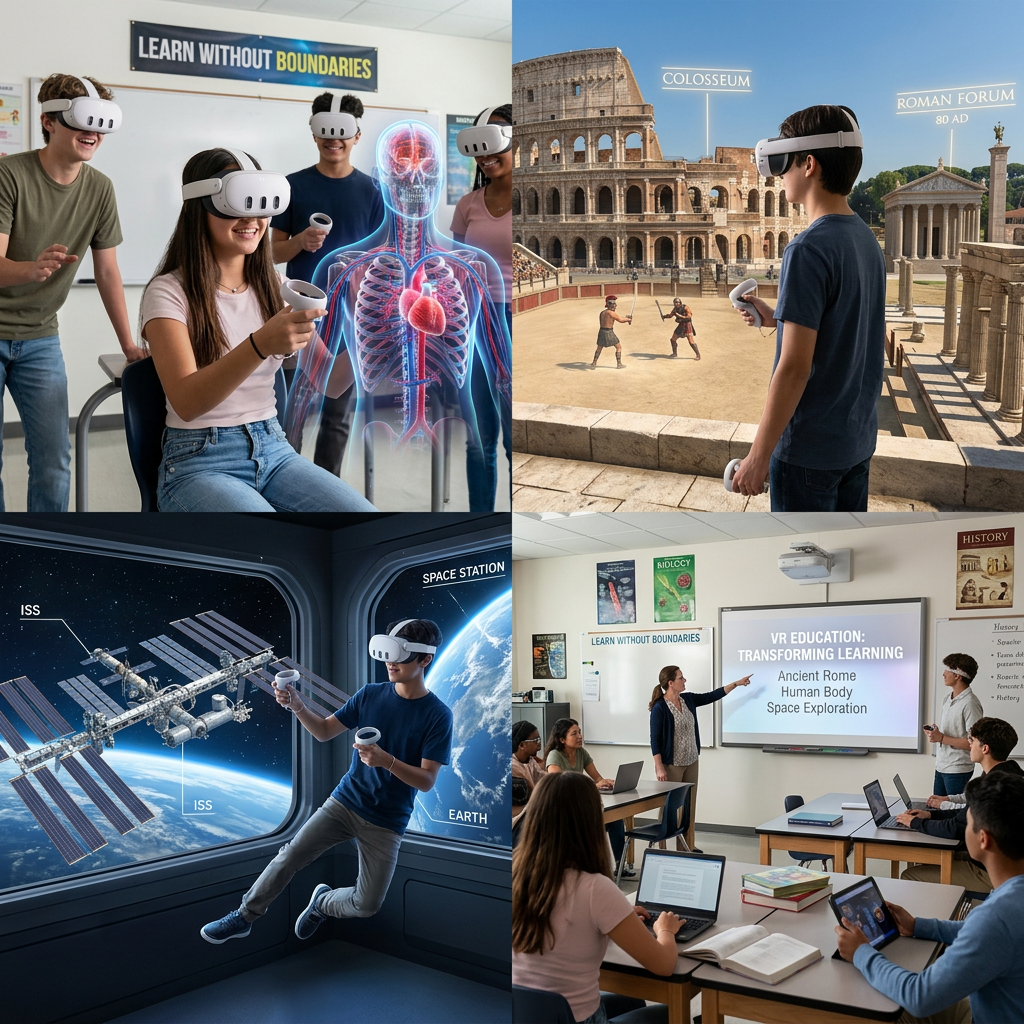
Imagine walking through an ancient civilisation during a history lesson. Imagine exploring the human circulatory system from the inside, practising a laboratory procedure without handling dangerous chemicals, or examining a distant planet in three dimensions.
These experiences are becoming possible through virtual reality (VR) and other immersive technologies.
For education, VR offers something traditional textbooks and ordinary videos cannot always provide: an opportunity to interact with simulated environments.
But does an immersive experience necessarily produce better learning? Can virtual reality make education more engaging, improve practical skills and help students understand complex subjects?
The technology is promising, but its educational value depends on how it is used.
1. What is virtual reality in education?
Virtual reality uses technology to create a simulated environment in which users can experience and interact with digital objects or spaces.
Some systems use head-mounted displays that provide an immersive three-dimensional experience. Others use computer screens or mobile devices to create less immersive virtual environments.
VR is related to, but different from, augmented reality (AR).
- Virtual reality: Places the learner inside a computer-generated environment.
- Augmented reality: Adds digital information or objects to the user’s view of the real world.
- Mixed reality: Allows digital and physical objects to interact within a shared environment.
These technologies are often grouped under the wider term extended reality (XR).
2. Five ways VR could transform education
1. Exploring subjects that are difficult to observe directly
Students can explore simulated environments that would otherwise be inaccessible, dangerous, expensive or impossible to visit.
Examples include the inside of a cell, a historical reconstruction or a virtual astronomical environment.
2. Practising procedures
Simulations may allow learners to rehearse procedures before attempting them in real settings.
This can be useful in areas such as healthcare education, engineering, aviation-related training and technical skills development.
However, virtual practice should not automatically be treated as a replacement for supervised practical competence.
3. Learning through interaction
Instead of simply watching an explanation, students may manipulate digital objects, change variables and observe the results.
This can support active exploration when the activity is designed around a clear educational objective.
4. Supporting visual and spatial understanding
Some subjects involve complex structures and spatial relationships. Three-dimensional visualisation may help learners explore these concepts from different angles.
5. Creating simulated experiences
Students can investigate scenarios that are difficult to recreate in an ordinary classroom, including emergency procedures, industrial processes and environmental changes.
3. What does the research say?
Research reviews suggest that immersive VR can support learning in certain contexts, especially when learners actively interact with the environment.
A 2024 systematic review of immersive virtual reality in education and training examined 30 relevant studies and reported positive findings in comparison with other media, particularly for learning environments involving active engagement and practical application.
Other reviews have also highlighted possible benefits while emphasising that outcomes depend on instructional design, cognitive demands, subject matter and the way technology is implemented.
This distinction matters. A visually impressive simulation is not necessarily an effective lesson.
4. The challenges schools and universities must consider
Cost
Headsets, software, equipment maintenance and technical support can be expensive.
Accessibility
Not all students can comfortably use head-mounted displays. Some may experience motion sickness, visual discomfort or other difficulties.
Digital inequality
Institutions with limited resources may struggle to provide suitable equipment and reliable technical support.
Distraction
Immersive environments can become entertaining without producing meaningful learning if the educational task is poorly designed.
Teacher preparation
Teachers need training to integrate VR into lessons, assess learning and manage technical problems.
Privacy and data protection
Institutions should examine what information VR platforms collect, how it is stored and who can access it.
5. How teachers can use VR effectively
The most useful starting point is not buying headsets. It is identifying a learning problem.
For example, if students struggle to understand the structure of a complex biological system, a three-dimensional simulation may provide a useful additional explanation.
A successful lesson could follow this structure:
- Introduce the learning objective.
- Explain the task and safety requirements.
- Allow students to explore the simulation.
- Ask questions that require observation and reasoning.
- Discuss what the experience demonstrated.
- Connect the virtual activity to textbooks, research or practical work.
- Assess what students actually learned.
Reflection is essential. Students should understand the concepts behind the simulation rather than merely remember what they saw.
6. Five subjects where VR may have particular value
- Medicine and healthcare: Exploring anatomy and rehearsing selected procedures.
- Engineering: Visualising structures and practising technical operations.
- Science: Investigating molecular, biological or physical processes.
- History and archaeology: Exploring reconstructed environments and historical spaces.
- Vocational education: Simulating equipment operation and selected workplace procedures.
The suitability of VR depends on the learning objectives, quality of the simulation and availability of appropriate supervision.
7. Will VR replace teachers?
There is little reason to treat immersive technology as a substitute for effective teaching.
Teachers provide explanation, feedback, encouragement, assessment, classroom management and human judgement. VR may enhance some learning activities, but it cannot automatically perform all these functions.
The strongest approach is to combine technology with teaching expertise.
Final verdict: The classroom of tomorrow may be immersive, but learning still needs a human purpose
Virtual reality has the potential to make certain subjects more interactive, visual and practical. It may help students explore complex environments and practise selected skills in controlled simulations.
But institutions should not purchase immersive technology simply because it looks futuristic.
The real question is not how realistic the virtual classroom looks. It is whether students understand more, practise better and develop skills they can transfer beyond the simulation.
Recommended further reading
- Systematic Review: Learning Effectiveness of Immersive Virtual Reality in Education and Training (2024)
- Virtual Reality and Gamification in Education: A Systematic Review (2024)
- UNESCO Global Education Monitoring Report: Technology in Education
Stay connected with Scholars Careers
Subscribe to Scholars Careers for insights into emerging education technologies, international education, research, scholarships and academic careers. Follow our updates and share this article with educators, students, researchers and technology enthusiasts.
If you could take one virtual field trip as part of your education, where would you go?
Disclaimer
This article is for general educational and informational purposes. VR applications are not automatically suitable for every learner, subject or assessment. Institutions should consider accessibility, health and safety, privacy, cost and educational effectiveness before adopting immersive technologies. Scholars Careers is an independent platform and is not affiliated with or endorsed by the research publishers or technology providers mentioned.


