Students are no longer limited to textbooks, lecture notes and search engines when they need help understanding a difficult subject. Generative AI assistants can explain concepts, summarise information, generate practice questions and help users organise ideas. Two of the most widely recognised names are ChatGPT, developed by OpenAI, and Gemini, developed by Google. But which is better for students?
The honest answer is that there is no universal winner. The best tool depends on the task, available features, institutional rules, privacy requirements and the student’s ability to verify the results.
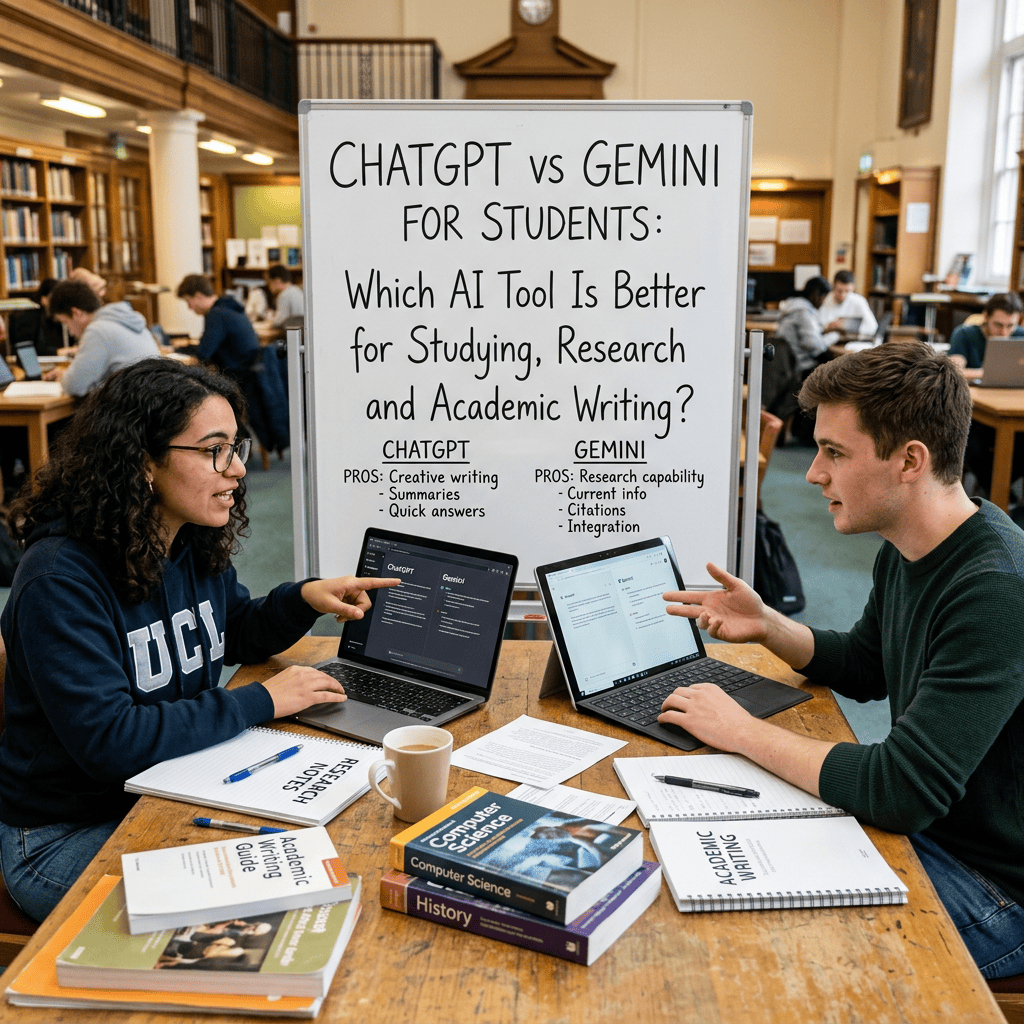
1. ChatGPT: A flexible study and writing assistant
ChatGPT can support students with a range of learning activities, depending on the version and features available.
Potential uses include:
- Explaining difficult concepts in simpler language.
- Creating revision questions and practice exercises.
- Helping students structure research ideas.
- Reviewing the clarity of a draft.
- Exploring counterarguments.
- Assisting with programming explanations.
- Practising interviews and presentations.
Its conversational format allows students to ask follow-up questions and request alternative explanations.
However, students should not assume that fluent answers are accurate. Generated references, quotations and technical claims must be independently checked.
2. Gemini: An AI assistant within Google’s ecosystem
Gemini offers conversational AI capabilities and, depending on the product version, subscription and account settings, may connect with features in Google’s wider ecosystem.
Potential educational uses include:
- Explaining subject concepts.
- Brainstorming research questions.
- Summarising information.
- Helping organise ideas.
- Supporting writing and revision.
- Working with supported files or services where available.
Feature availability can vary by country, age, account type, institution and subscription. Students should consult Google’s current product documentation rather than assuming every feature is available to everyone.
3. Which tool is better for different academic tasks?
| Student task | What to look for |
|---|---|
| Understanding difficult concepts | Clear explanations, follow-up questions and worked examples |
| Essay planning | Useful outlines, counterarguments and feedback |
| Research | Verifiable sources and accurate citations |
| Revision | Practice questions, explanations and feedback |
| Coding | Explanations, testing suggestions and debugging support |
| Document analysis | Supported file formats and privacy controls |
| Language practice | Conversation quality and appropriate feedback |
Neither tool should be treated as an authoritative academic source. A chatbot response is not a substitute for reading the original publication or consulting a recognised textbook.
4. The biggest mistake students make with AI research
One of the most dangerous habits is copying references generated by a chatbot without checking whether the publications exist.
AI systems can sometimes generate convincing but inaccurate bibliographic information. A student who submits fabricated references may undermine the credibility of an otherwise strong assignment.
A safer process is:
- Ask the AI tool to explain the research topic.
- Identify the important concepts and keywords.
- Search academic databases and library catalogues.
- Open the original publications.
- Check authors, titles, publication dates and findings.
- Cite only sources that you have actually consulted and that your institution accepts.
Use AI to help you navigate research—not to manufacture evidence.
5. A responsible comparison exercise
Try asking both tools the same question about a topic you are studying.
Then compare:
- Factual accuracy.
- Quality of explanations.
- Recognition of uncertainty.
- Strength of supporting evidence.
- Clarity and usefulness.
- Whether the answers identify credible original sources.
Do not choose the response that sounds most confident. Choose the response that survives independent checking.
6. Privacy and academic integrity matter
Before uploading lecture notes, research documents or personal information, review the platform’s current privacy terms and your institution’s rules.
Do not upload confidential research, identifiable personal data or restricted institutional information unless you are authorised to do so.
Similarly, check whether AI assistance is allowed in your assignment. Some assessments permit brainstorming or editing but prohibit generated answers. Others require disclosure.
7. The smartest way to use both tools
You do not need to treat ChatGPT and Gemini as replacements for teachers, librarians or academic databases.
A productive study routine might look like this:
Step 1: Read the relevant textbook chapter or lecture material.
Step 2: Write down what you understand and what remains confusing.
Step 3: Ask an AI assistant to explain the difficult parts.
Step 4: Verify key claims using recognised sources.
Step 5: Complete a practice task without AI assistance.
Step 6: Use feedback to identify what you need to improve.
This approach keeps the learner—not the chatbot—at the centre of the learning process.
8. The best AI tool is the one that helps you learn responsibly
ChatGPT and Gemini can both be useful educational assistants. Their capabilities change over time, and individual experiences may differ.
Instead of asking which chatbot can complete your assignment fastest, ask which one helps you understand the subject, question evidence and improve your own work.
The goal is not to become dependent on the smartest chatbot. It is to become a more capable student.
Official product information
Stay connected with Scholars Careers
Subscribe to Scholars Careers for practical guidance on academic writing, AI literacy, scholarships, research and international education. Follow our updates and share this comparison with students and educators.
Which AI assistant do you prefer for studying—and what makes it useful? Share your experience while remembering not to disclose private academic or personal information.
Disclaimer
This comparison is general educational information, not a product endorsement or a guarantee of performance. AI features, prices, privacy settings and availability can change. Always consult the providers’ current documentation and your institution’s academic-integrity policies. Scholars Careers is independent and is not affiliated with or endorsed by OpenAI or Google.


