What will a university classroom look like in 2030? Will students attend lectures through virtual environments? Will artificial intelligence help personalise lessons? Will online courses become a normal part of every degree? Could immersive simulations make practical training more accessible?
The future of education is unlikely to be defined by one device, platform or teaching method. Instead, it may emerge from the combination of digital technologies, skilled educators, new learning models and changing expectations among students and employers.
Some of these developments are already happening. Others remain experimental or unevenly adopted.
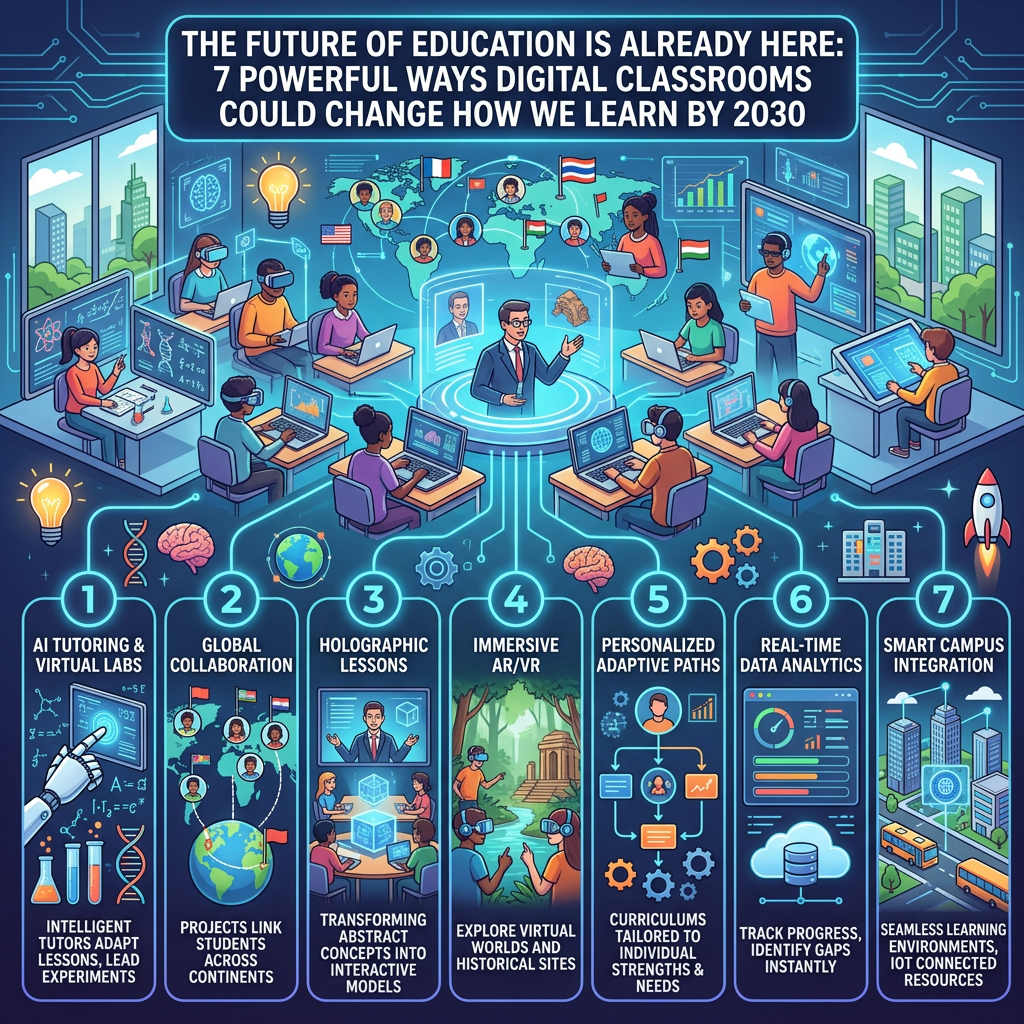
Here are seven important trends that could influence how people learn over the coming years.
1. More flexible combinations of online and classroom learning
Universities and schools are increasingly exploring ways to combine face-to-face instruction with digital learning resources.
Students may use online platforms for preparation, recorded lectures and independent practice while attending classrooms for discussion, laboratory work and collaborative activities.
The important development is not simply moving lessons online. It is designing learning activities around the strengths of different environments.
2. More personalised learning experiences
Digital platforms can provide feedback about student performance and, in some circumstances, recommend activities based on learning progress.
For example, a student who struggles with a particular mathematical concept might receive additional practice questions.
Personalisation may help teachers identify where learners need support, but automated recommendations should not be treated as perfect assessments of ability.
Human oversight remains important.
3. Greater use of virtual and augmented reality
Immersive technologies may support subjects that benefit from three-dimensional visualisation, simulations and practical rehearsal.
Medical students could explore anatomy, engineering students could examine virtual structures, and vocational learners could practise selected procedures.
However, cost, accessibility, technical support and evidence of educational value will influence how widely these technologies are adopted.
4. Gamification and interactive learning
Educational platforms may increasingly use challenges, progress tracking, simulations and collaborative activities to support participation.
The most valuable systems will connect rewards to actual learning outcomes.
A badge should represent a demonstrated achievement, not merely the number of minutes a student spends logged into a platform.
5. More attention to digital and AI literacy
Students will need to understand how to use digital tools, evaluate online information, protect personal data and recognise the limitations of automated systems.
AI literacy will become particularly important as learners encounter AI-assisted search, writing, tutoring and research tools.
Education should help students become informed users who can question technology rather than accept every automated result.
6. Greater attention to accessibility and inclusion
Digital education can create opportunities for learners who face geographical, physical or scheduling barriers.
Accessible formats, captions, screen-reader compatibility, flexible participation and assistive technologies can help make learning more inclusive.
But digital delivery can also exclude students without suitable devices, affordable internet or appropriate support.
The future of education must therefore address both technological innovation and unequal access.
7. More careful use of learning data
Educational platforms can collect information about participation, quiz performance and learning progress.
Used responsibly, such information may help teachers identify students who need additional support.
However, data collection raises important questions:
- What information is being collected?
- Who can access it?
- How long is it retained?
- Can students challenge inaccurate conclusions?
- Is the data used for educational support or commercial purposes?
- Are privacy and safeguarding requirements being followed?
Institutions should ensure that technology supports learners rather than turning education into unnecessary surveillance.
The biggest question: Will technology replace teachers?
Technology may change how teachers prepare lessons, provide feedback and organise learning activities. It may also automate selected administrative tasks.
But education involves more than delivering information.
Teachers help students develop judgement, curiosity, communication, resilience and the ability to work with others. They interpret context, respond to individual needs and create supportive learning environments.
These responsibilities cannot be reduced to a software feature.
The future is more likely to involve teachers working alongside technology than education becoming entirely automated.
What students should do to prepare for 2030
Students do not need to master every new educational platform. Instead, they should develop skills that remain useful as technology changes.
These include:
- Digital literacy and responsible technology use.
- Critical thinking and information evaluation.
- Independent learning and self-management.
- Communication and collaboration.
- Problem-solving and creativity.
- Adaptability and continuous professional development.
- Awareness of privacy, ethics and online safety.
These capabilities can help learners benefit from changing educational environments.
What universities and policymakers should prioritise
Educational institutions should evaluate technologies before adopting them at scale.
They should invest in teacher development, accessibility, reliable infrastructure, privacy protections and evidence-based course design.
Policymakers should also consider the needs of disadvantaged learners. A digital education strategy that benefits only students with high-quality devices and fast internet cannot deliver inclusive education.
UNESCO’s Global Education Monitoring Report emphasises that technology decisions should be guided by evidence, equity and the interests of learners and teachers.
Final verdict: The future of education is not simply digital—it must be better
Online learning, blended education, virtual reality and gamification are changing the possibilities available to students and teachers.
But technology alone cannot guarantee better education.
The most successful educational systems will be those that combine useful innovation with excellent teaching, human interaction, critical thinking, inclusion and meaningful assessment.
By 2030, the most important educational advantage may not be access to the newest technology. It may be the ability to use technology wisely while continuing to think, question and learn independently.
Recommended further reading
- UNESCO Global Education Monitoring Report: Technology in Education
- OECD: Shaping Digital Education
- OECD: Quality Matters – Digital Adult Education and Training
- Virtual Reality and Gamification in Education: A Systematic Review
Stay connected with Scholars Careers
Subscribe to Scholars Careers for reliable information on the future of education, scholarships, academic careers, digital learning and research. Follow our updates and share this article with students, educators, parents and policymakers.
Which development do you think will have the greatest influence on education by 2030: AI, virtual reality, blended learning, gamification or something else?
Disclaimer
This article discusses potential developments rather than guaranteed predictions. Technology adoption, educational outcomes and policy arrangements will vary by country and institution. Any decision to introduce educational technology should consider evidence, accessibility, privacy, cost and learner wellbeing. Scholars Careers is an independent educational information platform and is not affiliated with or endorsed by UNESCO, the OECD or the technology providers mentioned.


