What if students could enjoy the advantages of university classrooms without depending entirely on physical attendance? What if lectures, discussions, digital resources and independent study could be combined into one carefully designed learning experience That is the idea behind blended learning.
Rather than forcing students to choose between traditional classroom education and fully online study, blended learning combines face-to-face teaching with digital learning activities.
For universities, schools and professional training providers, this approach offers an opportunity to rethink how teaching is organised.
But is blended learning genuinely better? Or does it simply give students more platforms, more passwords and more assignments?
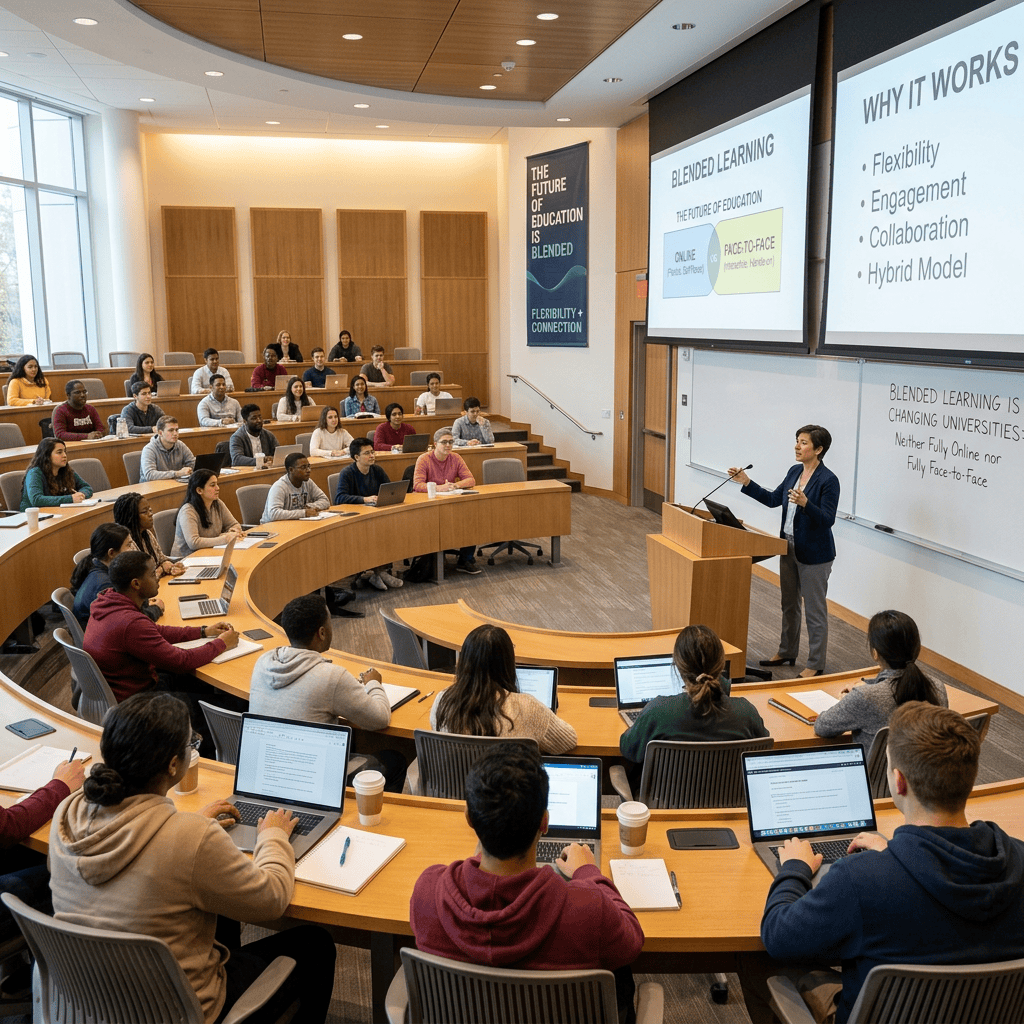
The difference lies in how effectively the two learning environments are connected.
1. What exactly is blended learning?
Blended learning integrates in-person instruction with online educational activities.
A university student might attend a classroom lecture, complete an online quiz, watch a recorded explanation, participate in a virtual discussion and then work with classmates on a practical project.
The online and classroom elements should complement each other rather than operate as unrelated activities.
For example, students might study introductory material online before attending a classroom session devoted to problem-solving and discussion.
This is sometimes associated with the flipped-classroom approach.
2. Why institutions are interested in blended learning
Blended learning can offer several potential advantages.
More flexible access to learning materials
Students can revisit recorded explanations and digital resources when revising difficult topics.
More classroom time for interaction
If basic explanations are provided before class, face-to-face sessions can focus on discussion, application and problem-solving.
Multiple ways to engage
Some learners benefit from classroom conversations, while others appreciate being able to review material independently.
Opportunities for feedback
Online quizzes and learning platforms can help students identify areas requiring further attention, provided the activities are well designed.
Continuity and resilience
Digital resources may help institutions maintain access to learning materials when physical attendance is disrupted.
However, these benefits are not automatic. Poorly designed blended courses can increase workload and create confusion.
3. Five common blended-learning models
The flipped classroom: Students study introductory material before attending class, where the instructor focuses on deeper discussion and practical application.
The rotation model: Learners move between different activities, such as classroom teaching, online exercises and small-group instruction.
The enriched virtual model: Most learning takes place online, but students also participate in scheduled face-to-face sessions.
The flex model: Online learning is central, with instructors providing support and targeted in-person assistance.
The project-based model: Digital resources and classroom collaboration are combined around a practical task or research project.
Institutions use different terminology and programme structures, so students should check how a particular course is actually delivered.
4. The problems that can undermine blended learning
Unequal digital access
Students may not have reliable internet, suitable devices or quiet places to study.
Poor course organisation
If online and classroom activities are not coordinated, students may receive repeated instructions or contradictory deadlines.
Increased workload
A blended programme should not simply add online tasks to an already full classroom timetable.
Limited staff training
Teachers need support in designing digital activities that improve learning rather than merely transfer existing lectures onto a screen.
Weak student engagement
Students who do not understand expectations may stop participating in online discussions or fall behind with independent work.
5. How to design a genuinely effective blended course
A strong blended course begins with the learning outcomes.
Instructors should decide what students need to understand, practise or demonstrate. They can then determine which activities are best delivered face-to-face and which can be completed online.
A practical design process includes:
- Define clear learning objectives.
- Identify activities requiring direct interaction.
- Select appropriate digital resources.
- Explain how online and classroom activities connect.
- Provide clear schedules and assessment instructions.
- Build in opportunities for feedback.
- Review student participation and learning outcomes.
- Adjust the design based on evidence.
The technology should serve the teaching strategy—not the other way around.
6. What students can do to succeed in blended education
Students should treat online activities as an essential part of their programme rather than optional homework.
A useful routine is to:
- Check the learning platform regularly.
- Download or organise essential materials.
- Prepare before classroom sessions.
- Participate in online discussions.
- Ask for clarification when instructions are unclear.
- Keep track of deadlines across all learning environments.
- Use feedback to improve future assignments.
Blended learning requires students to develop both independent-study habits and the ability to collaborate in person.
7. Is blended learning better than traditional education?
There is no universal answer.
Its effectiveness depends on the subject, learner characteristics, quality of teaching, digital access, course design and assessment methods.
For a subject involving practical laboratory work, classroom or laboratory attendance may remain essential. For theoretical modules, online materials may offer useful flexibility.
A well-designed blended course can make good use of both environments. A poorly designed course can make learning more complicated.
8. The future may belong to smarter combinations, not one delivery method
Blended learning challenges the idea that education must happen either entirely inside a classroom or entirely online.
It creates opportunities to combine structured teaching, independent study, digital resources and human interaction.
But successful implementation requires planning, staff development, accessibility and a clear understanding of how students learn.
The best blended classroom is not the one with the most technology. It is the one in which every learning activity has a purpose.
Useful resources
- OECD: Shaping Digital Education
- OECD: Quality Matters – Digital Adult Education and Training
- UNESCO Global Education Monitoring Report 2023
Stay connected with Scholars Careers
Subscribe to Scholars Careers for practical information on university education, teaching innovation, online learning, scholarships and academic development. Follow our updates and share this article with teachers, university leaders and students.
Would you prefer a blended university course or a fully face-to-face programme? Tell us why.
Disclaimer
This article provides general educational information. Blended-learning arrangements and programme requirements vary between institutions and disciplines. Always consult the official programme specification before enrolling. Scholars Careers is an independent educational information platform and is not affiliated with or endorsed by the OECD, UNESCO or any institution mentioned.


