You spend hours reading your notes, highlighting important paragraphs and watching educational videos. You feel confident that you understand the subject. Then the examination begins. Suddenly, a definition disappears from your memory. You cannot remember the steps in a process, and an answer that seemed obvious yesterday becomes difficult to explain. Why does this happen?
One reason is that recognising information while looking at your notes is not the same as being able to retrieve it independently.
The good news is that research in cognitive psychology and education has identified practical strategies that can help learners strengthen memory and improve long-term retention.
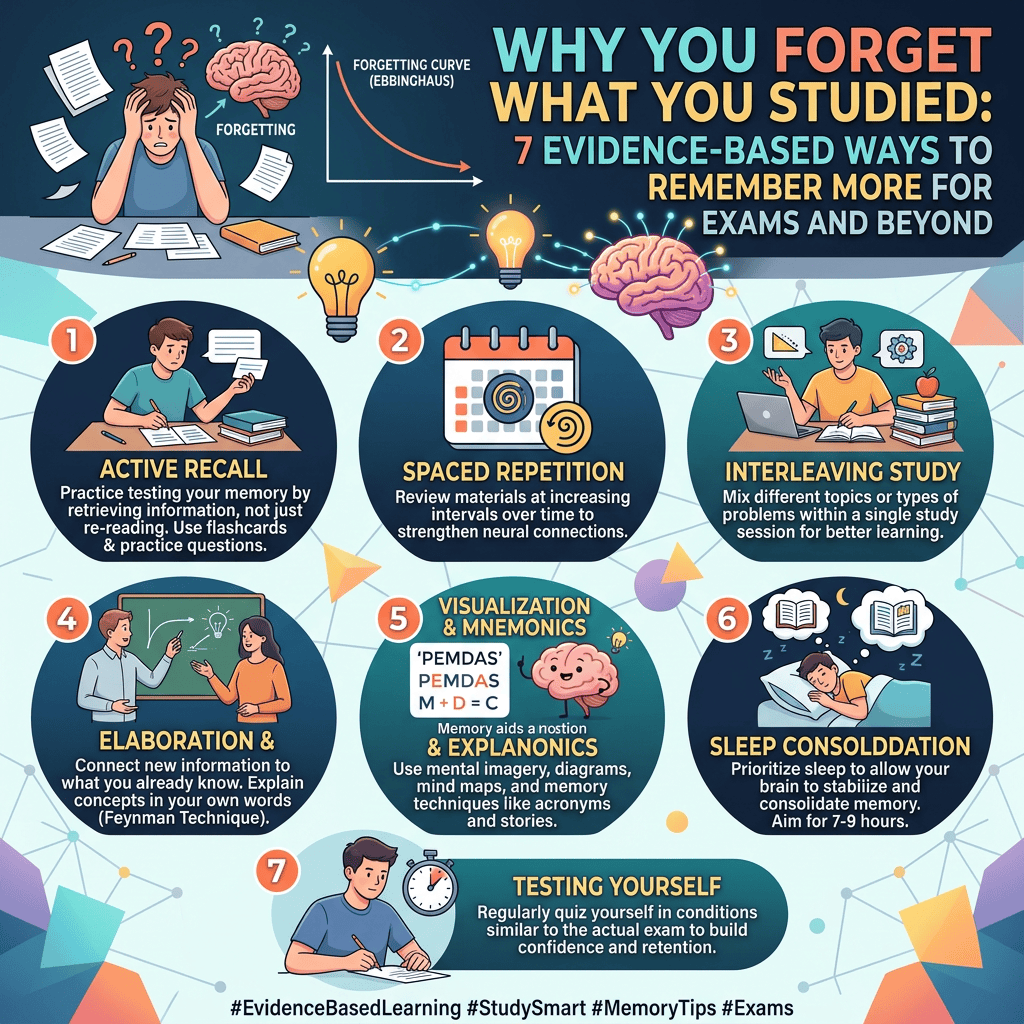
Here are seven approaches worth incorporating into your study routine.
1. Use retrieval practice instead of repeatedly rereading
Retrieval practice involves bringing information back from memory rather than simply looking at it again.
After studying a topic, close your book and ask yourself:
- What were the main arguments?
- Can I explain the process without looking?
- What are the key definitions?
- What examples can I remember?
- Which parts remain unclear?
You can use flashcards, practice questions, blank-page summaries or self-testing.
A systematic review by Agarwal, Nunes and Blunt examined 50 classroom experiments involving 5,374 learners. Most of the reported effect sizes showed medium or large benefits from retrieval practice.
This is strong support for including regular self-testing in education, although results will vary across contexts.
2. Space your revision over time
Many students rely on last-minute revision because it feels efficient.
However, studying everything in one long session may make it harder to retain information over longer periods.
Distributed practice, often called spaced practice, involves revisiting information across separate sessions.
For example, instead of studying a topic for three hours on one evening, you might review it briefly on several different days.
A simple illustrative schedule could be:
- First session: Learn the topic.
- Next day: Test yourself.
- Three days later: Review difficult points.
- One week later: Complete another practice test.
- Two weeks later: Apply the knowledge to a new question.
The ideal spacing depends on the difficulty of the subject and how long you need to retain the information.
3. Explain concepts in your own words
Understanding becomes more visible when you attempt to explain an idea without copying the textbook.
Choose a concept and explain it as though you were teaching someone who has never studied it.
If you cannot explain it clearly, identify the missing knowledge and return to the relevant material.
This approach can reveal gaps that passive reading might hide.
It also helps students distinguish genuine understanding from familiarity with terminology.
4. Connect new knowledge to what you already know
Learning becomes more meaningful when new information is connected to existing knowledge.
For example, a student learning about climate systems might connect new concepts to previously studied geography, physics and environmental science.
You can do this by:
- Comparing similar concepts.
- Creating concept maps.
- Identifying causes and consequences.
- Developing practical examples.
- Explaining relationships between theories.
The goal is not simply to memorise isolated facts but to understand how ideas relate to one another.
5. Mix different types of practice
Interleaving involves practising different but related topics rather than completing every question of one type before moving to another.
For example, a mathematics student might alternate between algebra, geometry and statistics problems.
This can encourage learners to identify which method is appropriate rather than automatically repeating the same procedure.
Interleaving is not always superior for every task, and beginners may initially benefit from focused practice before introducing more complex mixtures.
6. Use meaningful examples and apply knowledge
Information becomes more useful when students can apply it to real situations.
A business student might apply marketing theory to a company. A biology student might explain a concept using an observed process. A law student might analyse a hypothetical case using relevant legal principles.
Application encourages deeper processing and helps learners understand the conditions under which knowledge is useful.
7. Protect the conditions that support learning
Study methods matter, but so do the conditions in which learning takes place.
Adequate sleep, breaks, manageable workloads and a suitable study environment can support attention and effective learning.
Avoid assuming that sacrificing sleep to study longer will automatically improve examination performance.
If you are consistently exhausted, distracted or overwhelmed, changing your study schedule may be more useful than simply increasing the number of hours.
A practical weekly memory-building routine
| Day | Learning activity |
|---|---|
| Monday | Learn a new topic and create questions |
| Tuesday | Retrieve the main ideas without notes |
| Wednesday | Review errors and explain difficult concepts |
| Thursday | Practise mixed questions |
| Friday | Apply knowledge to a new example |
| Saturday | Complete a short self-test |
| Sunday | Review weak areas and plan the next week |
Adapt the routine to your timetable and assessment deadlines.
What should students stop doing?
Consider reducing these habits when they dominate your study routine:
- Highlighting large sections without testing yourself.
- Rereading notes without asking questions.
- Memorising definitions without understanding them.
- Revising only immediately before examinations.
- Watching educational videos without practising.
- Ignoring mistakes instead of learning from them.
These activities are not always useless. The problem arises when students mistake familiarity with material for durable learning.
Final verdict: The secret to remembering more is to practise remembering
Long-term learning requires more than exposure to information. Students need opportunities to retrieve, explain, apply and revisit what they have studied.
Research on retrieval practice and distributed practice provides a strong reason to move beyond passive revision habits.
Do not measure your learning only by how many pages you read. Measure it by what you can still explain and use when the book is closed.
Recommended further reading
- Retrieval Practice Consistently Benefits Student Learning (2021)
- Systematic Review of Distributed Practice and Retrieval Practice in Health Professions Education
- Retrieval Practice Versus Elaborative Encoding: A Systematic and Meta-analytic Review (2025)
Stay connected with Scholars Careers
Subscribe to Scholars Careers for practical strategies on academic success, research skills, study habits, scholarships and professional development. Follow our updates and share this article with students preparing for examinations.
Which study habit has helped you remember information for longer? Share your experience and help another student learn more effectively.
Disclaimer
This article is intended for general educational information and is not a guarantee of examination performance. Learning strategies differ in effectiveness depending on the learner, subject and assessment. Students who experience persistent difficulties with memory or concentration may benefit from appropriate professional or educational support. Scholars Careers is an independent educational platform and is not affiliated with the researchers or publishers mentioned.


