The traditional idea of a career often follows a predictable pattern: complete a degree, secure a full-time job, remain with one employer and gradually progress into more senior positions. This pathway still exists, and stable employment remains an important goal for many graduates. However, professional opportunities have become more varied, with some people combining employment, consulting, teaching, research, writing, project work and entrepreneurship throughout their careers.
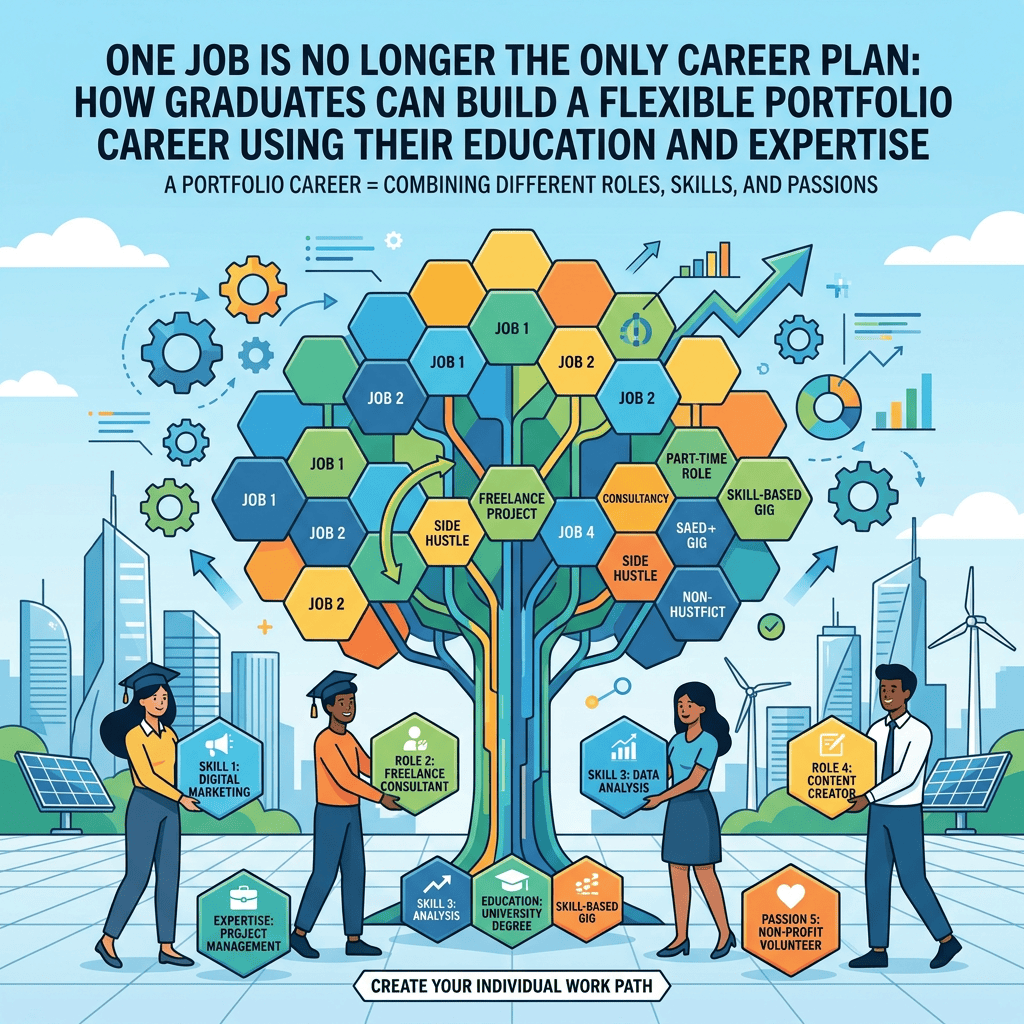
This approach is sometimes described as a portfolio career. Rather than depending on a single professional role, an individual develops a combination of activities that draw on different skills and sources of income. A researcher might work full-time in industry while teaching part-time, writing specialist articles or contributing to professional projects. A graduate in education might combine school employment with tutoring, curriculum development and educational consultancy. A data specialist may work for an organisation while undertaking occasional independent analytical projects, provided their employment and legal obligations permit it.
Portfolio careers can offer flexibility and opportunities to explore different interests, but they are not automatically more secure or profitable than traditional employment. They may involve irregular income, administrative responsibilities, competition for clients and the need to manage several commitments. This article explains how graduates can evaluate and develop a portfolio career responsibly.
1. What is a portfolio career?
A portfolio career combines two or more professional activities into a broader working life. These activities may be connected to one area of expertise or spread across different sectors. The common feature is that the individual develops several sources of professional contribution rather than relying entirely on one job title or employer.
The portfolio may include permanent employment, freelance projects, consultancy, teaching, research, writing, training, board or advisory work and business ownership. Not every person needs to combine all these activities. A portfolio should be designed around available time, financial requirements, professional interests and the rules that apply to the individual’s employment and location.
2. Why graduates and researchers may consider this approach
A portfolio career can allow graduates to use skills developed through education in different contexts. Someone with a doctorate in psychology might work in organisational research, provide specialist training where appropriately qualified and contribute to public communication. An environmental scientist might work in a consultancy while participating in research collaborations or developing educational materials.
For some people, a portfolio also provides a way to test new professional interests before making a major career change. A university researcher interested in science communication, for example, might develop a small writing portfolio alongside existing employment before deciding whether to pursue a full-time communications role. This gradual approach can provide information about the work and its market demand without immediately abandoning a stable position.
3. Identify the professional assets you can offer
The first step is to examine what people or organisations might reasonably pay you to do. Graduates should identify their strongest technical capabilities, subject expertise, communication skills, teaching experience, research methods and practical achievements. They should then consider which of these capabilities can be offered as a clearly defined service or professional contribution.
A broad statement such as “I can help with research” may be difficult for potential clients to understand. A more precise description might be “I support non-profit organisations with survey design and evaluation reporting” or “I develop technical training materials for early-career laboratory professionals.” Clear services help customers understand the value being offered and allow the provider to assess whether the work is within their competence.
4. Choose complementary activities rather than collecting unrelated jobs
A portfolio career is easier to manage when its activities reinforce one another. A researcher’s writing, teaching and consulting work may all draw on the same specialist knowledge, making it possible to develop a recognisable professional identity. By contrast, combining several unrelated activities can increase the administrative burden and make it harder to communicate a clear professional offer.
Complementary activities can also create opportunities for learning. Teaching may improve communication skills that are useful in consultancy, while applied projects may help researchers understand the practical questions that shape future research. However, these benefits depend on the nature of the work and should not be assumed in every case.
5. Build a professional reputation and visible portfolio
Potential clients and employers need evidence of capability. A professional portfolio may include a carefully selected CV, writing samples, technical projects, presentations, training materials, case studies or examples of previous work. Candidates should obtain permission before sharing confidential work and remove personal or commercially sensitive information.
A professional website or online profile can help explain services, qualifications and experience, but it should be accurate and easy to navigate. Testimonials should be genuine and used with permission. Graduates should avoid presenting unpaid practice projects as paid client work or exaggerating their responsibilities in collaborative projects.
6. Understand income, taxes and financial uncertainty
A portfolio career may involve several payment arrangements, such as a salary from employment, fees for consultancy, teaching payments or revenue from a business. Income can vary between months, particularly when project work is irregular or clients pay after delivery. Individuals should understand how much money they need for essential expenses and avoid assuming that potential future contracts are guaranteed income.
Record keeping is important. Depending on the jurisdiction and type of work, individuals may need to register as self-employed, report income, pay tax, maintain invoices and comply with business reporting obligations. They should also consider insurance, pension contributions, unpaid leave, equipment costs and periods without work. An accountant or qualified financial adviser can help clarify obligations and planning options.
7. Protect your time and prevent overcommitment
One of the most common risks of portfolio work is accepting too many commitments. People may agree to a consultancy project, teaching assignment and writing deadline without properly accounting for preparation, travel, communication and administration. This can lead to missed deadlines and reduced quality across the portfolio.
A realistic schedule should include the full time required to deliver each activity, not just the hours spent in direct contact with a client or employer. Individuals should define working boundaries, establish clear project terms and allow time for unexpected tasks. If the portfolio becomes difficult to manage, reducing the number of activities may be more sensible than trying to work continuously.
8. Check employment, confidentiality and conflicts of interest
People who combine independent work with employment need to review their contracts and organisational policies. Some employers require permission for outside work, restrict competing activities or have rules about the use of equipment, intellectual property and confidential information. Researchers may also have obligations arising from grants, research collaborations and university policies.
A portfolio should not create conflicts of interest or compromise professional standards. For example, an academic who consults for a company connected to their research may need to disclose the relationship and follow institutional procedures. Those working in regulated professions should check whether additional activities are permitted and whether separate insurance or registration is required.
9. Develop a client and opportunity pipeline
Portfolio professionals need a reliable way to identify potential opportunities. This may involve professional associations, alumni networks, conferences, former colleagues, specialist platforms, referrals and direct contact with organisations. The aim is to build professional relationships based on relevant expertise rather than relying on indiscriminate advertising.
A useful opportunity pipeline records prospective clients, the service discussed, the next action and the current status. It can help individuals avoid losing track of conversations and recognise whether demand is becoming concentrated in one client or sector. However, potential work should not be treated as confirmed income until a suitable agreement exists.
10. Create a long-term development plan
A portfolio career should evolve as professional interests and circumstances change. Some activities may provide income, while others develop reputation, skills or access to future opportunities. Individuals should review the balance regularly and consider whether each activity remains worthwhile.
A graduate might begin with full-time employment and occasional teaching, then gradually add consultancy once demand is established. A researcher may discover that professional writing is more fulfilling than independent consulting and choose to develop that area. There is no single correct portfolio structure; the best arrangement is one that is financially realistic, professionally credible and sustainable.
Frequently asked questions
Is a portfolio career the same as freelancing?
Not necessarily. Freelancing may be one component of a portfolio career, but a portfolio can also include permanent employment, teaching, research, consultancy and business ownership.
Can a PhD graduate have a portfolio career?
Yes. Doctoral graduates may combine research, industry employment, teaching, consulting, writing or other activities, provided they meet the relevant professional, contractual and legal requirements.
Is a portfolio career financially secure?
It can diversify income sources, but it can also create irregular earnings and additional costs. Financial security depends on demand, pricing, savings, contractual arrangements and the individual’s ability to manage risks.
Can I build a portfolio career while working full-time?
Possibly, but you should check your employment contract, outside-work policies, conflicts of interest and available time. Starting with a limited activity may be more sustainable than taking on several commitments at once.
Conclusion: Build a career around your strengths, not only a job title
A portfolio career can give graduates and researchers opportunities to combine expertise, explore professional interests and develop several forms of contribution. It is not a guaranteed route to higher income or greater freedom, and it requires careful planning, financial awareness and respect for employment and professional obligations. Nevertheless, it can provide an alternative to the assumption that a successful career must follow one employer, one role and one fixed progression.
The strongest portfolio careers are usually built deliberately. Individuals understand what they can offer, identify genuine demand, develop evidence of capability, protect their time and review the financial and professional value of each activity. With a realistic approach, education can become the foundation for a flexible working life that develops as interests and opportunities change.
Stay connected with Scholars Careers: Subscribe for more guidance on graduate employment, academic careers, entrepreneurship, research opportunities and professional development. Follow our updates and share this article with graduates who are exploring flexible career options.
Disclaimer: This article provides general career information and is not legal, tax, financial, immigration or employment advice. Rules on self-employment, outside work, taxation, professional registration and conflicts of interest vary by jurisdiction and contract. Consult relevant official guidance and qualified advisers before undertaking additional work.


