Imagine having access to a study assistant whenever you encounter a difficult mathematical equation, struggle to understand a scientific theory, need help interpreting a complicated reading passage or want to practise a foreign language. Instead of waiting for the next lesson or searching through dozens of online explanations, you could ask questions, request simpler examples and work through a problem at your own pace. This is one of the most attractive possibilities of artificial intelligence in education, and it is changing how students approach homework, revision and independent learning.
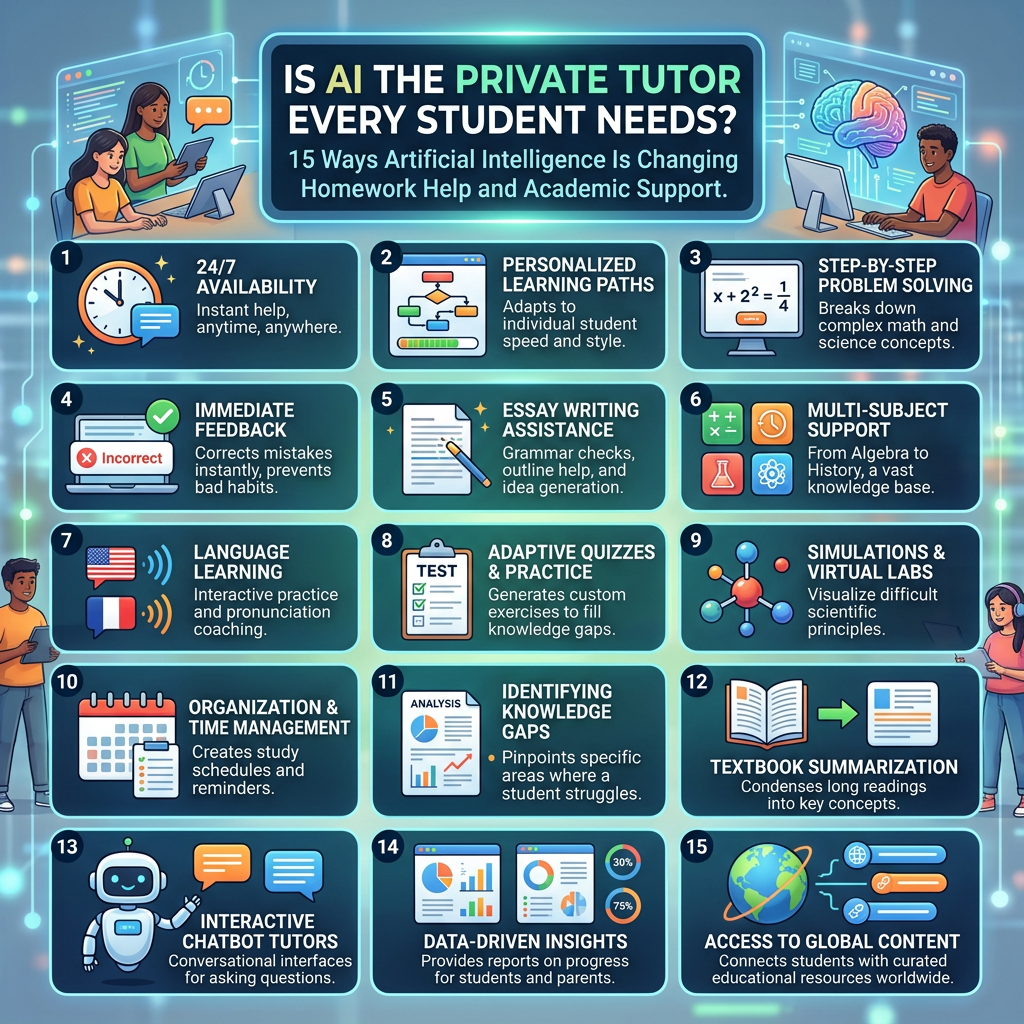
AI tutoring tools can explain concepts, generate practice questions, offer feedback, summarise study materials and help learners identify areas that need further attention. For students who cannot afford private tuition or who need additional explanations outside normal school hours, these capabilities may provide useful support. However, the growing availability of AI tools also creates important questions about accuracy, academic honesty, student privacy, overdependence and the quality of learning. An AI system can produce a convincing explanation that is incomplete or incorrect, and a student who copies its answer without understanding the underlying concept may finish an assignment without developing the skills the assignment was designed to assess.
The most useful way to approach AI tutoring is therefore to treat it as an additional learning resource rather than a replacement for teachers, textbooks, human tutors or independent thinking. This article explores 15 ways students can use AI for academic support while protecting the quality and integrity of their education.
1. Understand what an AI tutor can actually do
An AI tutor is a digital system that responds to questions and provides educational assistance through text, images, voice or other interfaces, depending on the platform. Some tools are designed specifically for mathematics, languages or examination preparation, while general-purpose AI assistants can support a wider range of subjects. Students may ask for definitions, worked examples, explanations, quizzes, revision plans or feedback on their understanding.
The important distinction is that an AI tutor does not necessarily teach in the same way as an experienced human educator. It generates responses based on patterns in data and the instructions it receives. It may adapt an explanation to a student’s request, but it does not automatically know the student’s full educational history, curriculum requirements or misconceptions. Students should provide relevant context and verify important information against reliable learning materials.
2. Ask for explanations rather than simply requesting answers
One of the most effective ways to use AI tutoring is to ask the system to explain the reasoning behind an answer. When a student encounters a difficult algebra problem, for example, requesting the final numerical result may help complete one question but provide little preparation for the next one. Asking for a step-by-step explanation, followed by a similar practice problem, creates a more useful learning experience.
Students can improve the quality of assistance by specifying their level and identifying where they became confused. A prompt such as, “Explain this quadratic equation as if I am learning algebra for the first time, show each step, and then give me a similar question without revealing the answer” gives the tool a clearer educational purpose. The student remains responsible for attempting the problem and checking whether the explanation makes sense.
3. Use AI to identify gaps in understanding
Many students continue revising a subject because they are familiar with the notes, not because they can independently explain or apply the concepts. AI can help test understanding by asking questions, presenting unfamiliar examples and requesting explanations in the student’s own words. This may reveal whether the learner understands a concept or has merely memorised a definition.
A student studying biology could ask an AI tutor to explain the difference between mitosis and meiosis, then request a series of questions that test the distinction. If the student repeatedly confuses chromosome behaviour or the purpose of each process, the tutor can be asked to revisit those areas. The student should still compare the explanation with their course materials, particularly where the syllabus uses specific terminology.
4. Break complicated subjects into manageable lessons
Some topics become difficult because they contain several connected ideas that students are expected to understand simultaneously. In mathematics, a learner may need to understand fractions before manipulating algebraic expressions. In programming, understanding variables and data types may be necessary before learning functions and object-oriented concepts. In a language course, grammar, vocabulary, pronunciation and sentence structure can interact in ways that initially seem overwhelming.
AI tools can help divide these subjects into smaller learning stages. A student can request a beginner explanation, a worked example, a visual analogy, a short practice activity and a final knowledge check. This approach can make independent study more organised, although students should follow the sequence and terminology required by their actual course.
5. Get additional homework support without outsourcing the assignment
Homework is intended to strengthen understanding, encourage independent practice and help teachers identify what students have learned. AI can support these aims when it explains instructions, clarifies concepts, offers hints or helps learners review their attempts. It becomes problematic when students submit generated work as their own or use an AI system to bypass the learning process.
A responsible approach is to attempt the question first, identify the specific difficulty and request a hint rather than an immediate solution. After receiving an explanation, the student should close the tool and try a comparable question independently. For essays, AI may help explain a writing concept or suggest ways to organise ideas, but students should follow their institution’s rules about permitted assistance and disclosure.
6. Use AI to prepare for examinations
AI tutoring can help students build a revision timetable, generate practice questions, create flashcards and explain mistakes from previous assessments. A learner preparing for a chemistry examination might ask for a revision sequence covering atomic structure, bonding, calculations and reaction types, with short quizzes after each topic.
The system should not be treated as an authoritative source of examination specifications. Students should use the official syllabus, assessment objectives and examination-board guidance to determine what is examinable. AI-generated questions can provide extra practice, but they may not match the difficulty, format or wording of the actual examination.
7. Make difficult mathematical concepts easier to understand
Mathematics is one area where AI tutoring can be useful because students often need several explanations before a concept becomes clear. A system can show an algebraic procedure, explain why a formula is used, generate additional examples and help a learner identify an incorrect step.
However, mathematical answers should be checked carefully. An AI system may make an arithmetic error, misinterpret a diagram or apply a method that is unsuitable for the student’s syllabus. Students should compare solutions with trusted textbooks, teacher explanations or reliable mathematical tools, and they should learn to perform essential calculations independently.
8. Learn programming through guided problem-solving
Programming students often encounter errors that are difficult to interpret, particularly when they are learning a language for the first time. AI can explain error messages, describe what a section of code does, generate small practice exercises and compare alternative approaches to a programming problem.
The greatest benefit comes when students use AI to understand the logic rather than simply copying code. They should ask what each line does, why a particular function is needed and how the solution might behave with different inputs. Code must be tested, reviewed for security and evaluated against assignment requirements; an explanation that sounds plausible does not prove that the code is correct.
9. Practise foreign languages through conversation
AI language tools can provide opportunities to practise vocabulary, grammar, reading comprehension and conversation. Learners can request a dialogue at beginner, intermediate or advanced level, ask for corrections and practise common situations such as ordering food, travelling, attending an interview or introducing themselves.
Students should be aware that generated language may sometimes sound unnatural or contain grammatical errors. Pronunciation feedback may also depend on the capabilities of the particular tool. Where possible, learners should combine AI practice with reputable dictionaries, structured courses, audio from fluent speakers and real conversations with teachers or language partners.
10. Turn class notes into useful revision resources
Students often accumulate lecture notes, slides, textbook extracts and reading materials without developing an effective system for reviewing them. Where a platform supports document uploads, learners may be able to use AI to organise their notes, identify key themes, generate questions or produce a topic summary.
However, summaries should be checked against the original material. An AI system may omit a qualification, misunderstand a diagram or give excessive attention to a minor point. Students should also consider copyright, institutional rules and privacy before uploading textbooks, unpublished materials, personal information or confidential documents.
11. Request feedback that improves academic writing
AI can help students identify unclear sentences, improve paragraph structure, understand grammar and evaluate whether an argument is logically organised. It may also explain the difference between describing evidence and critically evaluating it, which is particularly important in advanced academic writing.
The best use is developmental rather than substitutive. Students can write a paragraph themselves and ask the tool to identify where the argument becomes unclear, which claims need evidence or whether the conclusion follows from the discussion. They should retain ownership of their ideas and verify that any suggested changes preserve the intended meaning.
12. Learn through questions instead of passive reading
A student may understand a topic more deeply when required to explain it, apply it or defend an answer. AI tutoring can support this process by asking one question at a time, waiting for the student’s response and then providing feedback. This creates a more interactive experience than simply reading a long explanation.
For example, a student studying economics could ask the tutor to act as an examiner and question them about inflation, monetary policy and unemployment. The learner answers first, receives feedback and then attempts a more challenging question. Such practice can expose gaps in reasoning that may remain hidden during passive revision.
13. Use AI to make study support more accessible
Digital study tools may offer useful assistance to learners who need alternative explanations, adjustable reading levels, translation support or flexible opportunities to practise. Some platforms can rephrase complex passages, help organise study tasks or support students who are studying in a second language.
Nevertheless, accessibility should not be assumed. AI interfaces may be difficult for some learners, generated content may not meet accessibility standards, and automated explanations may not accommodate every disability or learning requirement. Students who receive formal educational support should continue working with teachers and relevant specialists rather than relying exclusively on a general-purpose AI assistant.
14. Protect personal information and academic integrity
Students should be cautious about sharing names, addresses, school records, assessment credentials, private correspondence or other sensitive information with online tools. They should check the platform’s privacy settings, age requirements and data-use policies, particularly when younger learners are involved. Schools and universities may also have rules about which tools can be used with institutional data.
Academic integrity is equally important. Students should not assume that a generated answer is acceptable simply because an AI tool produced it. The rules may differ between homework, coursework, examinations, research projects and collaborative assignments. Where disclosure is required, students should describe their use accurately and retain responsibility for the submitted work.
15. Combine AI support with human teaching
AI tutoring is most valuable when it complements a broader educational environment. Teachers understand curriculum expectations, classroom dynamics and the progress of individual learners in ways that general-purpose tools may not. Human tutors can also identify emotional barriers, respond to non-verbal communication and adapt their support through professional judgement.
A balanced study routine might involve attending lessons, reviewing class materials, asking an AI tutor to explain difficult concepts, completing independent practice and discussing unresolved questions with a teacher. This approach uses technology to increase opportunities for practice without removing the human relationships that are central to education.
Frequently asked questions
Can AI replace a private tutor?
AI can provide explanations and practice at flexible times, but it cannot reliably replace every function of a skilled human tutor. Human educators can assess wider learning needs, respond to classroom context and provide professional judgement that a general-purpose AI system may not offer.
Is it acceptable to use AI for homework?
That depends on the school’s or university’s rules and the specific assignment. Using AI for explanations or practice may be permitted, while submitting generated work as one’s own may violate academic integrity requirements.
Can AI help students prepare for examinations?
Yes. It can generate practice questions, explain difficult topics and help organise revision, but students should use official specifications and authentic examination resources as the main reference points.
Is AI tutoring suitable for younger children?
It depends on the tool, the child’s age, privacy protections, supervision and educational needs. Parents and schools should check age requirements and safeguarding arrangements before allowing children to use AI services independently.
Conclusion: The best AI tutor helps students become independent learners
Artificial intelligence is creating new possibilities for homework assistance, examination preparation and personalised study. Students can use it to explore complex ideas, practise difficult skills, receive additional explanations and organise revision. Yet the quality of the learning experience depends on how the technology is used. Copying answers may create the appearance of progress, whereas asking questions, testing understanding and attempting problems independently can support genuine learning.
The future of academic support is unlikely to depend on technology alone. Effective education will continue to require knowledgeable teachers, reliable learning materials, appropriate assessment and students who take responsibility for their development. AI can strengthen this environment when it is used carefully, transparently and with a clear educational purpose.
Stay connected with Scholars Careers: Subscribe for more guidance on AI in education, digital learning, academic success, scholarships and career development. Follow our updates and share this article with students, teachers and parents interested in responsible AI-assisted learning.
Disclaimer: This article is for general educational information and does not endorse any AI tool as a substitute for qualified teaching or professional educational support. Platform features, age requirements, privacy policies and institutional AI rules may change. Students should verify important information and follow the academic integrity policies of their schools or universities.


