For generations, many students have viewed a doctorate as a direct route into university teaching and academic research. The traditional progression appears straightforward: complete a PhD, secure a postdoctoral position, publish research, obtain a permanent academic appointment and eventually become a lecturer or professor. Although this remains a meaningful career path, it is no longer the only way to use advanced education. Competition for permanent academic positions can be intense, research funding may be uncertain, and some highly qualified graduates discover that their interests, financial priorities or preferred working environments have changed during doctoral study.
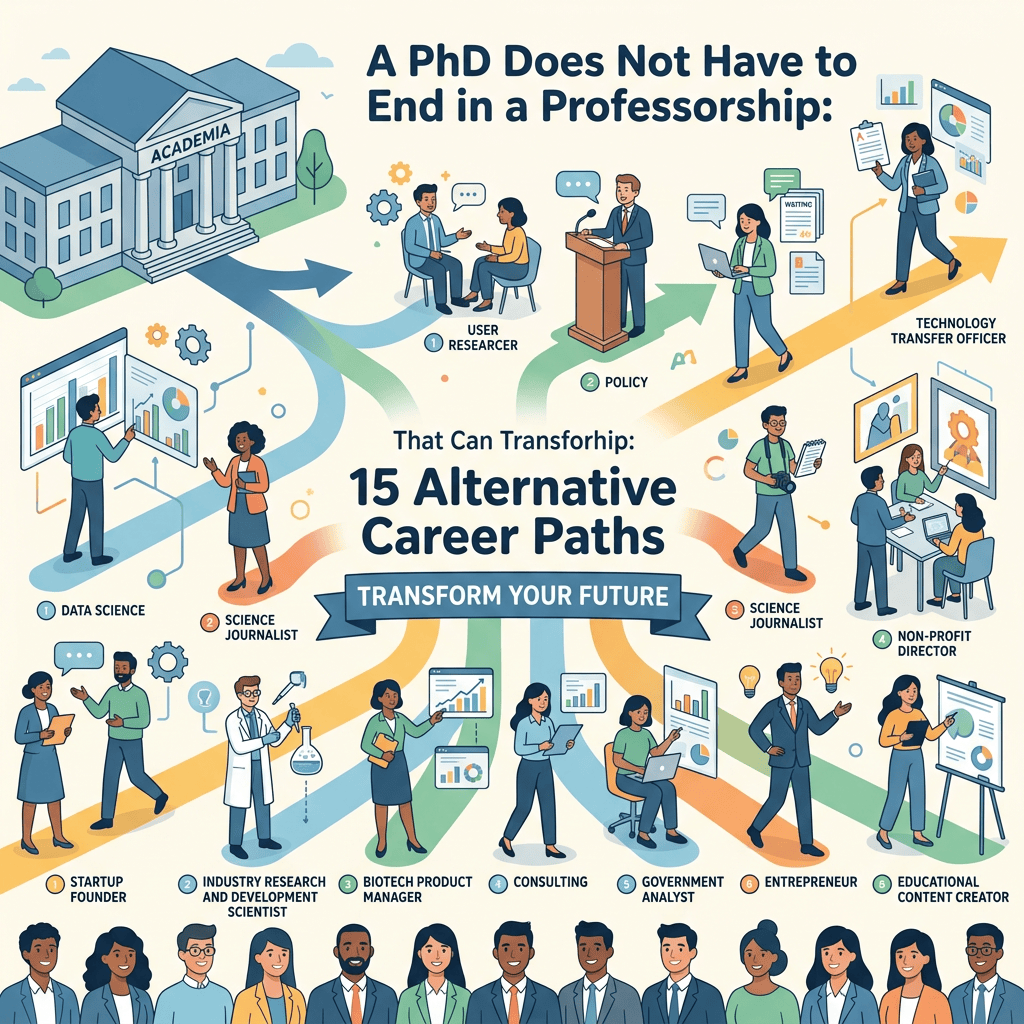
The important point is that a PhD is not simply a qualification for working inside a university. It is an extended period of developing expertise, investigating complex problems, evaluating evidence, communicating findings and managing projects with uncertain outcomes. These capabilities can be valuable in many organisations, although graduates must learn how to explain their relevance to employers outside academia.
This guide explores 15 career pathways that graduates and researchers can investigate, the skills they may need to develop and practical steps for making a transition.
1. Why consider a career beyond academia?
Leaving the traditional academic pathway does not mean abandoning research, intellectual development or professional ambition. Some graduates want more predictable career progression, opportunities to work in multidisciplinary teams, greater exposure to commercial applications or roles that connect research with public policy and everyday decisions. Others may enjoy research but prefer not to depend on short-term contracts, repeated relocation or a narrow competition for academic posts.
There is no universally superior career choice. A university role may provide the opportunity to teach, supervise students and pursue independent research, while an industry position may offer a different combination of resources, collaboration, commercial responsibility and professional development. The right choice depends on a person’s interests, circumstances and long-term priorities.
2. Fifteen career paths worth exploring
1. Research and development in industry. Companies in pharmaceuticals, engineering, biotechnology, technology, energy, agriculture and other sectors employ researchers to investigate problems, test products and improve existing processes. A PhD can be relevant when the role requires specialist knowledge or experience with complex research methods, but candidates should also demonstrate an understanding of commercial objectives, deadlines and teamwork.
2. Data science and analytics. Researchers who have worked with quantitative data, statistical modelling, programming or complex datasets may find opportunities in analytics teams. However, a research qualification alone does not automatically establish competence in industry data tools. Candidates may need to demonstrate practical ability in programming languages, databases, visualisation and communicating findings to non-specialists.
3. Government research and policy analysis. Government departments, public agencies and policy organisations employ people who can evaluate evidence, interpret data and explain the likely consequences of different decisions. Researchers in economics, public health, education, environmental science, law and social sciences may have relevant backgrounds, particularly when they can translate specialist findings into concise recommendations.
4. Scientific and technical communication. Research organisations, publishers, professional associations and science communication companies need people who can explain complex ideas accurately. Roles may include science writer, technical editor, research communicator, content specialist and public engagement officer. A strong writing portfolio and the ability to adapt content for different audiences are often important.
5. Medical and regulatory writing. Life-sciences graduates may investigate opportunities in medical communications, clinical documentation, regulatory writing and scientific publication support. These roles can require familiarity with specific regulatory frameworks, clinical research processes and industry standards, so additional training may be necessary.
6. Management and strategy consulting. Consulting firms recruit graduates to investigate organisational challenges, analyse information and develop recommendations. Researchers may bring valuable analytical and problem-solving experience, but they should be prepared for commercial case interviews, client communication, teamwork and sometimes demanding project schedules.
7. Intellectual property and patent-related work. Researchers in engineering, chemistry, biotechnology, computing and other technical fields may explore patent analysis, technology transfer and intellectual property support. Some positions require specific professional qualifications or legal training, so candidates should distinguish between technical patent-related roles and regulated legal practice.
8. University administration and research management. A person can work in higher education without holding an academic teaching position. Research offices, graduate schools, international offices and knowledge-exchange teams employ professionals who understand funding applications, research governance, doctoral education and institutional processes.
9. Research funding and grant development. Charities, universities, foundations, research councils and international organisations need staff who can manage funding programmes, evaluate applications or support researchers preparing proposals. Experience with budgets, project design, reporting and grant administration may be useful.
10. Public health and health policy. Graduates with relevant scientific, medical, epidemiological or social research experience may investigate roles in health research organisations, public agencies, charities and healthcare systems. Requirements vary considerably, and some clinical or regulated positions require professional registration rather than a research degree alone.
11. Environmental and sustainability careers. Climate research, environmental assessment, conservation, renewable energy and sustainability planning offer opportunities for specialists who can analyse evidence and assess complex systems. Employers may value technical expertise alongside knowledge of policy, regulation, stakeholder engagement and project delivery.
12. Educational technology and learning design. Researchers in education, psychology, computing and related fields may contribute to digital learning products, assessment systems, instructional design and educational research. Practical experience with learning platforms, user research and accessibility can strengthen applications.
13. Entrepreneurship and research commercialisation. Some researchers develop businesses around technology, specialist services, software, scientific products or professional knowledge. Starting a business involves market research, customer discovery, financial planning, intellectual property considerations and regulatory obligations, so the scientific idea is only one part of the process.
14. International development and programme evaluation. Non-governmental organisations, development agencies and international programmes recruit people who can assess interventions, conduct field research and evaluate outcomes. Relevant experience may include monitoring and evaluation, development economics, public health, education, governance or environmental policy.
15. Specialist professional and advisory roles. Depending on their discipline, graduates may enter scientific advisory work, risk analysis, forensic research support, market intelligence, technical due diligence or sector-specific policy roles. These positions often require a combination of specialist knowledge, practical experience and the ability to explain complex information clearly.
3. Translate academic skills into employer language
One of the biggest barriers to moving beyond academia is not necessarily a lack of ability; it is the difficulty of explaining academic experience in terms employers recognise. A doctoral candidate might describe a project as “investigating the relationship between variables through a mixed-methods approach,” whereas a commercial employer may be more interested in the ability to analyse complex information, identify patterns, manage a project and communicate evidence-based recommendations.
This does not mean exaggerating or disguising academic experience. It means explaining what the work involved, which tools were used, what decisions were made and what outcomes were produced. A candidate who managed a multi-year research project can describe project planning, stakeholder communication, risk management, budget awareness and delivery against milestones where those responsibilities genuinely applied.
4. Identify your skills gaps before applying
Candidates should review job descriptions in their target sector and identify the capabilities that appear repeatedly. A researcher interested in data science might need stronger programming and software engineering experience, while someone considering consulting may need to practise commercial problem-solving and concise presentations. A potential policy analyst may benefit from developing policy briefing skills and learning how government or public institutions use evidence.
The most effective development plan is usually focused. Rather than collecting unrelated certificates, candidates should select a small number of skills that are directly relevant to the roles they want. Practical projects, short courses, professional networks and supervised experience can help demonstrate capability, although no certificate guarantees employment.
5. Build experience before completing your degree
Where possible, students should explore career options before the final months of their doctorate. Internships, industry collaborations, professional conferences, volunteering, consultancy projects and university knowledge-exchange programmes can provide insight into different working environments. Even when a formal internship is unavailable, candidates may be able to contribute to interdisciplinary projects or develop a portfolio demonstrating relevant skills.
International students should also check visa and employment conditions before undertaking work experience, particularly where placements, self-employment or external consultancy are involved. Immigration rules differ by country and individual status, so official guidance should be checked before making commitments.
6. Rewrite your CV for the role you want
An academic CV is designed to document research achievements, teaching experience, publications, grants and scholarly contributions. An industry résumé or professional CV often needs a different structure, placing relevant skills, achievements and experience near the beginning. Publications can remain important for research-intensive industry positions, but they should not dominate an application for a role where project delivery, communication or commercial experience matters more.
A useful application should show how a candidate’s experience connects to the employer’s needs. Instead of listing only responsibilities, explain the scale and purpose of the work, the methods used and the results achieved. Claims should remain accurate and verifiable, and candidates should not invent commercial outcomes for academic projects.
7. Prepare for a different recruitment process
Some non-academic employers use competency interviews, technical assessments, case studies, presentations or practical tasks. Candidates who are accustomed to academic interviews may need to practise explaining their experience concisely and responding to questions about teamwork, conflict, deadlines, customer needs and decision-making.
A strong transition strategy involves preparing examples that demonstrate relevant capabilities. A researcher might explain how they resolved a methodological problem, coordinated a collaborative project or communicated an unexpected result to a mixed audience. These examples can show professional value without pretending that academic and commercial work are identical.
Frequently asked questions
Can I get a good job outside academia with a PhD?
Yes, PhD holders work across many sectors, but outcomes depend on discipline, experience, location, employer requirements and the skills demonstrated. A doctorate is an advantage in some roles and unnecessary in others.
Will leaving academia waste my PhD?
No. The knowledge and experience gained during doctoral study can remain valuable in research, policy, industry, communication and other professional settings. The challenge is identifying where those capabilities are relevant.
Do employers understand what a PhD involves?
Some employers have substantial experience recruiting researchers, while others may not understand the qualification’s practical value. Candidates should explain their achievements in clear, role-specific language.
Should I leave academia immediately after my PhD?
Not necessarily. Some graduates benefit from a postdoctoral position, industry placement or further professional training, while others move directly into another sector. The decision should reflect career goals rather than assumptions about what a successful PhD graduate is expected to do.
Conclusion: Your doctorate can open more than one professional door
A PhD represents a substantial investment in specialist knowledge, research capability and independent problem-solving, but it does not dictate one professional destination. Graduates can investigate careers in industry, public policy, consulting, research management, communication, education, sustainability and entrepreneurship, among other fields.
The most effective transition begins with honest self-assessment, careful exploration of job requirements and a clear explanation of how academic experience can solve problems outside the university. Rather than viewing non-academic employment as a second-best option, researchers should evaluate each opportunity on its actual responsibilities, working environment, development prospects and fit with their ambitions.
Stay connected with Scholars Careers: Subscribe for more guidance on PhD careers, academic opportunities, research funding and professional development. Follow our updates and share this article with postgraduate students and researchers considering their next career move.
Disclaimer: This article provides general career information and does not guarantee employment, salary levels, professional registration or visa eligibility. Requirements vary by country, employer and occupation. Candidates should check official job specifications and relevant professional or immigration guidance before making decisions.


