For students planning to apply to universities that consider standardised admissions tests, examination preparation can become one of the most demanding parts of the application journey. The SAT, for example, requires students to demonstrate skills in mathematics and reading and writing under timed conditions. Many candidates spend weeks watching online videos, downloading practice questions and searching for explanations, yet still struggle to identify which topics need attention or how to turn their practice results into measurable improvement.
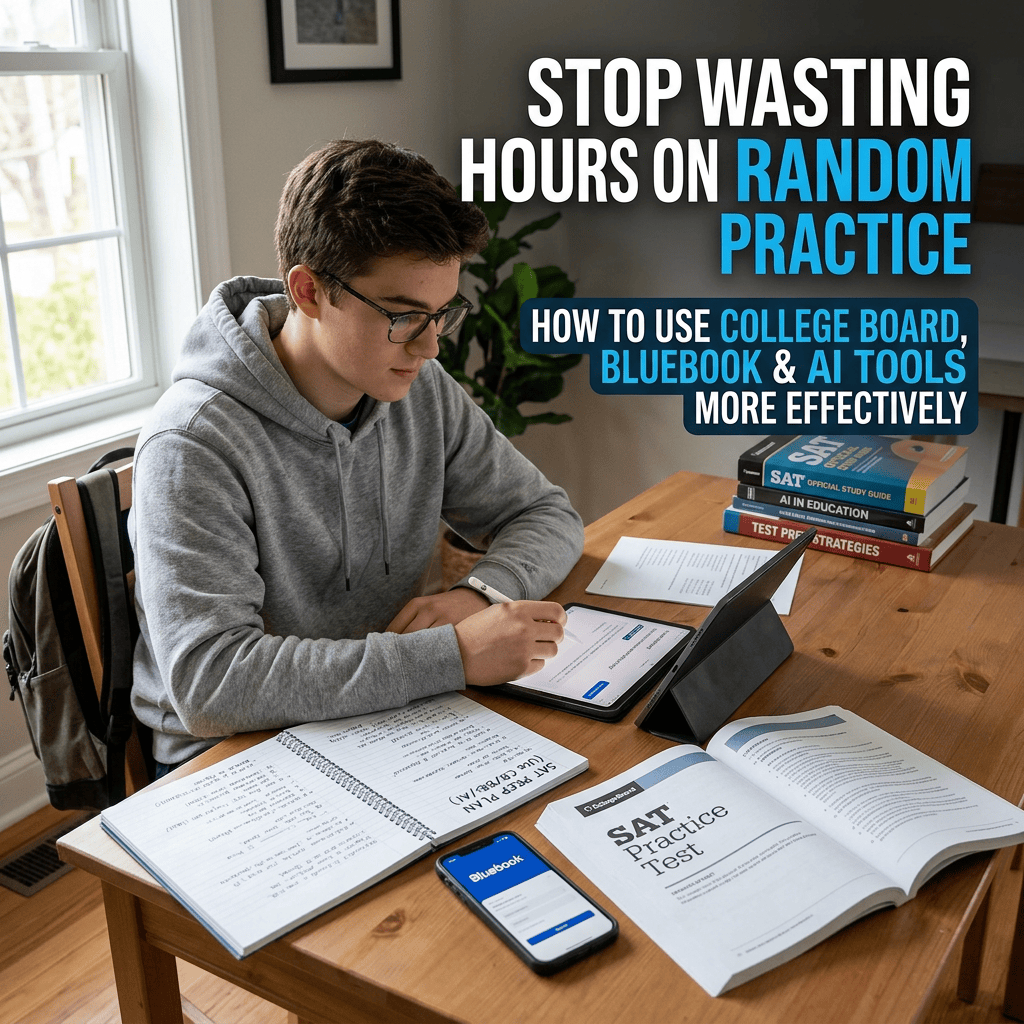
The problem is not necessarily a lack of effort. Students may be using resources that do not match the current examination format, practising questions without reviewing their mistakes or relying on unofficial materials that do not accurately reflect the skills being assessed. Artificial intelligence introduces additional opportunities to explain difficult questions and generate personalised practice, but it should complement rather than replace official examination resources.
The College Board provides a structured collection of digital SAT preparation materials, including full-length practice tests through its Bluebook application, a Student Question Bank and links to Official Digital SAT Prep on Khan Academy. Students can use these resources alongside carefully selected AI study tools to develop a more organised preparation strategy. This article explains how to build that strategy, avoid common mistakes and approach examination preparation with greater confidence.
1. Begin with the official examination requirements
Before choosing a preparation platform, students should establish which examination they are taking, when it will occur and which content areas it assesses. Examination formats can change, and resources designed for an older version of a test may no longer provide an accurate representation of the current assessment.
For the SAT, students should begin with the College Board’s official preparation information at SAT Suite Practice and Preparation. The official pages provide information about practice tests, preparation materials and the digital testing experience. Students should also check the requirements of their intended universities, since not every institution uses standardised tests in the same way.
2. Use Bluebook to become familiar with the digital SAT
The College Board’s Bluebook practice tests allow students to experience the digital examination environment and complete full-length practice tests. Familiarity with the interface can be important because examination performance involves more than subject knowledge; students also need to understand how to navigate questions, manage time and use the available digital tools.
The official practice information explains that full-length tests are timed and scored, and that students can review their results through My Practice. Bluebook also offers a test preview, which allows learners to explore the digital testing environment, although the preview itself does not provide a score. Students should distinguish between practising with an accommodation feature and being formally approved to receive that accommodation in the actual examination. College Board’s Bluebook guidance explains this distinction.
3. Use practice scores as diagnostic information
A practice score is useful because it provides an indication of current performance under particular testing conditions. However, it should not be treated as a prediction of guaranteed future results or as a measure of a student’s overall intelligence. Scores can vary depending on preparation, concentration, familiarity with the test, timing and other factors.
After completing a practice examination, students should review the questions they answered incorrectly, the questions they guessed and the questions that took too long. The aim is to identify patterns. A learner may discover that mathematical errors are concentrated in algebra, while reading and writing difficulties involve grammar or interpretation of evidence. This analysis provides a more useful foundation for revision than simply taking another full practice test.
4. Use the Student Question Bank for targeted practice
The College Board’s Student Question Bank provides access to official SAT Suite practice questions that students can use to focus on particular skills and levels of difficulty. Targeted practice is especially valuable after a diagnostic assessment because it allows students to concentrate on specific areas rather than repeatedly revising material they already understand.
Students should use the questions as opportunities to learn, not merely as a way of counting correct answers. After completing a set, they should review the explanations, identify the reason for each mistake and attempt additional questions that test the same skill. This process can help turn practice into a structured learning activity.
5. Combine College Board resources with Khan Academy
Khan Academy provides free digital SAT learning materials in mathematics and reading and writing. Its current digital SAT preparation courses include lessons, instructional content and practice opportunities. The platform’s role should be understood correctly: full-length digital SAT practice tests are provided through College Board’s Bluebook application, while Khan Academy provides additional instructional and targeted practice resources.
Students can begin by reviewing the relevant Khan Academy Digital SAT courses. The College Board also directs students to its official preparation resources through its SAT practice and preparation page. Because platform arrangements can change, candidates should check the current official guidance rather than rely on old tutorials that describe previous versions of SAT preparation.
6. Use AI to understand why an answer is correct or incorrect
AI tools can provide additional explanations when a student struggles to understand a practice question. A learner might paste a question they are permitted to share, describe their attempted solution and ask for a step-by-step explanation. The tool can then explain the underlying concept, identify a possible reasoning error and generate a similar practice problem.
Students should avoid treating AI-generated explanations as official examination guidance. The system may misinterpret a question, produce an incorrect calculation or explain a method that is unnecessarily complicated. Whenever possible, students should compare the explanation with the official answer rationale or a trusted instructional resource.
7. Develop a mathematics revision strategy
SAT mathematics preparation should involve more than memorising formulas. Students need to understand the relationships between mathematical concepts and apply them to unfamiliar questions. Depending on the examination content, preparation may involve algebra, functions, data analysis, geometry and other relevant mathematical skills.
A useful approach is to group practice questions by topic and difficulty, then record recurring mistakes. If a student repeatedly struggles with linear equations, they should review the concept, study worked examples and complete a sequence of practice questions before moving to more difficult applications. AI can provide additional explanations, but independent problem-solving remains essential.
8. Strengthen reading and writing skills
Reading and writing preparation involves more than memorising grammar rules. Students need to understand the purpose of a passage, interpret evidence, recognise relationships between ideas and select appropriate language. They should practise reading carefully, identifying the central meaning of a text and evaluating why one answer is better supported than another.
AI can help explain unfamiliar vocabulary, clarify grammatical structures and create additional exercises. However, students should not rely exclusively on generated passages because they may not accurately reproduce the style or difficulty of official examination questions. Official College Board materials should remain central to test-specific preparation.
9. Create a realistic study timetable
Students often make ambitious revision plans that are difficult to maintain alongside school, work, family responsibilities and other examinations. A realistic timetable should allocate time to specific skills, practice activities and review sessions. It should also include rest and allow for changes when a student discovers that a topic requires more attention than expected.
For example, a weekly plan might include mathematics practice on selected days, reading and writing exercises on others, and a shorter review session at the end of the week. Students preparing for several examinations should coordinate their schedules so that SAT preparation does not undermine performance in their regular school subjects.
10. Practise under examination conditions
Untimed practice can be useful when learning a new method, but students also need opportunities to work within realistic time limits. Full-length practice tests help candidates experience the concentration and pacing required by an examination. They can also reveal whether a student understands the content but struggles to complete questions within the available time.
Students should avoid taking full practice tests too frequently without reviewing their results. A practice examination takes time and energy, and its educational value depends partly on what happens afterwards. Reviewing errors, identifying patterns and practising weak skills may be more productive than repeatedly completing tests without a clear plan.
11. Use AI-generated practice questions carefully
AI can generate additional practice exercises when students need more opportunities to work on a particular concept. For example, a learner who struggles with percentages might request a sequence of questions that begins with basic calculations and progresses towards more complex applications. The tool can also provide explanations after the learner submits an answer.
However, generated questions should be treated as supplementary practice rather than authentic representations of the SAT. They may not match the official examination’s wording, difficulty or scoring approach. Students should not use unofficial AI-generated score predictions as a substitute for official practice-test results.
12. Address examination anxiety as part of preparation
Exam preparation involves psychological as well as academic demands. Students may worry about disappointing family members, missing application deadlines or failing to achieve a score they believe is necessary for university admission. Excessive anxiety can interfere with concentration and make revision less effective.
A structured preparation plan can reduce uncertainty by turning a large goal into manageable tasks. Students may also benefit from practising under timed conditions, maintaining a healthy sleep routine and discussing persistent anxiety with a trusted teacher, counsellor or qualified professional. AI tools may offer general relaxation exercises or help organise revision, but they are not a substitute for mental health support.
13. Check university admissions requirements before deciding on a test
A common mistake is assuming that every university requires the SAT or that a particular score guarantees admission. Institutions have different admissions policies, and requirements can vary by course, applicant category, application year and educational background. Some universities are test-required, some are test-optional and others may have different arrangements.
Students should check the official admissions page of every institution on their shortlist. They should also consider whether other qualifications, such as school-leaving examinations, national qualifications, language tests or subject-specific assessments, are required. The College Board provides information about the SAT, but individual universities determine how they use scores in admissions.
14. Avoid unreliable preparation products and misleading promises
Students should be cautious of services that guarantee exceptional scores, claim to possess confidential examination questions or promise access to leaked papers. Such claims may be misleading or fraudulent. Preparation resources should be evaluated according to their accuracy, transparency, teaching quality and relevance to the current examination.
Before paying for a course, students should examine the curriculum, instructor qualifications, refund policy, sample materials and independent reviews. Free official resources should be considered before purchasing expensive products, particularly when a family has limited financial resources.
15. Evaluate progress through learning, not only scores
A strong preparation strategy should help students become more capable of understanding and applying the assessed skills. Practice scores provide useful information, but students should also examine whether they can explain their reasoning, solve unfamiliar problems and manage their time more effectively.
At the end of each study week, learners can review which topics improved, which mistakes continued and what should be prioritised next. If progress is limited, they may need to change the learning method, obtain human tutoring or revisit foundational knowledge rather than simply increase the number of practice questions.
Frequently asked questions
Is College Board Bluebook free?
College Board provides free digital SAT practice tests through Bluebook. Students should consult the official practice pages for current access instructions and technical requirements.
Can Khan Academy replace Bluebook?
No. Khan Academy provides digital SAT instructional and practice materials, while College Board provides the full-length digital SAT practice tests through Bluebook. Students can use the resources together.
Can AI predict my SAT score?
AI-generated predictions should not be treated as official or reliable score forecasts. Students should use official scored practice tests and interpret results as indicators of current performance under practice conditions.
How many practice tests should I complete?
There is no universal number that guarantees success. Students should prioritise meaningful review and targeted improvement rather than completing tests without analysing their mistakes.
Conclusion: Prepare strategically, practise authentically and learn from every mistake
Successful examination preparation depends on using the right resources in the right way. College Board’s official materials provide a foundation for understanding the digital SAT, while Khan Academy offers additional instructional practice and AI tools can help explain difficult concepts. Together, these resources can support a more organised approach, provided students verify information and remain responsible for their own learning.
Rather than spending months collecting random worksheets and watching unrelated videos, candidates should begin with a diagnostic assessment, identify their weakest skills, practise systematically and review their mistakes. Examination success cannot be guaranteed by any platform, tutor or preparation timetable, but a thoughtful strategy can help students make better use of their time and prepare with greater confidence.
Stay connected with Scholars Careers: Subscribe for more examination preparation advice, study strategies, scholarship information and university application guidance. Follow our updates and share this article with students preparing for the SAT or other standardised assessments.
Disclaimer: This article provides general educational guidance and is not affiliated with or endorsed by College Board or Khan Academy. Examination formats, platform features and university admissions policies can change. Always consult official examination and university websites for current requirements.


