The market for online academic support has expanded rapidly, giving students and parents an enormous range of options for homework assistance, examination preparation, tutoring and independent learning. Some platforms provide structured lessons and curriculum-based exercises, while others offer interactive quizzes, video tutorials, language practice or AI-generated explanations. General-purpose AI assistants have added another dimension by allowing learners to ask questions, upload study materials where supported and request explanations adapted to their needs.
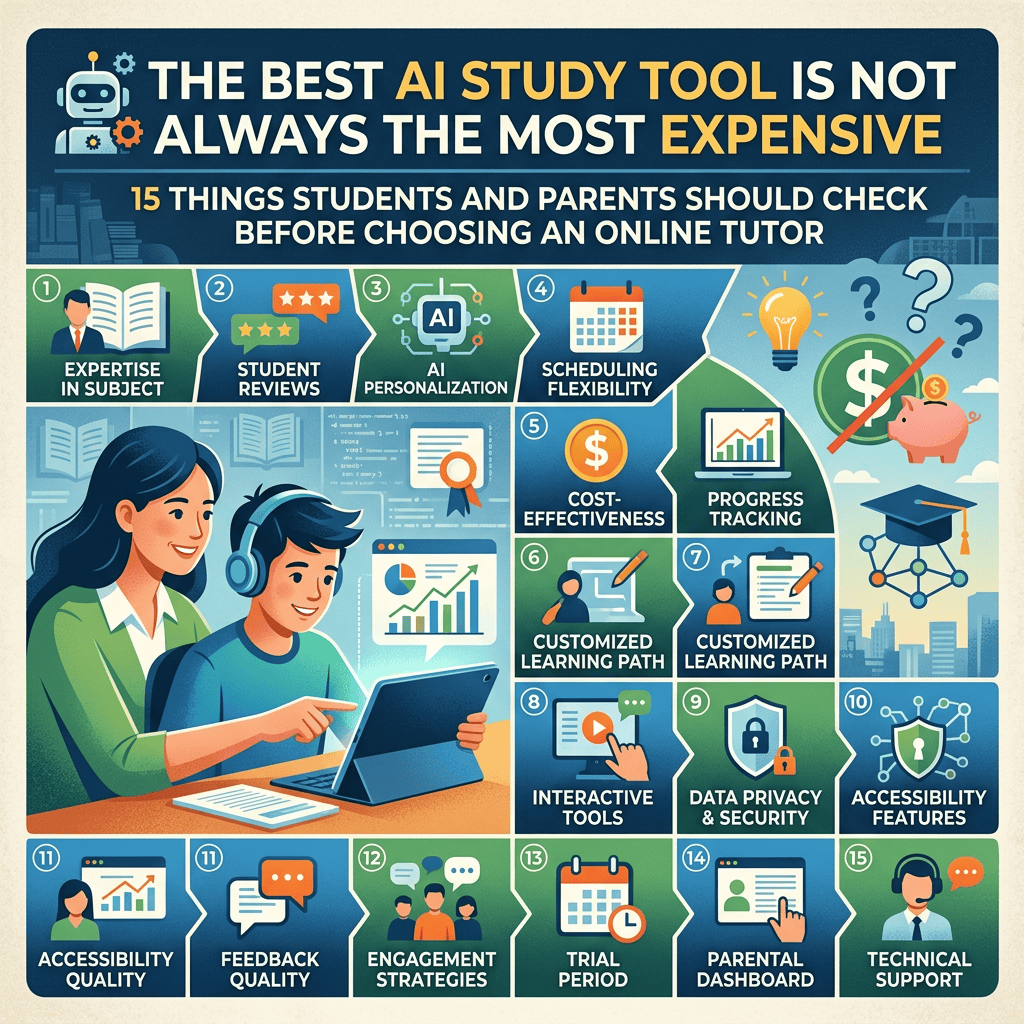
Although this wider choice can make educational support more accessible, it also creates a difficult purchasing decision. A platform with impressive advertising may not provide the quality of instruction a student needs, and an expensive subscription does not necessarily offer better educational value than a free resource. Some services focus on examination preparation, others on general subject learning, and some provide automated answers without sufficient attention to whether students actually understand the material.
Students and parents should therefore evaluate online learning tools according to their educational purpose, accuracy, teaching quality, privacy, accessibility and cost. The best resource is not necessarily the one with the largest number of features; it is the one that helps a particular learner make meaningful progress while supporting independent thinking. This guide provides 15 practical criteria for selecting academic support platforms and AI tutoring tools.
1. Start by identifying the student’s actual learning needs
Before purchasing a subscription or downloading another application, students should identify the problem they are trying to solve. A learner preparing for the SAT may need official examination practice, while someone struggling with algebra may need detailed explanations and additional exercises. A university student learning programming may benefit from practical coding projects, whereas a language learner may need regular conversation practice and feedback on grammar.
This distinction matters because no single platform is designed to meet every educational need equally well. Students should identify the subject, educational level, assessment requirements and type of support they need before comparing products. A clear objective makes it easier to reject tools that offer attractive features but do not address the actual problem.
2. Check whether the content matches the student’s curriculum
A platform may provide excellent general explanations while still being unsuitable for a particular school syllabus or examination. Differences in terminology, assessment objectives, mathematical methods and subject coverage can create confusion when students use resources designed for another curriculum.
Before choosing a service, parents and students should check its subject coverage, educational level and alignment with the relevant examination or course. In the United Kingdom, for example, students may need resources aligned with their particular GCSE, A-level or vocational qualification. International students may need materials suited to a different national curriculum or university admissions system.
3. Give priority to educational accuracy
Accuracy should be one of the most important considerations when evaluating an academic support platform. An incorrect explanation can reinforce a misunderstanding, and students may find it difficult to recognise an error when they are learning a subject for the first time. AI systems can sometimes produce plausible but incorrect answers, especially when questions are ambiguous or require detailed calculations.
Students should check whether the platform provides explanations, references, worked examples and opportunities to verify answers. For examination preparation, official materials from the examination provider should be prioritised. For advanced academic subjects, textbooks, reputable educational institutions and recognised academic sources can provide additional verification.
4. Look for teaching features rather than answer generation alone
A useful academic support platform should help students understand the material, not merely provide completed answers. Features such as guided explanations, worked examples, interactive exercises, hints, quizzes and feedback can make learning more active.
When evaluating an AI tutor, students should test whether it can explain a concept in different ways, ask questions about the learner’s reasoning and generate suitable practice exercises. A tool that immediately provides the final answer to every question may be convenient, but it may not encourage the independent problem-solving skills required for examinations and future study.
5. Evaluate whether the platform supports independent learning
Good educational support should gradually help students become more independent. A learner should be able to move from guided examples to practising with fewer hints and eventually solving unfamiliar questions without assistance.
Parents and teachers can assess this by asking students to explain what they have learned after using a platform. If the student can repeat an answer but cannot explain the reasoning or solve a similar question, the tool may be providing convenience without sufficient understanding. Independent knowledge checks should therefore form part of the learning process.
6. Consider free educational resources before paying
Many high-quality educational resources are available without a paid subscription. Students can investigate structured lessons, practice materials and subject explanations from recognised educational organisations before committing money to commercial platforms.
Useful starting points include:
- Khan Academy — free lessons and practice across a wide range of subjects, including mathematics and science.
- BBC Bitesize — educational resources covering school subjects and examination preparation.
- OpenLearn — free learning materials and courses from The Open University.
- freeCodeCamp — programming education and practical coding exercises.
- BBC Learning English — English language learning materials.
- College Board SAT preparation — official digital SAT preparation resources.
Free resources may be sufficient for many students, although some learners may benefit from additional human tutoring or specialist paid services. The important question is whether a paid product provides a meaningful benefit that cannot reasonably be obtained from suitable free alternatives.
7. Understand what AI study features actually provide
AI-enabled platforms may advertise personalised tutoring, instant feedback, adaptive learning and automated assessment. Students should investigate what these features mean in practice rather than relying on promotional language.
For example, a tool that generates questions based on a learner’s previous answers may offer useful practice, but this does not necessarily mean that it has accurately diagnosed the student’s underlying learning difficulties. Similarly, a chatbot that can explain a topic is not automatically equivalent to a qualified teacher who understands the curriculum and the learner’s progress.
Students should test a platform using real learning tasks and assess whether its explanations are clear, relevant and accurate. They should also examine the limitations of the system and understand when human assistance is necessary.
8. Check privacy and data protection arrangements
Online study platforms may collect account details, learning activity, assessment results, device information and other data. AI systems may also process questions, uploaded documents or images. Students and parents should understand what information is collected, how it is used, whether it is retained and what controls are available.
This is particularly important for children and young people. Parents should check age requirements, parental controls and the platform’s privacy policy before creating an account. Students should avoid uploading confidential school documents, personal records or sensitive information unless they have confirmed that the platform is approved for that purpose.
9. Consider age suitability and safeguarding
A platform suitable for a university student may not be appropriate for a primary-school learner. Younger students may need simpler interfaces, carefully controlled content and adult supervision. Parents should also consider whether the tool includes advertising, social interaction, external links or features that allow users to communicate with strangers.
Schools should assess educational technology according to their safeguarding policies and the age of the students using it. An application should not be adopted simply because it is popular or inexpensive. Its design, content and data practices should be appropriate for the intended learners.
10. Check accessibility and inclusive learning features
Students have different educational needs, and a platform that works well for one learner may create barriers for another. Useful accessibility features may include adjustable text sizes, keyboard navigation, captions, screen-reader compatibility, alternative input methods and clear visual presentation.
Learners with disabilities or additional educational needs should not be expected to adapt to inaccessible software without support. Parents and schools should examine whether the platform meets relevant accessibility requirements and whether it complements any formal accommodations or specialist teaching arrangements.
11. Compare the real cost of subscriptions
Subscription prices can be misleading when platforms advertise low introductory rates or offer features through several different payment tiers. Students and parents should examine the full cost, including renewal prices, additional purchases, cancellation requirements and any charges for premium content.
A family should also consider how frequently the learner will use the service. Paying for several overlapping subscriptions may provide little additional value if the student uses only a small proportion of the available features. A simple comparison of cost, educational purpose and expected usage can help avoid unnecessary expenditure.
12. Check whether the platform provides meaningful progress information
Progress dashboards and automated reports can help students understand which topics they have practised and where further revision may be needed. However, a high activity score does not necessarily indicate strong understanding. Completing many exercises, watching several videos or spending hours on a platform should not be confused with mastering a subject.
Useful progress information should show what the student can do, which skills remain difficult and what the next learning steps might be. Students should combine digital progress reports with independent practice, teacher feedback and actual assessment performance.
13. Examine the qualifications and credibility of human tutors
Where a platform provides human tutoring, students should investigate the tutors’ qualifications, subject knowledge, experience and teaching approach. A tutor who has achieved a high examination score may be knowledgeable, but that does not automatically mean they have the skills required to explain concepts effectively to another learner.
Parents should also understand how tutors are selected, whether background checks are required, how lessons are supervised and what safeguarding procedures apply. Students should be able to ask questions, receive constructive feedback and understand the learning objectives of each session.
14. Avoid misleading claims and guaranteed results
Some educational services use ambitious marketing claims, suggesting that a particular subscription will guarantee top grades, admission to prestigious universities or exceptional examination scores. Students and parents should be cautious because academic performance depends on many factors, including prior knowledge, teaching quality, effort, assessment conditions and individual circumstances.
A credible platform should explain what it provides without promising outcomes it cannot control. It should present its pricing and terms clearly, avoid misleading testimonials and distinguish between verified evidence and promotional claims. Independent reviews may provide useful information, but they should be considered alongside the platform’s actual features and terms.
15. Review the platform regularly
Choosing a study tool should not be a permanent decision. Students’ needs change as they move between educational levels, prepare for different examinations or develop new interests. A platform that was useful for introductory mathematics may become less relevant when the learner begins advanced calculus, while a language-learning application may no longer provide enough speaking practice for an advanced student.
Parents and students should periodically review whether the service is being used, whether learning has improved and whether the cost remains justified. If a tool is no longer useful, cancelling the subscription and selecting a more appropriate resource may be the better decision.
A practical comparison of academic support options
The following table summarises the main types of educational support and the circumstances in which they may be useful.
| Resource type | Main advantage | Important limitation |
|---|---|---|
| AI tutoring assistant | Flexible explanations and additional practice | May produce incorrect or incomplete answers |
| Official examination resources | Relevant assessment format and authoritative guidance | May provide less individual explanation |
| Structured online courses | Organised lessons and progression | May not address every personal difficulty |
| Human private tutor | Personalised teaching and professional judgement | Can be expensive and availability may vary |
| Free educational websites | Accessible learning materials | Quality and curriculum relevance vary |
| Specialist subject platforms | Focused exercises and technical practice | May cover only a limited subject area |
Frequently asked questions
Are free AI study tools good enough for students?
Some free tools can provide useful explanations and practice, but their suitability depends on accuracy, features, subject coverage and privacy arrangements. Students should test the available free resources before paying for additional services.
Should parents pay for an AI tutor?
Only after assessing whether the tool addresses a genuine learning need and offers sufficient value. A paid subscription is not automatically better than free educational resources or appropriate human support.
Can an AI study tool identify learning disabilities?
General-purpose AI tools should not be treated as diagnostic services. Students with suspected learning difficulties should be assessed by appropriately qualified professionals.
How can students know whether an online tutor is trustworthy?
They should examine qualifications, educational experience, platform policies, safeguarding procedures, transparent pricing and independent evidence of service quality. They should be cautious of guaranteed results and unverifiable claims.
Conclusion: Choose educational technology according to learning value, not advertising
Online academic support and AI tutoring can provide students with more ways to understand difficult subjects, prepare for examinations and develop independent study habits. However, the growing number of platforms makes careful selection essential. Students and parents should prioritise accuracy, educational quality, curriculum relevance, privacy, accessibility and affordability rather than assuming that the most expensive or heavily advertised product is the best.
The strongest learning strategy often combines several resources: official examination materials, structured online lessons, textbooks, appropriate AI assistance and human teaching when necessary. By evaluating tools according to genuine educational needs and reviewing their value regularly, families can make more informed decisions about where to invest their time and money.
Stay connected with Scholars Careers: Subscribe for more guidance on AI study tools, academic support, examination preparation, scholarships and educational technology. Follow our updates and share this article with students, teachers and parents who want to make informed decisions about online learning resources.
Disclaimer: This article is for general educational information and does not endorse or guarantee the performance of any specific commercial platform. Features, prices, eligibility conditions and privacy policies can change. Parents and students should review official terms and seek appropriate professional educational advice where necessary.


