Professional certifications can help candidates demonstrate specialised knowledge, develop technical competence and show commitment to a particular career path. In fields such as information technology, project management, accounting, finance, human resources and digital marketing, employers may recognise selected credentials as evidence that an applicant has studied a relevant body of knowledge or passed an assessment. For graduates and career changers, a well-chosen certification can provide a structured route into a new subject and help make a CV more relevant to particular vacancies.
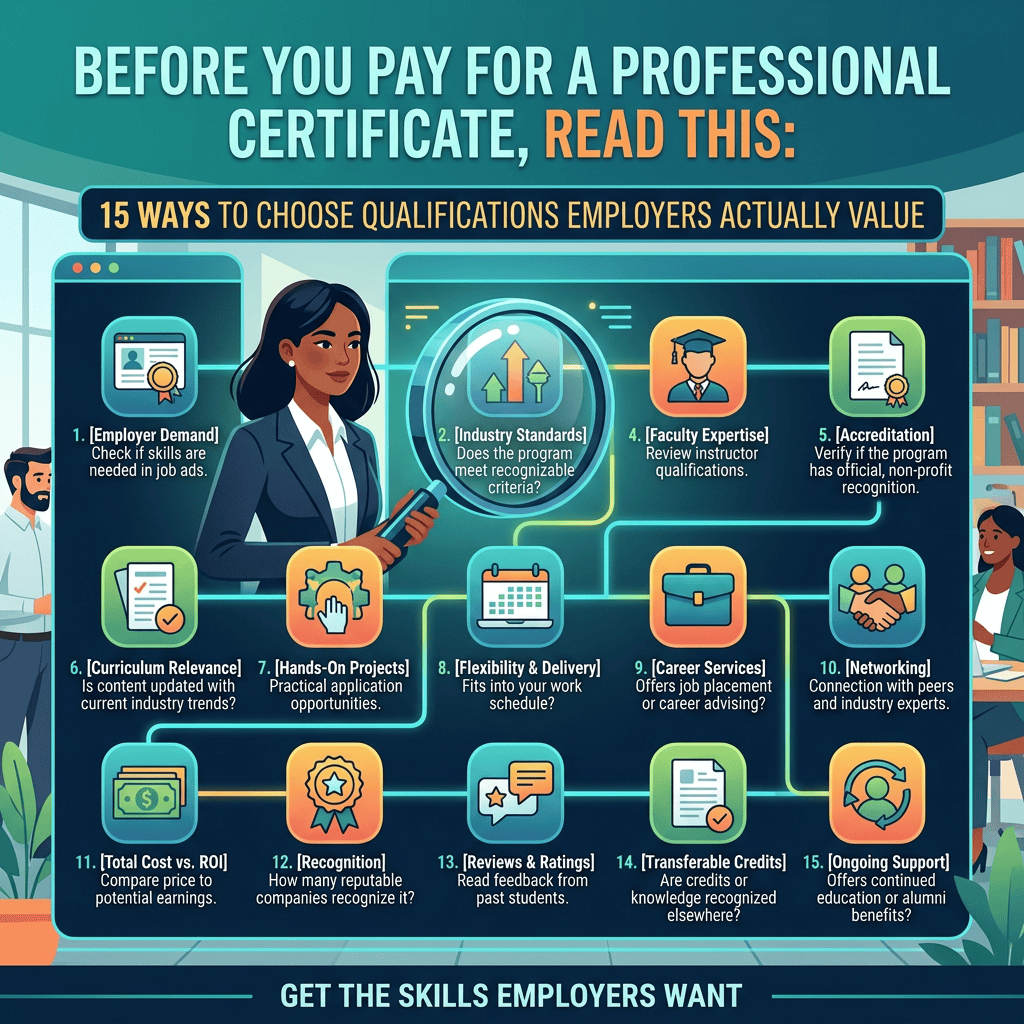
However, the growing number of online certificates has made it harder to distinguish credible professional development from qualifications that offer limited value. A course may advertise itself as internationally recognised without explaining who recognises it, what assessment is involved or whether employers in the target industry actually request it. Some credentials are respected within a profession, while others are simply certificates of course completion. Paying for the wrong programme can cost money and time without improving a candidate’s competitiveness.
The solution is to evaluate a certification as a career investment. It should be selected because it develops or verifies a skill that is relevant to a particular role, not because its title sounds impressive. This article explains how to research certifications, compare providers, evaluate costs and turn a qualification into evidence of professional competence.
1. Start with the job you want, not the certificate you have seen advertised
A professional certificate should support a defined career objective. Someone interested in project coordination may benefit from learning scheduling, risk management and stakeholder communication, while a candidate pursuing data analysis may need spreadsheet, database and visualisation skills. A person interested in cybersecurity may require technical foundations that are quite different from those needed in general business administration.
Before enrolling, select several job titles and examine current vacancies. Record qualifications that appear repeatedly, identify essential versus desirable requirements and note whether employers mention a specific certification or simply request practical experience. This research will help you avoid paying for training that has little connection to your intended role.
2. Distinguish professional certification from course completion
A certificate of completion normally confirms that a learner finished a course or met its attendance requirements. A professional certification may require an examination, practical assessment, documented experience or ongoing professional development. The precise meaning depends on the organisation issuing it.
Neither type of certificate should be dismissed automatically. A completion certificate may demonstrate introductory learning, while a professional certification may provide stronger evidence of assessed competence. The important point is to describe the credential accurately on a CV and never imply that a short introductory course is a regulated professional licence or advanced industry qualification.
3. Check the organisation issuing the credential
Find out whether the certificate comes from a university, professional association, industry body, recognised awarding organisation or commercial training provider. Examine the organisation’s history, subject expertise, governance and assessment standards. If it claims to be recognised by employers, identify which employers and what that recognition actually means.
For qualifications in England and Northern Ireland, the government’s Register of Regulated Qualifications allows users to check whether a qualification is regulated and obtain further information. <Cite refs={[“turn958494search2”]}/> This register does not cover every course or professional certificate, so absence from the register does not automatically mean that a programme is worthless. It does mean learners should distinguish between regulated qualifications and other forms of professional learning.
4. Look for assessment that tests real competence
A certification is more convincing when the assessment reflects the work the learner is expected to perform. A cybersecurity programme might include practical scenarios, while a project management qualification could assess planning, risk identification and delivery concepts. A data-related course might require the learner to interpret information and explain conclusions.
Students should examine whether assessments are supervised, whether practical work is required and how the provider verifies identity and results. A course that awards a credential after watching a few videos may still provide useful introductory knowledge, but it should not be presented as proof of advanced professional ability.
5. Examine whether employers request the qualification
One of the strongest ways to assess a credential’s relevance is to examine real recruitment information. Search employer websites and job advertisements for the certificate’s exact name. Look at the level of role, the type of organisation and whether the qualification is listed as essential, desirable or simply one of several acceptable options.
A certification may be valuable in one sector but unfamiliar in another. A technology credential may be relevant to IT support recruitment, for example, but have little value in a role focused on public policy. The learner should assess recognition within the target employment market rather than relying on general claims about international recognition.
6. Investigate whether the certification has prerequisites
Some professional certifications require prior experience, an earlier qualification or completion of foundational training. Others are designed for beginners. Choosing a programme that is too advanced may lead to unnecessary expense and frustration, while selecting an introductory certificate may not provide sufficient depth for an experienced professional.
Read the official eligibility requirements and consider whether the course assumes knowledge you do not yet have. If a qualification requires documented work experience, make sure you understand how that experience must be recorded and verified before paying for preparation materials or an examination.
7. Understand examination and renewal requirements
Some professional certifications require candidates to renew their status through continuing professional development, additional assessments or periodic fees. This can be reasonable where knowledge changes quickly, but learners should understand the long-term commitment.
Check how long the certification remains valid, whether renewal is compulsory and what activities count towards continuing education. Consider whether the professional benefits justify the renewal costs. A qualification that appears affordable initially may involve a significant ongoing financial commitment.
8. Compare the full cost rather than the headline price
The cost of a certification may include training, examination registration, resits, study materials, membership fees, renewal charges and specialist software. Candidates should calculate the total cost before enrolling and compare it with other routes to the same learning outcome.
Some employers may reimburse approved training, while colleges, universities or government-funded programmes may provide alternative support. Employees should ask their manager or human resources team whether professional development funding is available. Learners in England can also investigate official information about training and funding through GOV.UK career skills and training. <Cite refs={[“turn958494search13”]}/>
9. Consider established professional organisations
Professional associations can provide information about recognised qualifications, standards and development pathways in their sectors. For example, accounting, project management, engineering, human resources and information technology each have organisations that publish professional guidance and qualification information.
Candidates should investigate the official organisation rather than relying on a third-party training provider’s marketing page. They should confirm the exact qualification name, examination arrangements and whether membership is required. Where a career is regulated, the relevant regulator or licensing body should be treated as the authoritative source for entry requirements.
10. Evaluate online certificates carefully
Online learning can make professional development more flexible, especially for people balancing work, family responsibilities and study. Some platforms provide high-quality courses from universities or industry experts, while others offer short introductory lessons. The format alone does not determine quality.
Before purchasing an online certificate, review the syllabus, teaching team, assessment method, workload, learner support and refund conditions. Check whether the certificate can be verified and whether the course provides practical activities. A polished website or a large number of enrolments should not be treated as proof of professional recognition.
11. Investigate employer-backed training
Some training programmes have relationships with employers or professional organisations. These arrangements can provide useful insight into the skills companies consider relevant, although participation does not necessarily guarantee a job or interview.
Google’s UK Employer Consortium, for example, describes a group of companies that recognise Google Career Certificates as relevant experience in their recruitment processes. The initiative is an example of how a provider may work with employers to improve the visibility of a training route, but candidates should still check the participating employers, current arrangements and requirements for individual vacancies. <Cite refs={[“turn958494search0”]}/>
12. Ask whether the qualification is appropriate for your experience level
A certification can be useful at different career stages, but its purpose should match the learner’s current position. A graduate may need foundational training and practical projects, while an experienced professional may require an advanced specialist qualification. Taking an introductory course after years of relevant work may add little, unless it addresses a specific knowledge gap.
Learners should compare the course level with their existing education and professional responsibilities. They should also consider whether the qualification helps them progress towards a recognised next step, rather than merely adding another line to a CV.
13. Check whether the credential is relevant internationally
Professional recognition can vary between countries. A certificate that is valued by employers in one country may not satisfy the regulatory requirements of another. This is especially important for occupations involving public safety, professional licensing, healthcare, finance or legal responsibilities.
International applicants should check local professional requirements before investing in overseas training. They should also distinguish between an employer recognising a certificate as useful evidence of learning and a national regulator accepting it as a formal qualification.
14. Build practical experience alongside certification
A certificate can help a candidate learn a subject, but employers often want to know whether the candidate can use that knowledge. A learner completing a project management programme could volunteer to coordinate a small event, while someone studying data analysis could prepare a portfolio using public datasets. A marketing student might develop a sample campaign and explain how its performance would be evaluated.
These activities help bridge the gap between theoretical learning and workplace application. Candidates should describe what they personally did, what tools they used and what they learned. They must also respect confidentiality, intellectual property and data protection when creating portfolio material.
15. Review the return on investment before enrolling
The return on a professional certification is not simply the difference between a course price and a possible future salary. Learners should consider the time invested, opportunity cost, examination fees, renewal charges and whether the credential is likely to improve their ability to perform relevant work.
A useful decision is to ask three questions: Does the target occupation value this qualification? Will the course develop or verify a skill I genuinely need? Can I demonstrate the skill after completing it? If the answers are unclear, further research may be more valuable than immediate enrolment.
Frequently asked questions
Which professional certifications are best for graduates?
There is no universal best certification. The right choice depends on the target occupation, employer requirements, existing qualifications and the candidate’s skill gaps.
Are online professional certificates recognised by employers?
Some are recognised, while others are primarily evidence of course participation. Candidates should examine the issuing organisation, assessment method and actual employer requirements.
Does a professional certificate guarantee a job?
No. Recruitment decisions depend on experience, qualifications, interview performance, competition and employer needs. A certificate may strengthen an application but cannot guarantee employment.
Can I put an online course certificate on my CV?
Yes, if it is relevant and described accurately. Include the provider, course or certification name and completion date where appropriate, and avoid implying that a course-completion certificate is a professional licence.
Conclusion: The right certification should strengthen your professional evidence
Professional certifications can be valuable when they are carefully selected, credible and connected to the work a candidate wants to perform. They can help graduates develop technical knowledge, support career transitions and demonstrate commitment to professional learning. Their value is much less certain when candidates choose them solely because of marketing claims or assume that every certificate is widely recognised.
Before paying for training, examine job advertisements, verify the provider, understand the assessment and calculate the full cost. Most importantly, combine the qualification with practical work that demonstrates competence. Employers need people who can apply knowledge, not simply list certificates.
Stay connected with Scholars Careers: Subscribe for more information on professional qualifications, career development, certifications, graduate employability and skills training. Follow our updates and share this article with anyone considering a professional certificate.
Disclaimer: This article is general career guidance and does not endorse a particular certification as suitable for every profession. Recognition and regulatory status vary by country, employer and occupation. Check official awarding-body and regulator information before making a financial commitment.


