A graduate can spend years completing a university degree and still discover that employers expect additional skills that were not developed in sufficient depth during formal study. A business graduate may be asked to analyse data, prepare reports and use project management software. A science graduate may need to communicate findings to non-specialists, manage digital records or work with statistical tools. An administration professional may be expected to use automation, customer relationship systems and collaborative digital platforms. These expectations can make the transition from education to employment challenging, particularly when job advertisements contain long lists of technical and personal competencies.
The answer is not to enrol in every short course that promises to make someone employable. A more effective approach is to identify the skills required in a particular career, assess existing strengths and select training that closes meaningful gaps. The UK National Careers Service recommends reflecting on strengths and areas for improvement, exploring skills development and considering courses, apprenticeships or learning on the job as possible routes. <Cite refs={[“turn958494search10″,”turn958494search5”]}/> This approach encourages learners to connect training with realistic career decisions.
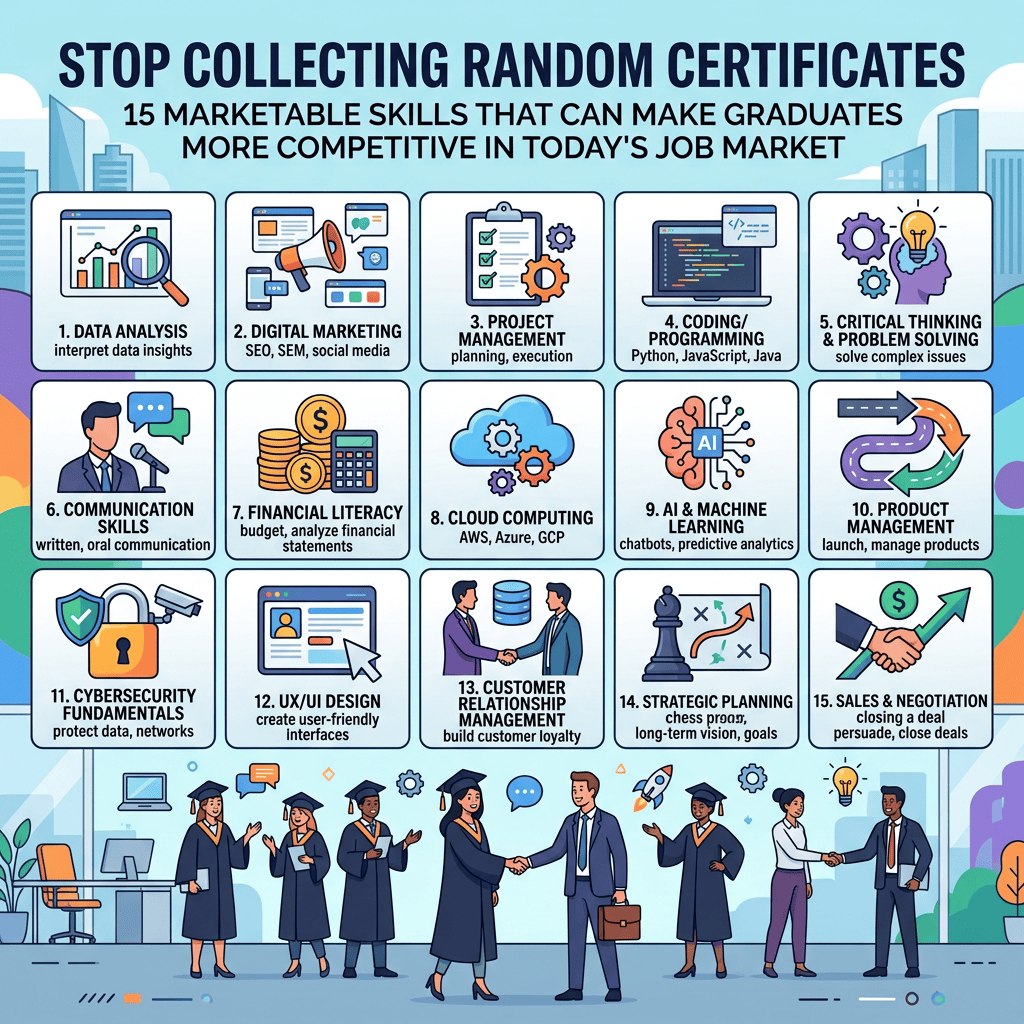
This article examines 15 broad skill areas that may be useful across different sectors, explains how graduates can develop evidence of competence and shows how to prioritise professional learning without wasting money on unrelated certificates.
1. Digital confidence and workplace technology
Digital confidence is no longer limited to people applying for technical jobs. Many organisations use online collaboration tools, digital records, cloud-based systems and software applications to coordinate everyday work. Employees may need to manage files, share information securely, communicate through digital platforms and learn new applications as workplace systems change.
Graduates can strengthen this capability by becoming comfortable with commonly used office software, online collaboration systems and basic digital security practices. They should not simply list applications on a CV; they should explain how they used them. For example, a candidate might describe creating a structured spreadsheet to monitor project deadlines or using a shared document system to coordinate a team task.
2. Data literacy and analytical thinking
Data literacy involves understanding how information is collected, organised, interpreted and communicated. It does not mean every graduate must become a professional statistician. However, many roles involve reviewing figures, identifying patterns, interpreting reports or using evidence to support decisions.
A learner can begin with spreadsheet skills, basic statistics and data visualisation before progressing to specialist tools where relevant. A practical portfolio project could involve analysing publicly available data, producing charts and explaining the limitations of the findings. This demonstrates more than a certificate because it shows how the learner approaches a real information problem.
3. Communication and professional writing
Employers often need people who can explain ideas clearly, write accurate emails, prepare reports, present information and communicate with different audiences. Communication is important in technical roles as well as customer-facing and management positions. A technically skilled employee who cannot explain a problem to colleagues may struggle to contribute effectively to a team.
Graduates can develop this skill through presentations, report writing, volunteering, group projects and workplace experience. They should also learn to adjust their communication to the audience. A detailed technical report may be appropriate for specialists, while a short summary may be more useful for a senior manager who needs to make a decision.
4. Problem-solving and critical thinking
Problem-solving involves identifying an issue, examining evidence, considering possible explanations and selecting a reasonable response. Employers may value people who can approach unfamiliar situations methodically rather than simply follow instructions without understanding the wider purpose.
Students can develop this capability through case studies, research projects, practical assignments and workplace challenges. When describing a project in an application, they should explain the problem, the actions they took and the outcome. This gives recruiters a clearer picture of how the candidate thinks and works.
5. Project management fundamentals
Project management skills can be useful in business, education, technology, research, construction, healthcare administration and many other areas. Even employees who are not project managers may need to organise tasks, manage deadlines, coordinate colleagues and monitor progress.
Beginners can learn how to define objectives, identify stakeholders, create schedules, manage risks and review results. A course may introduce project management methods, but learners should also practise using them. Organising a university group project, coordinating a community activity or managing a small workplace improvement task can provide practical examples.
6. Artificial intelligence literacy
AI tools are increasingly being introduced into workplaces, but professional AI literacy involves more than knowing how to write prompts. Employees may need to understand what a system can and cannot do, how to verify its outputs, when human judgement is required and what information should not be entered into an external tool.
Graduates can develop this skill by learning responsible AI use in their particular field. A marketing professional might investigate content planning and analytics applications, while a researcher may explore literature discovery and data organisation. In every case, users should understand confidentiality, copyright, bias, accuracy and organisational policies before applying AI to professional work.
7. Cybersecurity awareness
Cybersecurity is relevant to almost every organisation that uses digital systems. Employees may handle personal data, business documents, payment information or confidential communications. Weak password practices, unsafe downloads and careless handling of information can create risks for individuals and employers.
A graduate does not need to become a cybersecurity engineer to benefit from basic security knowledge. Understanding multi-factor authentication, phishing, secure file sharing, device protection and data privacy can strengthen workplace readiness. Specialist training may be appropriate for people pursuing technical security roles, but general awareness is valuable across many occupations.
8. Customer service and relationship management
Customer service involves understanding people’s needs, communicating professionally, responding to concerns and helping resolve problems. It is relevant not only to retail and hospitality but also to education, healthcare administration, financial services, public organisations and business-to-business operations.
Students can build evidence through part-time employment, volunteering, student support roles or community activities. They should describe how they handled enquiries, managed difficult conversations or improved the experience of a customer or service user. These examples can help demonstrate interpersonal ability even when a candidate has limited full-time employment experience.
9. Digital marketing and content skills
Many organisations need employees who understand how to communicate with audiences through websites, email, social media and online campaigns. Digital marketing can include content planning, search engine optimisation, audience research, campaign measurement and paid advertising.
Graduates interested in this area should avoid treating social media familiarity as equivalent to professional marketing competence. They can build stronger evidence by creating a sample campaign, analysing website performance or developing a content strategy for a real or simulated organisation. They should also understand that marketing outcomes depend on factors beyond the individual’s control, including budgets, products, competition and market conditions.
10. Financial and commercial awareness
Financial awareness helps employees understand costs, budgets, revenue, resource allocation and the wider business environment. Even professionals who do not work in finance may need to understand why a project requires a budget, how spending is monitored or how operational decisions affect organisational performance.
Students can develop this skill through introductory accounting, business finance and budgeting courses. Practical exercises might include preparing a simple project budget, comparing supplier costs or explaining the financial implications of alternative decisions. The goal is to understand how financial information supports responsible choices.
11. Collaboration and teamwork
Most workplaces require employees to work with colleagues who have different responsibilities, experiences and communication styles. Teamwork involves contributing reliably, listening to others, sharing information and resolving disagreements constructively.
Graduates can demonstrate teamwork through group assignments, research collaborations, student societies, volunteering and employment. Rather than writing “excellent team player” on a CV without evidence, they should describe the role they played, the responsibilities they accepted and how their contribution supported a shared result.
12. Adaptability and continuous learning
Professional environments change as technology, regulations, customer expectations and organisational priorities evolve. Employees may need to learn new processes, move between tasks or develop additional skills during their careers. Adaptability therefore involves more than simply being willing to change; it requires the ability to learn, evaluate new information and respond thoughtfully.
A learner can demonstrate adaptability by describing a situation in which they acquired a new skill, adjusted a project plan or responded to unexpected challenges. Employers may also look for evidence that a candidate can learn from feedback rather than becoming defensive when asked to improve.
13. Leadership and decision-making
Leadership is not limited to senior management positions. Graduates may demonstrate leadership by coordinating a group task, mentoring a colleague, organising a community activity or taking responsibility for a project. Effective leadership involves setting direction, communicating expectations and supporting others.
Short courses in leadership can introduce useful concepts, but practical experience is important. A certificate does not automatically demonstrate the ability to manage people or make sound decisions under pressure. Learners should seek opportunities to take responsibility at an appropriate level and reflect on what they learned.
14. Research and information evaluation
Research skills are useful beyond universities. Professionals may need to investigate a market, evaluate suppliers, understand a policy change, compare evidence or prepare a recommendation. The ability to distinguish reliable information from unsupported claims is particularly important in an environment where large amounts of content can be generated quickly.
Graduates can develop this skill through academic projects, professional reports and practical investigations. They should learn to identify original sources, evaluate evidence quality, recognise limitations and communicate uncertainty. These habits are valuable in policy, business, education, science and many other fields.
15. Sector-specific technical competence
General employability skills are important, but many occupations also require specialised knowledge. An engineering role may require particular design software, a healthcare position may require approved clinical training, and an accounting role may value recognised technical qualifications. A broad collection of generic certificates cannot replace the specific competencies required by a profession.
Graduates should therefore study the actual job requirements in their target sector. They can identify recurring technical skills, check whether formal qualifications are mandatory and ask experienced professionals which tools are used in practice. This prevents learners from spending money on courses that have little connection with the work they hope to perform.
How to identify which skills you should learn first
Start by choosing two or three job titles that genuinely interest you. Read a selection of current job advertisements and record the skills that appear repeatedly. Separate requirements into technical skills, professional behaviours, formal qualifications and experience. Then compare the list with your existing capabilities.
The UK National Careers Service provides a skills and careers assessment that can help people reflect on their strengths, interests and possible directions. It also offers careers information and advice. <Cite refs={[“turn958494search5″,”turn958494search12”]}/> The assessment is a starting point rather than a definitive career decision, and its suggestions should be considered alongside job-market research and personal circumstances.
Frequently asked questions
Which skills are most marketable to employers?
There is no universal list for every occupation. Digital competence, communication, analytical thinking, problem-solving and sector-specific technical knowledge can be useful, but their importance depends on the job.
Should graduates learn AI before other skills?
AI literacy may be valuable in many sectors, but it should be developed alongside subject knowledge, critical thinking, communication and professional judgement.
Can short courses make someone employable?
They can strengthen relevant skills, but employability also depends on experience, qualifications, personal circumstances, labour-market conditions and the requirements of individual employers.
How many skills should I put on my CV?
Prioritise skills that are relevant to the vacancy and support them with credible examples. A long list of unrelated abilities is usually less persuasive than a focused description of demonstrated competence.
Conclusion: Build a skills profile that matches the work you want to do
The strongest career development strategy is not to collect as many certificates as possible. It is to understand the work you want to perform, identify the skills employers request and build evidence that you can apply those skills effectively. Marketable abilities may include digital confidence, communication, analytical thinking, project coordination, AI literacy and specialist technical knowledge, but their importance will vary by profession.
Graduates should combine relevant training with practical projects, work experience, volunteering and professional networking. When a course is selected for a clear purpose and its learning is demonstrated through real examples, it can become a meaningful part of a competitive career profile.
Stay connected with Scholars Careers: Subscribe for more guidance on employability, graduate skills, professional certifications, career planning and opportunities for continuous learning. Follow our updates and share this article with students and graduates preparing for the workplace.
Disclaimer: This article provides general career guidance and does not predict recruitment decisions or guarantee employment. Skill requirements vary by employer, occupation and location. Always check current job descriptions and professional requirements before investing in training.


